Martin Austermuhle
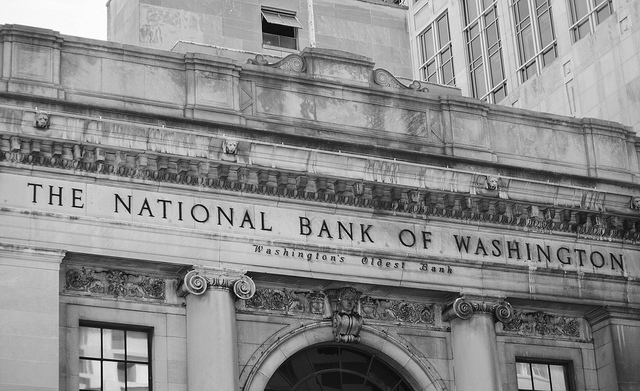 Photo by ekelly80.
Medical marijuana entrepreneurs certainly won’t have it easy in the District. Beyond spending a chunk of money to set up dispensaries and cultivation centers, they’ve had to sign legal waivers admitting that they’re breaking federal law, suffer the barbs of irate residents and generally sit on their hands as the long-awaited program takes shape.
Add one more challenge to that list: banking.
Montgomery Blair Sibley, an outspoken applicant for a cultivation center license, told DCist that he recently received a notice from Wells Fargo that it was closing the bank account he was using for his business, the Medicinal Marijuana Company of America. While the letter the bank sent him did not directly reference his business’ activities, it cited a confidential “risk assessment process” as a reason for shuttering the account, which Sibley had opened with Wachovia before it was taken over by Wells Fargo.
While Sibley seems to be the first medical marijuana entrepreneur in the District to suffer such a fate, his counterparts in other states have long been subjected to rejections and account closures by banks nervous over potential repercussions from the federal government. (They’ve also had to deal with IRS prohibitions on writing off business expenses and ATF mandates that prohibit medical marijuana patients from getting gun licenses.)
According to Reuters, concerns over providing banking services to dispensers and cultivators date back to 2008, when the DEA warned Bank of America of the liability it could face. Banks in Colorado and California, both of which have active medical marijuana programs, have closed accounts in recent months. In late October, ABC reported that as part of a crackdown on some medical marijuana programs, the federal government was even targeting banks that provided mortgages to dispensaries and cultivation centers.
Wells Fargo did not return calls for comment, but explained its position in a CreditCards.com article earlier this year:
“In view of the complex, inconsistent legal environment relating to medical marijuana dispensaries, Wells Fargo Regional Banking has opted not to bank these businesses. While medical marijuana dispensaries are legal in some states, they are still illegal under federal law. The policy extends to all medical marijuana dispensaries, and based on our customer information, we have advised all such businesses that bank with us that they will need to close their deposit accounts. Additionally, it has been our policy not to provide merchant card processing services to businesses of this type.”
Not all banks have established policies on medical marijuana businesses, and many businesses and non-profits use more discrete names that may allow them to slip under the radar.
Still, the inconsistency between federal and state laws on medical marijuana has provoked at least one member of Congress to act. Earlier this year, Rep. Jared Polis (D-CO) introduced legislation that would guarantee state-certified medical marijuana entrepreneurs access to banking services by limiting federal intrusion into bank records. The legislation only has seven co-sponsors, though, meaning that it’s not likely to move anywhere soon.
Sibley has applied to run a cultivation center at a site along New York Avenue NE. His bank account will be closed as of November 26; he hasn’t yet decided which bank he’ll work with next.