Martin Austermuhle
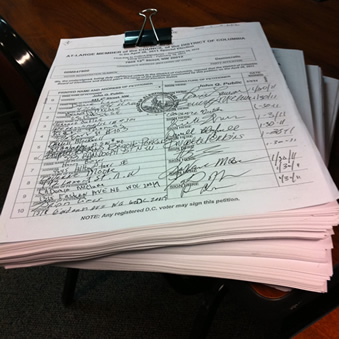 It’s about that time again — starting today, candidates for the April 3, 2012 D.C. primary election will be out gathering signatures to get themselves on the ballot.
Hopefuls for elected office in the District don’t just get on the ballot as some sort sort of democratic courtesy; they actually have to put some work in just to be considered by the voters. Ward-based candidates have to collect signatures from one percent of voters in their ward and political party — for Democrats, that’s around 250; for Republicans and Statehood Greens, it’s significantly less. (In Ward 7, for example, Ron Moten will only need signatures from 14 fellow Republicans, for example.) At-Large candidates, meanwhile, have to gather more than that — 2,000 or so for Democrats, fewer for Republicans and Statehood Greens.
All told, candidates have a month-and-a-half to get signatures, after which their petitions are open to challenges from residents and other campaigns before being deemed ballot-worthy or not.
The seats up for grabs next year are Wards 2, 4, 7 and 8; two At-Large spots; the delegate to the House of Representatives; the shadow delegation; candidates for the U.S. presidency, and others.
Ward 8 candidate Jacque Patterson was first to pick up his petitions this morning, pledging to gather 5,000 by the time they’re due in January. Though 20 times more than what he needs, the signature-gathering process has often been a way to show organizational strength — in 2010, Mayor Adrian Fenty turned in over 21,000 signatures for his re-election campaign, though only 2,000 were needed.
Signature gathering may be tedious for both candidates and voters, but it’s a vital part of the democratic process — and a part that has tripped up many a hopeful politician. Earlier this year, Patterson was bounced from the ballot after a challenger contested enough of the signatures he had gathered, placing him below the legal requirement for ballot access. (Fellow candidates Bryan Weaver and Patrick Mara also had their signatures challenged, but they survived to run in the April 26 Special Election.)
More famously, though, former Mayor Anthony Williams was removed from the mayoral ballot in 2002 after his campaign was found to have forged some 5,400 signatures — or 54 percent of what was turned in — on his nominating petitions. (His campaign was also fined $277,000.) Williams was forced to run as a write-in, and, despite the slip-up, he easily cruised to re-election.
Gathering signatures also has the effect of thinning the herd somewhat. For Councilmember Muriel Bowser (D-Ward 4), who was second to appear at the board this morning, that could be a good thing — she currently faces seven declared challengers.
If you’re asked to sign a petition, don’t just scribble your John Hancock and move along. First off, you need to be a D.C. voter. Second, unless it’s a position that’s elected citywide (like an At-Large member of the D.C. Council), you actually need to live in the ward where the person petitioning you is running. Third, you have to be registered in the same political party as the person whose petitions you’re signing.
Finally, review your voter registration card to see what address is on there. If your name doesn’t match up to your address (you might have an old address on that card, for example), you’re subject to challenge. While that doesn’t mean much for you, it does mean that an antsy campaign staffer could well be asking you to verify your information again in a couple of months.
Oh yeah, this is but the first of two times you might be asked for signatures — candidates not affiliated with the three main political parties in the District will be doing this next summer to get on the ballot for the November general election.