Martin Austermuhle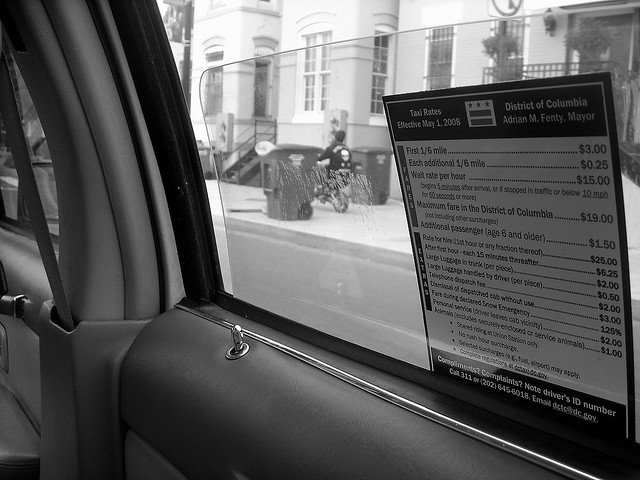
 Photo by NCinDC
Before we get to the actual hearing that took place today at the D.C. Taxicab Commission, let’s get this out of the way: fares are not doubling. The Examiner’s front page headline boldly announced that “Mayor appointees set to double taxi fares,” gravely over-simplifying the current debate over proposed fare increases and setting of a mini-panic in the local Twitterverse. (See the Post’s Mike DeBonis for more on this.)
Regardless — today, the commission held a hearing on a proposal submitted by an independent driver that would increase the per-mile rate for D.C. cabs from $1.50 to $2.75 while dropping many existing surcharges. Had the proposal sailed through the commission hearing today and encountered no other substantial opposition, it could have taken effect as early as February.
Nothing is that simple in the world of the District’s taxicabs, though.
During the five-hour hearing, a number of cab drivers criticized the rate increase proposal as insufficient and seemed to side instead with an alternative increase that would keep the drop-rate at $3, while increasing the per-mile rate from $1.50 to $2 and the per-hour wait time from $15 to $25. (Surcharges would remain in place under that plan.)
Drivers and their advocates stated that the fare increase would tide them over while the commission completed a more detailed and independent study of the city’s fare structure and possible rate increases. Most drivers complained that local rates as they stand are too low, both when compared nationally and regionally, and that only an independent three- to six-month study could determine what rate increases would be appropriate. Ironically enough, while most drivers said they disliked Mayor Adrian Fenty for implementing a meter system, they pined for the original fare structure that came with the meters, which included a $4 drop-rate.
For members of the District’s lucrative hospitality industry, any talk of rate increases without first seeing improvements in service would be a non-starter, though, and they said as much today.
Solomon Keene, president of the Hotel Association of Washington, argued that before any rate increases could be considered, the city’s “antiquated” cabs would have to see improvements ranging from credit card payment options to more consistent climate control. The Downtown Business Improvement District similarly wanted a “data-driven study” before any increases, while the D.C. Chamber of Commerce laid out a series of safety and efficiency improvements that would have to parallel any rate hikes.
Jack Jacobson, a Ward 2 ANC Commissioner and founder of the rider advocacy group D.C. Taxi Watch, laid out a seven-point plan he said would improve service for riders and fares for drivers. He said he wanted surcharges scrapped, credit card readers in all cabs, consumer representation on the commission and environmentally friendly cabs.
Stuck between the many competing voices was Ron Linton, the commission’s chairman. While he has advocated for an eight-point improvement plan proposed by Mayor Vince Gray, those won’t come cheap — and may require a surcharge on fares. During the hearing, Linton hinted that an interim fare increase may have to be implemented while improvements to cabs are made, simply because the process of modernizing the city’s estimated 6,500 cabs wouldn’t happen overnight. (Linton has executive authority to raise fares unilaterally, but he has opted not to use it.)
Linton faces a perilous and thankless task in moving forward. Not only does he lead an understaffed commission that doesn’t even have the capacity to accurately account for the number of cab drivers in the District and where they live, but the relationship between some cab drivers and the commission is so tense that finding common ground is almost impossibly difficult. (That doesn’t even begin to describe how noxious the relationship between riders and drivers can be, only adding a layer of mistrust to the discussion over fare increases.)
He may have a way out that could satisfy almost everyone, though — an independent study. Many cab drivers say that one is long overdue — a rate survey is supposed to happen every 24 months — and representatives of the hospitality industry would only be likely to acquiesce to rate increases if a study found that local rates were too low. Of course, the question is whether the study would be preceded by a temporary increase along the lines of what some drivers proposed.
Linton said he anticipates having a decision by the commission’s December 13 meeting.