Martin Austermuhle
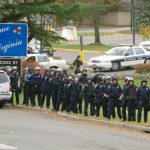
 Photo by vpickering
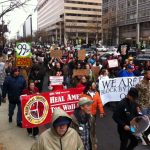
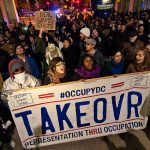
For all intents and purposes, yesterday’s Occupy Congress protests were relatively mild. There weren’t many arrests, few occupiers managed to speak directly to their congressional representatives and a late-night gathering at the White House dispersed rather quickly after a smoke bomb was tossed into the compound.
For Jeff Smith, a member of the New York-based Occupy Wall Street movement’s press team, the whole thing was so, well, Washington, as he wrote in a column at The Daily Beast:
For many of the New York occupiers I spoke to on Tuesday—and there seemed to be as many of them there as D.C. occupiers—there was an overwhelming sense that the capital was very different from the Apple. Maybe it’s that the police are so nice. Or how the D.C. occupiers are generally compliant and abide by the cops’ orders. There was no feeling of urgency, no tension.
It felt as if the city was immune to protest—that Washington has professionalized managing dissent.
As I sat in the House gallery yesterday evening, the representatives in the chamber acted as if they didn’t notice the occupiers there to protest them, let alone the couple of thousand more protesters outside.
Occupy Wall Street touched a nerve in New York because it pointed to a truth—the banks ripped us off—and tapped that populist rage. But in Washington, the nerve seems to be dead.
All the more indication that we were right to target Wall Street.
Kudos to Smith for his honesty, and there’s certainly a nugget of truth to what he says. Protesting is a daily occurrence in Washington, and by and large local police have become very careful in handling any large-scale gathering. (Especially after the 2002 Pershing Park debacle.) All told, both the U.S. Park Police and the Metropolitan Police Department have been so nice to our local occupiers that a Republican congressman wants to know why they aren’t acting more like their New York and Oakland counterparts.
But he somewhat misunderstands the ways of the nation’s capital. It’s not that anyone’s nerves are dead here — hell, everyone with passion and a cause ends up down here at some point — but rather that people quickly understand that when you’re trying to influence the legislative or policy-making process, you can’t just set up a tent and try to goad cops into repeatedly arresting you. If that’s all it took to create change, then every movement from the Tea Party to Lyndon LaRouche would be sending its minions to D.C. on a weekly basis to block traffic or storm congressional buildings. (Populist rage can swing either way, after all.)
It’s true that the initial Wall Street encampment drew its energy from a sense of populist disgust over how powerful banks are, and Mayor Michael Bloomberg responded in a way that only gave the protesters more national sympathy and a bigger soapbox. All those arrests were certainly a powerful symbol of how Bloomberg — himself a rich, rich man — dealt with dissent.
But Washington is different. People who live and work here wouldn’t likely respond well to New York-style occupation tactics, nor have local police followed the lead of their New York brethren in dealing with occupiers. This city is well-accustomed to protest, just as it knows what it takes to make policy. A good balance of tactics and strategies would yield more results than just yelling more loudly and being more disruptive, as Smith seems to have wanted.
Maybe that’s what makes so many people look at Washington skeptically — passionate folks with good causes show up here with great big plans, but it can quickly seem that they’re giving in to the ways of the city as they learn the art of compromising. (Hello President Obama! And Tea Party congressmen!) In that, this is a funny town — it’s almost a bigger badge of honor to be seen as a person who doesn’t dogmatically stick to their guns than one who does. And yes, this is also a town where we love to hear about solutions, the very ones that Occupy Wall Street has been loathe to propose.
That’s why some people love Washington, others hate it and some just plain don’t understand it. It’s both a place where grand compromises can be struck, and where huge sellouts can happen. It’s a place where a lobbyist can work for a huge bank or the ACLU and where a lawyer can both represent a dictatorial regime and fight on behalf of Guantanamo detainees. It’s a place where occupiers have to do more than just occupy.
It’s not New York — nor should it be.