 Photo by philliefan99
Similar to an order he issued in December requiring the U.S. Park Police to give Occupy D.C. at least 24 hours’ notice before cracking down on any violations of park regulations, a federal judge said today that if the National Park Service decides to close McPherson Square, it needs to give the income-inequality protest group enough time to mount a legal response.
At a brief hearing this morning in the U.S. District Court for the District of Columbia, Judge James E. Boasberg told federal attorneys representing NPS that should the agency decide to go a step further than enforcing the ban against camping in McPherson Square and decide to clear the park, attorneys representing the Occupy movement—so long as it is in compliance with the no-camping rules—will be allowed time to attempt to block such a move.
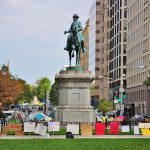
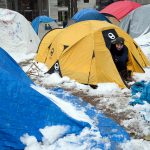
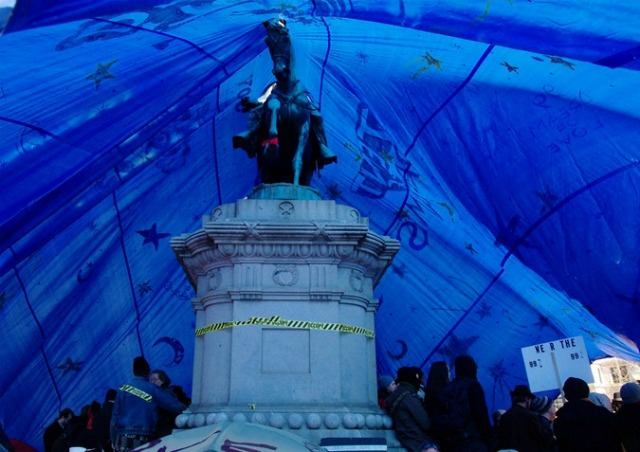
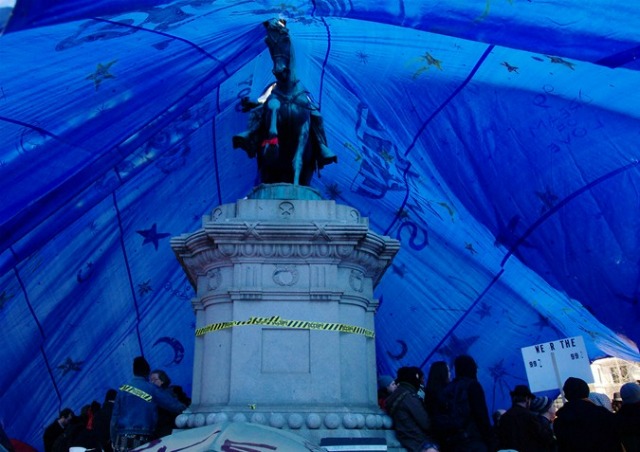
Members of Occupy D.C. woke up yesterday ready for a showdown at noon, which is when the Park Police said they would start issuing citations, making arrests and confiscating tents of those those deemed to be “camping”—defined as either sleeping or having bedding materials—instead of maintaining a round-the-clock vigil. No arrests have been made at either McPherson Square or the other Occupy settlement at Freedom Plaza. At McPherson Square yesterday, protesters draped a large blue tarp over the statue of Gen. James B. McPherson, the Civil War commander for whom the park is named. (Park Police have asked that the tarp, nicknamed the “Tent of Dreams” for its celestial decorations of stars and unicorns, be removed.)
In court, Jeffrey Light, an attorney representing Occupy D.C. tried to make the case that when confiscating demonstrators’ property, Park Police were making it difficult for those items to be retrieved. Boasberg did not buy it, telling Light that any specific description of one’s tent or other personal artifact should be sufficient enough to get back personal belongings.
“How detailed do you want them to get?” Boasberg asked. “If someone says, ‘I have a green-and-white tent, REI brand, with a red stain,’ you don’t think they’re going to return that?”
But Light was playing with too many hypotheticals with respect to confiscated property, Marina Braswell, the assistant U.S. attorney representing NPS, said in response. Retrieval of seized property wasn’t the issue, it was on what grounds the authorities may seize property.
With enforcement of the camping ban now in effect, Boasberg asked Braswell, will the Park Police be confiscating tents for reasons other than violations of the camping ban?
“Assuming no other violations of the law, the answer is no,” she replied.
But that answer comes with an asterisk. The Park Service does have the authority to shut McPherson Square entirely, expelling occupiers and pedestrians alike. Here, Light argued, the model set by Boasberg’s December order should be followed, requiring NPS to issue advance warning should it decide to close the square, but he insisted there be enough of a window to file a motion to keep it open.
Citing legal precedent, Light pointed out that the definition of public notice includes a one-day print advertisement in a local newspaper. Boasberg, noting that NPS had issued warnings on widely distributed handbills several times in late 2011 as well as each day this past weekend, doubted that a single-day newspaper display ad would be the preferred method of announcing a park closure.
Still, he told Braswell that the government, should it seek to bar any entry into McPherson Square, there will need to be enough time for Occupy D.C. to mount a legal response. Only in an emergency situation is NPS allowed to close it without warning.
Boasberg also heard an argument for a temporary restraining order against NPS enforcement of any kind, including against sleeping in the square. The motion was argued by a young man named Dale Primerano. The judge, acknowledging Primerano’s lack of legal expertise, aided the soft-spoken demonstrator through his argument, though ultimately rejected his claim that the government should accomodate protesters’ housing needs. When Primerano tried to make a Constitutional argument, Boasberg also pointed out a 1984 Supreme Court decision that ruled that violating NPS regulations against sleeping does not constitute a protest protected by the First Amendment.
Speaking to reporters after the hearing, Light, who said he’ll go forward representing the protesters who are complying with the no-camping rules, called today’s resolution something of a victory for Occupy D.C. in “that we’ll have notice if the government closes the park.”
Not that any NPS or Park Police action to date have suggested that is on the horizon, he said.