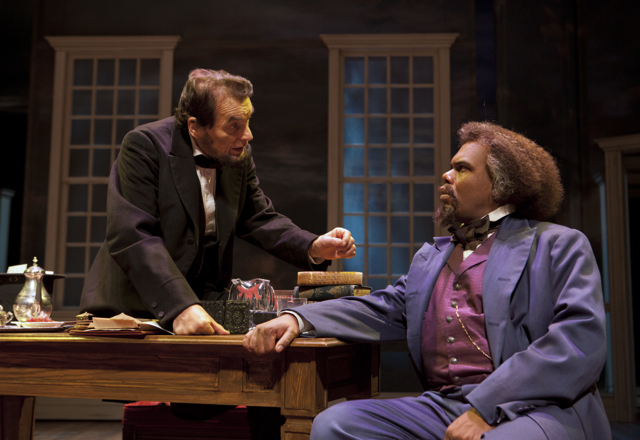
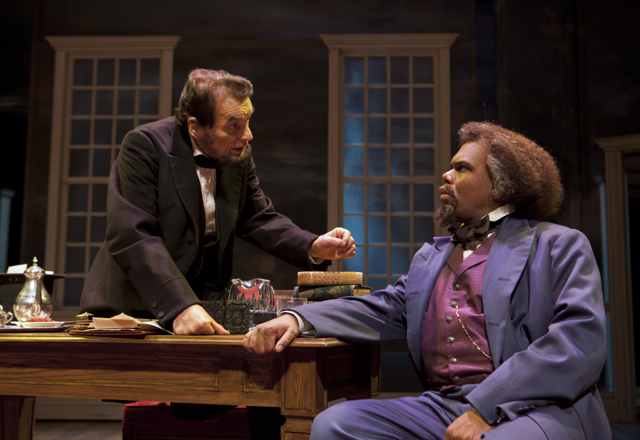
 David Selby, left, as Abraham Lincoln and Craig Wallace as Frederick Douglass. (Ford’s Theatre/Laura Keane)
So, there’s this president nearing the end of his first term. Elected on the prospect of sweeping change during a period of incredible tumult. Lots of promise, so many hopes tied up in his administration, surely bound to be the greatest ever to hold the office.
But, things don’t always move as quickly as we’d liked. The change doesn’t arrive as soon as demanded. Oh, sure, when said president steps up to a podium, some get that tingle up their legs as if the nation were born anew and anything were possible.
And then we’re reminded that such men, lofty as our goals for them may be, are still and ultimately mortal. It’s frustrating when progress is so incremental. We want our change yesterday, damn it! Why hasn’t this president lived up to our hopes and our dreams, especially when he’s such a damn fine orator?
“It was a great speech,” one of the non-presidential characters in Necessary Sacrifices says early in the second act. “He always gives great speeches.”
No, not him.
Those lines do not belong to some butthurt 21st-century activist. Rather, they’re spoken by Frederick Douglass, frustrated with the slow pace at which Abraham Lincoln ended slavery. Played by Craig Wallace, Douglass opens the first act bemoaning that the Emancipation Proclamation lifted the shackles for only those slaves still behind Confederate lines. It’s near impossible to justify incrementalism in this matter, so I won’t.
The formula of Necessary Sacrifices, which runs at Ford’s Theatre through February 18, is such: monologue by Douglass, snippet of one of Lincoln’s famous speeches, then a lengthy White House meeting. Repeat for the second act and epilogue. Wallace is serviceable as the escaped slave-turned-abolitionist leader. His emotiveness is hardly the problem—frankly, one hopes the real Douglass approached the real Lincoln with such brio.
No, it comes down to the dialogue, which is more dramatization than dramaturgy. But that’s to be expected, considering the playhouse. It’s been true for a while that in the annals of historical fiction, Lincoln’s been done to death (sorry), but one still hopes for something a little animated.
David Selby’s turn as the 16th president, however, is just too colorful, playing the Great Emancipator with so much homespun folksiness, it’s sometimes easy to forget this man waged the Civil War. For every one of Douglass’ grievances, this Honest Abe just responds with more prairie-spun bonhomie. We’re meant to see them as equals—personally, when considering Douglass’ personal history of bondage, rebellion and freedom, I could care less if Lincoln has some quip about settling his childhood fights with a good ol’ wrestling match.
In The Atlantic’s recent Civil War Issue, Ta-Nehisi Coates looked at why so few blacks study the conflict. He wrote:
For African Americans, war commenced not in 1861, but in 1661, when the Virginia Colony began passing America’s first black codes, the charter documents of a slave society that rendered blacks a permanent servile class and whites a mass aristocracy. They were also a declaration of war.
Inhabited by Wallace, Douglass’ sentiment in Richard Hellesen’s declamation-heavy script isn’t far off from Coates’ argument. For blacks, the war started with the codifying of slavery as the law of the land, and, as Douglass predicted—both in reality and on this stage—not over until well after 1865.
But Necessary Sacrifices is just too dry, too classroom-like, that it’s hard to endorse it for anyone outside a school group. It’s an important message, but it’s all lectures. And Abe, seriously, tone it down a notch.
By Richard Hellesen, directed by Jennifer Nelson. About 2 hours with one 15 minute intermission. At Ford’s Theatre, 511 10th Street NW. Tickets available at fords.org or (202) 347-4833.