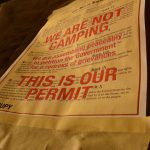
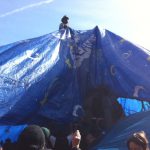
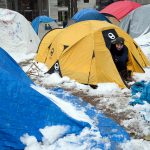
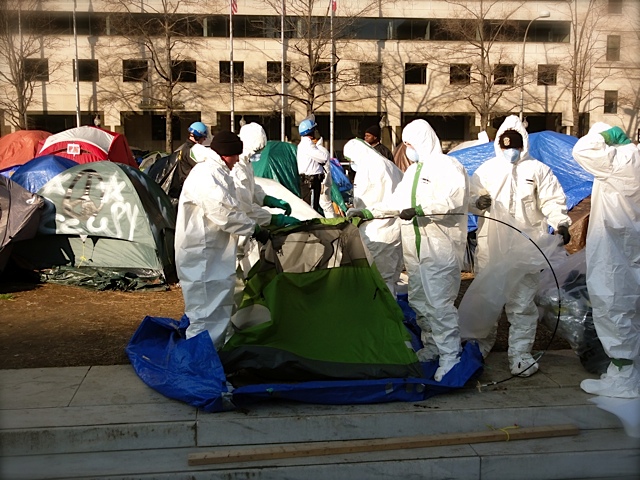
 National Park Service workers and U.S. Park Police dismantle a tent at Freedom Plaza. Photo by Martin Austermuhle.
A day after they removed more than half the tents from the four-month-old Occupy D.C. encampment at McPherson Square, U.S. Park Police arrived Sunday morning at Freedom Plaza prepared to do the same.
But compared to clearing out of McPherson Square on Saturday, the enforcement of the National Park Service’s ban on camping in Freedom Plaza was a slow burn. Police officers donning light-blue riot helmets and hard plastic shields, accompanied by a team of hazardous-materials workers in white jumpsuits, arrived around 11 a.m., announcing they were on scene to inspect the tents that have dotted the downtown plaza since mid-October.
As with yesterday’s enforcement of McPherson, Freedom Plaza was cordoned off in sections as officers checked each tent to determine if any were in violation of longstanding NPS regulations against camping. If a tent was observed to contain bedding, clothing or cooking materials, a scene commander told the group of several dozen demonstrators, it would be marked with a red tag and its owner given the opportunity to clean it out. Under NPS rules, tents are allowed as tools of protests, but may not be used as living quarters. The Occupy Wall Street movement has, since its inception in September 2011, maintained that camping in public spaces is an essential part of its message, even though a 1984 U.S. Supreme Court ruling states that restrictions on camping are permissible.
The officer who addressed the protesters said that just as at McPherson Square, any tents at Freedom Plaza found to contain biohazards would immediately be taken down and collected by the hazmat team. On Saturday, inspectors found urine-soaked mattresses, dead rats and bottles of urine in several tents.
As the afternoon proceeded, Park Police officers moved in sections to peek into each tent. Some were taken down and their contents bagged by the hazmat teams, but it appeared to be a smaller percentage than at McPherson, which, having been emptied of more than 100 tents, now resembles a barren mud pit rather than the verdant urban space it was before the protest began.
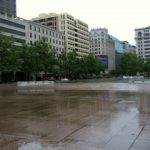
Freedom Plaza, on the other hand, is largely a marble and concrete plane sitting across Pennsylvania Avenue NW from the John A. Wilson Building, the seat of the D.C. government. As the inspection continued, protesters repeated their boilerplate chants—”We are the 99 percent!” and the like—and sometimes broke out into song, Queen’s “Bohemian Rhapsody” being a crowd favorite.
But unlike Saturday, which had several testy moments, the inspection and removal of tents from Freedom Plaza was mostly incident-free. One person was arrested for making threatening comments toward police officers, the Examiner’s Aubrey Whelan reported. Objects judged to be hazardous to public health were bagged up and hauled away in dump trucks, but several tents remained standing.
The encampment at Freedom Plaza is something of a different beast than the one that took over McPherson Square. Unlike the latter, which is a direct outgrowth of the Occupy Wall Street protest spearheaded by the Canadian magazine Adbusters, the Freedom Plaza settlement grew out of an anti-war demonstration last year called Stop the Machine, which later renamed itself Occupy Washington D.C. but has not always coordinated its activities with the McPherson group. Moreover, while Occupy D.C. members tend to be in their late teens and early 20s, the Freedom Plaza encampment is made up more of an older generation of veteran activists.
By 4 p.m., with Park Police on their last section of the plaza, even the cameraman behind an Internet video stream had retreated to McPherson Square an Occupy D.C. in which the movement discussed its next course of action. The inspection of Freedom Plaza continued, but in a weekend of what the National Park Service called “further enforcement” of its rules against camping, Saturday at McPherson Square was the main event; Sunday at Freedom Plaza was the undercard.