When we think of meat in tube form hot dogs are usually the first thing that comes to mind. Or maybe, if we’re being specific to the District, half smokes. But there’s a whole world of delicious meat in casings that goes beyond fresh products like half smokes, hot dogs, and sausage. Of course we’re referring to the cured, aged, and deliciously flavorful world of charcuterie.
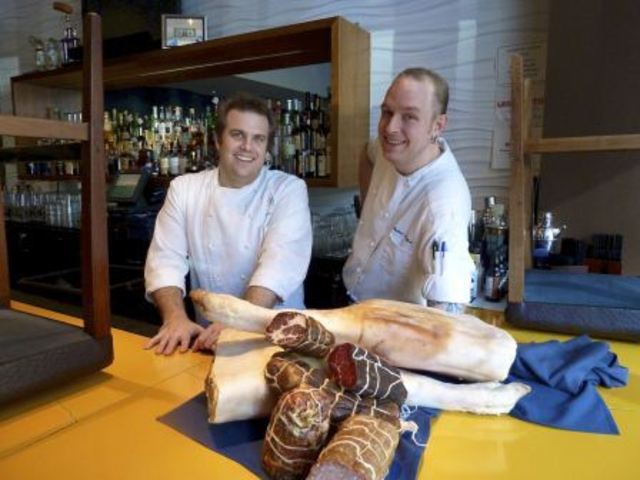
Fortunately, there’s a restaurant here in D.C. where you can get an award-winning half smoke, house-made mini hot dogs, and some serious charcuterie as well. DCist sat down with Peter Smith, Executive Chef and Owner of PS 7’s, and Andrew Markert, his Chef de Cuisine, to talk meat in casings.
First things first, you’ve got a pretty great half-smoke on the menu and last year you won People’s Choice at the D.C. half-smoke competition with it but you had house-made hot dogs on the menu well before that. When did you first decide that was something you wanted to do? The restaurant itself obviously opened with a much more high-end concept.
Smith: Yeah, a much different concept. But it’s funny, we were looking through a charcuterie book and we saw a recipe for hot dogs and we were like, “We should make these.” So we made them in a small batch, we tried them out and we [the kitchen staff] ate them in the back and then we sent some out to a couple of people in the bar and they tried them and they liked them. Then we started playing with the recipe again and we finally got it to the point where we really liked it and we were kind of just like, “Screw it, it’s so simple, why not?” Originally they were only in the bar and then people were ordering them hand over fist in the bar so then we went ahead and put them out here [in the dining room]. I guess it was probably two years after we opened that we started doing them.
But it’s not something you’d previously sourced from outside, it was just a totally a one-off “Let’s see if we can do it” sort of thing?
Smith: Right, if it didn’t work we wouldn’t have done it. It was the novelty of making it that appealed to us.
Then you started making charcuterie in house. There are a ton of people in the area who make it professionally and many other restaurants don’t make their own product, they source it from outside. Obviously it’s extra work and when you’re sold out you’re sold out. Was there ever a time you thought of expanding the charcuterie program and sourcing it outside the restaurant?
Smith: No. Not at all.
Because you like making sausage that much?
Markert: We both do.
Smith: Yeah, it’s just something we both enjoy. He makes a lot more than I do now.
Markert: You’ve actually been doing a lot more charcuterie and I’ve been doing a lot more of the hot dogs.
Smith: Yeah, he does all of the hot dogs and sausages.
So Drew is the hot dog king?
Markert: I am the hot dog king.
Smith: I passed the torch after making 900,000 of them.
Markert: I’m going to change my name to Abe Froman.
Markert: Exactly.
How do you guys choose what types of charcuterie you’re going to make? Is there a specific process?
Markert: Dartboard.
Seriously?
Smith: I think it really is.
Markert: Yeah, there are some ones that we’ve had a lot of success with and so we stick with those and then occasionally we’ll try to broaden the selection and try some new ones out and see which of those come out the best. But we definitely have some staples that we roll with.
You mentioned earlier that you’re looking to make more and keep more product on hand. Is there anything in particular you’re focusing on doing? I know a lot of menus now seem to have more unusual charcuterie using duck or lamb or wild game even and are expanding beyond the more traditional pork or beef.
Markert: I think we’re still staying fairly traditional.
Smith: I mean, it works. The recipes have been around for a long time for a reason. And when you start playing around with duck or other things you’re always kind of playing along this fine line where it’s either going to work or it’s not going to work or it’s good to you but it’s not good to somebody else or it doesn’t have enough fat or it’s too dry. It’s not that I don’t want to do that kind of stuff but pork is perfect for making sausage.
The perfect meat?
Smith: It is the perfect meat. Duck prosciutto is cool but is it the best thing you’ve ever had in your entire life? Probably not. You take a Farmers’ Cross [a special hybrid pig bred from five specific breeds: the Poland China, Chester White, Berkshire, Duroc, and Hampton breeds] and you salt a leg and you let it hang for a year and it’s something pretty special. I actually have two of them in the back right now.
In terms of choosing the meat that you’re using, is it the same meat you would normally use for pork that’s on the menu or do you work specifically with farmers to get whole animals or larger cuts?
Smith: Well, we have gotten whole animals in and we’ve gotten special parts from Bev [Eggleston of EcoFriendly Foods].
You had a whole veal calf in house at one point, right?
Markert: Darrel.
His name was Darrel?
Smith: Well, there was Darrel 1 and Darrel 2. We try to source stuff like that for charcuterie but for hot dogs or half smokes you can use commodity beef or pork.
Sure but whenever you’re working with whole muscle cuts you want to be choosier.
Smith: You want to make sure that whatever you’re using is good quality. [To Markert] What’s the one we’ve got in there now that we’ve got to do something with soon?
Markert: It’s a Berkshire.
Smith: Yeah, it’s a Berkshire pig that was fed acorns in the Iberico style. Doing whole muscle cuts with something like that is awesome. You start getting some specific flavors and it’s rich and it’s just really beautiful.
One of the things I wanted to ask about was the idea of making charcuterie at home. There are people who are starting to get really serious and make more involved types of product. Thoughts on that? Is it a good idea to do that at home and is it worth the upfront investment for equipment or are there secrets or tips that you think can make it easier?
Smith: Doing it at home is up to you but you just have to be careful. Making sure that everything is clean and that you have the right space for it and a place to incubate it and to hang it. That’s the biggest issue. You have to have the right stuff to be able to do it. It’s a bit of an investment to do in the beginning. A grinder is not cheap and a sausage stuffer is not cheap.
So you don’t suggest people use the KitchenAid stand-mixer attachments?
Smith: It’s not worth it. They work, but…
Markert: It doesn’t get it tight enough. You can’t really pack the mixture properly into the casings.
Smith: I think everyone looks at it and is like, “Oh, I have a KitchenAid and it’s all-in-one and I can grind it, I can stuff it,” and so on. Those grinders grind well for small amounts of stuff but when you’re trying to run meat and fatback and it’s all half frozen and you’re trying to get it through…
Markert: You’ll burn out the motor.
Smith: Yeah, you’ll burn out the motor, you’ll break blades, you’ll break the grinder. You do all kinds of damage to it. If you’re going to do it you need to get a good grinder and a good sausage stuffer.
Another issue that comes up when people are doing this kind of stuff at home is recipes. There are a lot of recipes on the internet but do you have specific sources or places that you think home cooks should look to?
Smith: I would say if anyone wants to do charcuterie at home, go to the Charcuterie book [by Michael Ruhlman].
Markert: The recipes are based on home use.
Smith: Exactly. The recipes are scaled to home use and they’re safe for home use. For example, the Bactoferm — which is the culture that you actually put into the meat — a bag of Bactoferm is meant to do like 100 or so pounds of meat and they say to use a whole bag in a five pound batch. And you don’t need to but what they’re trying to do is to make sure that even if you don’t ferment it properly, something is still going to survive and give you enough of the good bacteria that you need to take care of the bad bacteria.
So it all seems geared to err on the side of caution if you don’t happen to have the perfect temperature spaces that you have in a restaurant.
Smith: Exactly. It’s meant for the home cook.
Well, now that we’ve talked this much about charcuterie I’m sure we’ve alienated pretty much every vegetarian who reads the site.
Smith: Actually, it’s funny because we have a regular who always orders charcuterie when he comes in and he hosted a party here for his whole staff and he wanted to make sure that the first course was charcuterie. But there happened to be like 12 vegetarians in the group. So we made vegetable charcuterie. We took beets and picked them one way and we added pastrami spices to turnips. We took carrots and cooked them and sliced them thin and did all kinds of different spice mixtures that drew from the charcuterie. It was almost like a pickle plate but it was all flavored based on the charcuterie we were doing. It worked out really well and it was really pretty. And it didn’t exclude anyone.