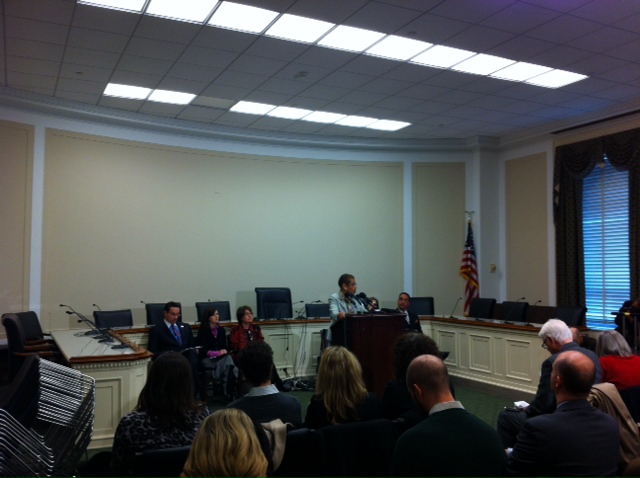
Outraged over proposed legislation that would make it illegal for women in the District of Columbia to seek an abortion more than 20 weeks after a pregnancy begins, Del. Eleanor Holmes Norton staged a press conference Tuesday to excoriate the measure and its Republican sponsors, Rep. Trent Franks of Arizona and Sen. Mike Lee of Utah.
The latest brouhaha over congressional meddling in the health concerns of District women began last month when Franks introduced the “District of Columbia Pain-Capable Unborn Child Protection Act.” Lee announced last week he would sponsor the Senate version of the bill.
“This bill discriminates against women because they live in the District of Columbia,” said Norton, who was joined behind the podium at the Rayburn House Office Building by Mayor Vince Gray, several pro-choice advocates and Christy Zink, a George Washington University professor who said she ended a pregnancy after 22 weeks due to severe complications.
Noting that Franks brought up the measure during Congress’ first week back from Christmas and New Year’s holiday, Norton said “it appears he spent his time at home not attending to his Arizona residents.”
Franks and Lee’s bill is modeled on language promoted by the National Right to Life Foundation, but applying it strictly to the District, Norton said, was an “exercise in political cynicism.” Noting that both Franks and Lee enjoy strong support from the states-rights-focused Tea Party movement, Norton added that their bill is “defying federalist principals.”
To that end, Gray half-jokingly recommended that if Franks and Lee were so adamant about passing abortion restrictions on District residents, they “resign from Congress, establish residency in D.C. and run for the council.” The mayor, more seriously, suggested why Franks and Lee are pushing the ban on abortions after 20 weeks solely on the District.
“If it is so good, Congressman Franks, why not introduce it across the country?” Gray asked. “I think we know what would happen.”
The press conference brought up memories of a similar scene last year in which Gray, several members of the D.C. Council and dozens of D.C. statehood activists were arrested outside the U.S. Capitol while protesting an amendment to a budget resolution that blocked the District from using its own revenues to pay for abortion services for low-income women.
“Action in our country reminiscent of authoritarian regimes has always invited resistance,” Norton said.
Zink spoke in detailed terms about her decision to end a pregnancy in 2009, a choice she and her husband made after doctors said their unborn son was not developing a full brain structure. Zink, who has two children, said ending the pregnancy as “the most difficult decision of our lives.” She also said that because the abnormalities discovered by teams of radiologists and neurologists could have only been uncovered by a brain scan, they would have been impossible to detect before the 20-week cutoff proposed by Franks and Lee.
Zink also responded to the not-subtle-at-all name of the bill. “Its very premise—that it prevents pain—is a lie,” Zink said. “If this bill had been passed before my pregnancy, I would have had to carry to term and give birth to a baby who the doctors concurred had no chance of a life and would have experienced near-constant pain.”
Norton, Gray and the other speakers took a few questions, and several reporters were curious if any kind of repeat showing of last year’s protest was in the works. Not right now, they said.
The bill’s introduction comes at amid a wave of anti-abortion legislation in several states, most recently and most closely Virginia, where the state legislature has passed legislation that would require women considering the termination of a pregnancy to first undergo a ultrasound. The House of Delegates also passed another bill that defines fertilization as the beginning of a life, also known as a “personhood” law.