 Kara Hayward, Jared Gilman and Jason Schwartzman. (Niko Tavernise/Focus Features)
Wes Anderson has a lock on a kind of hipster whimsy that can polarize audiences. His films operate more and more in a self-conscious land where authenticity and artifice rub up against each other, creating an aesthetic distance between the viewer/filmmaker and recognizable human emotion. An Anderson joint can be awfully precious, and his latest deadpan bauble does not depart from that model.
The film opens with an introduction to the Bishop house, in the fictional New England island of New Penzance. The year is 1965. Suzy (Kara Hayward) is the oldest child of Walt (Bill Murray) and Laura Bishop (Frances McDormand). The siblings are gathered around a portable record player, Suzy lounging in a bay window while her little brother puts on a recording taken from Leonard Bernstein’s Young Peoples Concerts, a television series whose music was later issued on vinyl. The work highlighted in this program is an apt frame for the story you are about to see. A young narrator on the record explains how Benjamin Britten’s “The Young Person’s Guide to the Orchestra” is arranged to highlight each part of the orchestra before bringing them together in unison to make a complete musical experience. This is a self-conscious but efficient way of explaining how Anderson puts together his film, conducting an ensemble cast of myriad voices to sing their songs to become a unified team.
Scoutmaster Ward (Edward Norton) instructs Khaki Scouts of North America Troop 55 in the basics of survival. An effective scoutmaster educates his charges to operate on their own in the wilderness, and as such he represents not only the Khaki Scouts of North America but also the director, who heads this creative collaboration with an almost military discipline. Twelve-year old Sam (Jared Gilman) has learned his lessons all too well. An orphan and an outcast, dismissed even by his foster parents, he resigns from the Khaki Scouts to embark on a romantic adventure with Suzy.
Anderson’s young charges are adolescents on the run from an unhappy childhood, but what we can see of their inner lives is less tragic than cool. Take Suzy, attached to the binoculars through which far away things seem closer — she observes the world while keeping her distance. Sam is an orphan who has sublimated feelings of loss and longing to an early career of excellence in scouting. His courtship of Suzy plays at the edges of love rather than become immersed in it.
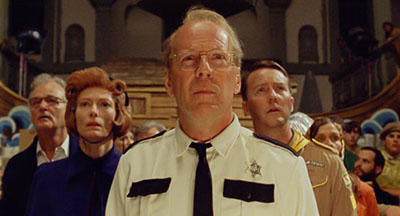 Bill Murray, Tilda Swinton, Bruce Willis, Edward Norton, Frances McDormand (Niko Tavernise/Focus Features)
Early scenes are all about Anderson’s attention to detail, which practically suffocates the bittersweet emotion of the young lovers’ plot. That deadpan distance keeps feelings at bay, and much of the film, even exterior shots, feels stage-bound, the actors pawns in a game of Cinema whose actions seem imposed from outside rather than coming from a living character.
Bruce Willis, of all people, wrings the most emotion out of this theatrical straitjacket. You feel Captain Sharp’s paternal affection for runaway Sam more than you feel a budding love between Sam and Suzy. Anderson helped revive Bill Murray’s career, but the desperation of his character in Rushmore is more elusive here. Walt Bishop’s daughter is missing, his wife (Frances McDormand) is having an affair, and his weathered visage seems only to recall lines from an earlier career: “It just doesn’t matter.”
But the ironic distance also helps the whimsy go down easier. A more sentimental treatment would be simple melodrama. The carefully structured plot, framed around a perfect storm, carried me along despite some reservations. Strange that a story of a boy who takes a different path takes paths that are laid down so meticulously, from music to color palette all the way down to font selection. The credits to this mid-century fairy tale abandon Anderson’s signature Futura for a script suitable for wedding invitations, but sans serif fonts are in full force in the town’s signage, and, appropriately, in its police force. Too often, Anderson’s signature whimsy stifles the feelings that bubble under this young person’s journey. But his gift for storytelling, and a colorful ensemble cast, keeps Moonrise Kingdom from drowning.
Anderson shot Moonrise Kingdom on 16-millimeter film, but as multiplexes convert to digital presentation, 35-millimeter prints are in limited release. Landmark’s E Street Cinema is the only Washington-area venue showing the film the way it was meant to be seen.
—
Moonrise Kingdom
Directed by Wes Anderson
Written by Wes Anderson and Roman Coppola
With Edward Norton, Bruce Willis, Jared Gilman, Kara Hayward, Bill Murray and Frances McDormand.
Running time 94 minutes
Rated PG-13 for sexual content, smoking and the kind of 12-year-olds you’d only find in a Wes Anderson movie.
Opens today at E Street and Bethesda Row cinemas.