Martin Austermuhle
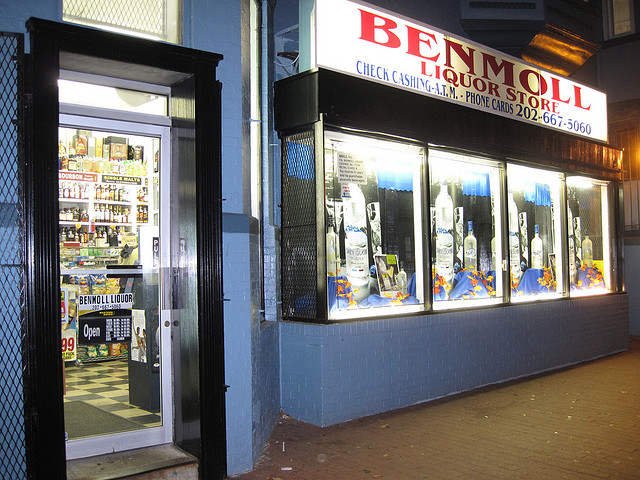 Photo by Maryland Route 5
Whenever a government restricts a business from doing something, any proposal to lift that restriction is usually met with approval from the business that would benefit. But during a D.C. Council hearing today on allowing liquor sales on Sundays, it was the liquor store owners themselves that seemed skeptical on proposals to rescind the city’s longstanding Blue Laws.
Rick Genderson, owner of Schneider’s of Capitol Hill, argued that any potential revenue he would see from Sunday sales would be negligible and would likely cut into the sales of small beer and wine stores. Additionally, he worried, a change to the Sunday restrictions would allow big-box retailers to apply for liquor licenses, causing “economic devastation” for the mom-and-pop stores that make up a majority of the city’s liquor retailers.
Michael Fonseca, speaking on behalf of the Washington D.C. Retail Liquor Dealers, similarly spoke out against allowing the sale of spirits on Sundays, saying that most stores enjoyed the option of remaining closed on Sundays. Should that change, he argued, stores would feel compelled to open their doors for fear of losing business. Genderson agreed: “It’d be a hardship for us. I work six days a week. I don’t want to work seven.”
That liquor stores seemed skeptical of a proposal that could generate up to $710,000 in tax revenue annually for the city somewhat upended the debate, leaving even Councilmember Jim Graham (D-Ward 1)—who vigorously fought a recent proposal to extend bar hours and recommended raising the alcohol excise tax—flummoxed. Calling the existing Sunday laws a “prohibition-era restriction,” Graham seemed amenable to being flexible on the sale of liquor. “It permits a convenience for residents,” he said. “We’re American. We can buy a bottle of rum and take it home.”
Mt. Pleasant ANC Commissioner Jack McKay, urban revitalization consultant Richard Layman and Ward 2 resident Abigail Nichols were of varying opinions of the wisdom of allowing Sunday liquor sales, but they also settled on what could be a compromise—allowing local ANCs to opt out if they so chose. Similar flexibility exists for a ban on the sale of single beers in stores, with some ANCs allowing stores to apply for exemptions.
Fred Moosally, the director of the D.C. Alcoholic Beverage Regulation Administration, said that neither he nor the Alcoholic Beverage Control Board had any objections to lifting the Sunday restrictions, and that a working group had proposed that D.C. do just that as part of a larger overhaul of the city’s liquor laws.
Moosally said that Montgomery County has been testing Sunday sales since November 2010, and that Virginia’s state-run liquor stores also sell on Sundays. (D.C. is one of 14 states that maintains some form of a Sunday restriction.) He mentioned that when July 4 fell on a Sunday in 2010, the city allowed liquor sales, and 114 of the 220 stores had opted in for the day. He also added that city officials should maintain a standing limit of one Class A liquor license per group, to prevent big-box retailers like Walmart from applying for and gaining multiple licenses to sell spirits.
Graham said he was hoping to introduce comprehensive liquor regulation reform legislation before the council’s summer recess, but it remains to be seen how far it could go without the support of the businesses that it would target.