Martin Austermuhle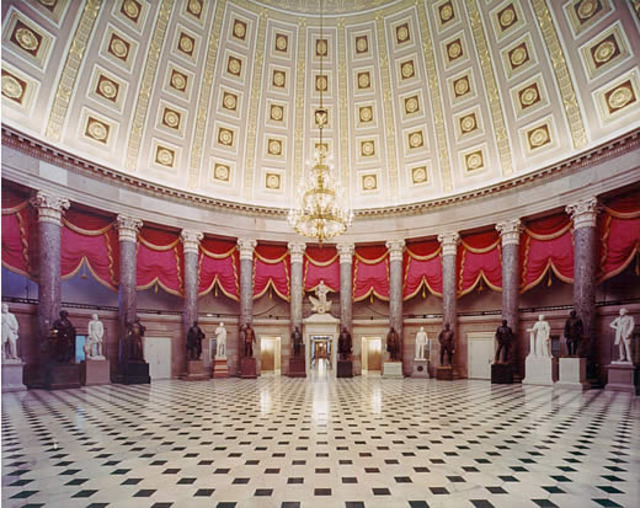
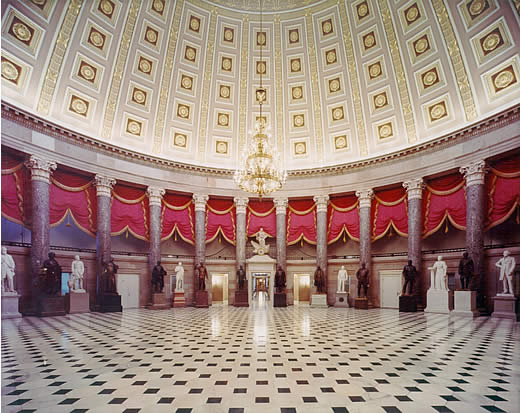 Statuary Hall in the U.S. Capitol
D.C. might finally get a place in the U.S. Capitol’s Statuary Hall, it seems.
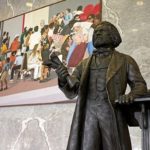
A Senate spending bill for D.C. that passed this week would allow a statue of Frederick Douglass to be moved from a D.C. government building in Judiciary Square to Statuary Hall, placing it amid the two statues that each state is entitled to place in the Capitol complex. It would be only the third bust of an African-American in the hall, which has 120 statues on display.
D.C. officials have long fought for their two statues—the second is of Pierre L’Enfant—but their efforts have long been stymied by Republicans. The one-statue compromise was floated by a California Republican in 2010, but it died in the Senate.
The spending bill would also allow D.C. to spend its own money in the event of a federal government shutdown, a huge win for city officials who have long complained that they have to prepare for a local shutdown every time members of Congress can’t agree on a federal budget. And as we recently reported, the Senate bill allows D.C. to spend its own funds on abortions.
The bill also includes funding for a number of other D.C. priorities, according to a press release from D.C. Del. Eleanor Holmes Norton’s office:
The bill also would fund critical D.C. programs, including $35.1 million for DCTAG, an increase of $5.1 million from fiscal year 2012, which Norton got through Congress in 1999 to provide higher education opportunities for D.C. students equal to those available to other Americans by granting D.C. students up to $10,000 annually for in-state tuition at any U.S. public college and up to $2,500 annually to attend private colleges in D.C. and the region. DCTAG has doubled college attendance rates in D.C., now up to 60 percent – 10 points above the national average. The bill also includes $20 million each for D.C. public and public charter schools; $5 million for HIV/AIDS prevention and treatment; $15 million for her top environmental priority, the D.C. Water and Sewer Authority’s Clean Rivers Project to reduce combined sewer overflow and restore the Anacostia River; $24.7 million for emergency planning and security costs associated with national events and demonstrations, at least $9.8 million of which is to cover costs associated with the next presidential inauguration; $500,000 for tuition for D.C. National Guard soldiers; and $9.8 million to help start D.C.’s redevelopment of the East Campus at St. Elizabeths in Ward 8. The Senate Appropriations Committee-passed Homeland Security Appropriations bill provides the full $89 million requested by President Obama for the continued development of the Department of Homeland Security headquarters on the St. Elizabeths West Campus. The House approved $34.5 million for the headquarters project.
Certain provisions of the spending bill don’t align with a similar bill passed by the House, and the two will have to be reconciled in a conference committee. The House bill bans local funding for abortions, does not mention the Douglass statue and does not fund some of the programs covered by the Senate bill.