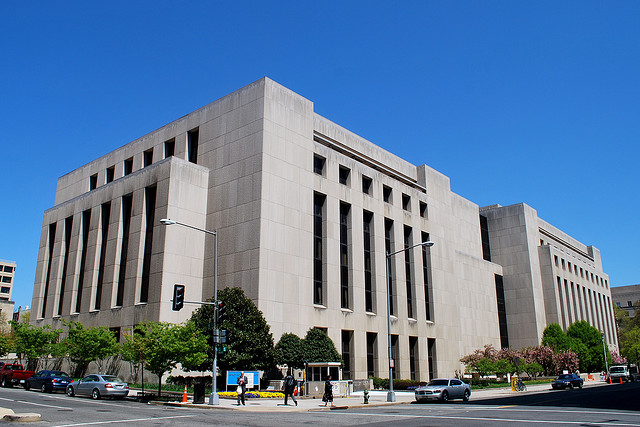
 H. Carl Moultrie Courthouse (Photo by M.V. Jantzen)
The complaints raised last week by a group of recent grand jury members that their five-week civic duties left them unfairly severed from the outside world did not take long to reach the attention of D.C.’s judiciary.
On Tuesday, 13 members of a grand jury offered an open letter to D.C. Courts stating that while they were carrying out their summonses, they were not permitted to use their laptops, tablet devices or other personal electronics while the jury was out-of-session, despite being under the opposite assumption. One of the jurors told DCist that the separation from wired society left jurors disconnected and lagging behind on personal and professional correspondence.
“None of us wanted to violate the secrecy of the grand jury,” Chris Strohm, a reporter with Bloomberg News who penned the letter, told DCist last week. “In today’s age and reliance on technology, going five days a week without access to the Internet is difficult to do.”
Although selected by and registered at D.C. Superior Court, grand juries meet at a federal building a few blocks away in the office of U.S. Attorney for the District of Columbia, where they are not permitted to bring electronic devices. (The District’s Moultrie Courthouse does permit people to bring computers and other devices inside.)
But Strohm also said that jurors thought they could bring along their computers to grand jury service because that’s what was printed on informational material when his group was impaneled in late April. During their five-week service, Strohm and his fellow jurors asked the U.S. Attorney’s office in an April 30 letter to clarify and relax the policy.
In fact, there appears to be a recent history of inconsistency with the advertised policy toward electronic devices and actual practice. Last year, Duane Delaney, the clerk of D.C. Superior Court, wrote in a letter to John Cummings, chief of the major crimes division in the U.S. Attorney’s office, that several grand jurors then complained of being denied admission to the federal building at 555 Fourth Street NW because they were carrying personal electronic devices they thought they would be permitted to use during breaks between hearings.
“These citizens were reportedly told that they had to immediately store all personal technology items in their cars or return them to their homes,” Delaney wrote in the letter dated October 13, which was shared with DCist by D.C. Courts. “It is my understanding that during down time your office previously permitted grand jurors the use of laptops, DVD players, iPods, iPads, PDAs and cell phones without a camera function. I am aware that in the past any type of camera or technology with a camera function was logged in at the security desk upon arrival and returned to the juror at the end of the day’s session.”
After DCist’s report last week, D.C. Chief Judge Lee Satterfield replied to Strohm in a letter. In his letter, Satterfield wrote that the U.S. Attorney’s office never replied to Delaney’s earlier request for clarification. But he reminded Strohm that even though the grand juries are weighing District cases, they are not meeting on District property.
“Please understand that the D.C. Courts do not own the building at 555 Fourth Street NW, nor do we rent or control any of the space there,” Satterfield wrote. “Thus, the Superior Court does not have any control of the policies implemented in that building.”
In an interview today, Strohm, who is still waiting to receive Satterfield’s letter in the mail, says he is less than enthused by the response.
“So they’re passing the buck,” he says. “I don’t know who is responsible.”
Strohm says that during his service, he brought his complaints to Cynthia Walicki, a U.S. Attorney’s office employee who coordinates grand jury operations, who he says told him she would take the issue under advisement.
“We simply asked for the old policy,” he says.
But in a brief statement Friday afternoon, the U.S. Attorney’s office said the restrictions on grand jurors having access to electronic devices have always been clear. “The policy at the U.S. Attorney’s office has consistently banned the use of electronic devices in the grand jury area,” Bill Miller, a spokesman for U.S. Attorney Ron Machen, wrote in an email.
The portion of the D.C. Courts website featuring information pertinent to grand jury service reflects Miller’s email, but was only edited to read that way a few months ago, Strohm says.
Still, in his letter, Satterfield wrote that some more clarification could be in order. He told Strohm he intends to confer with both Machen and Cummings about the electronics policy so that D.C. Courts materials provide future grand jurors with up-to-date information on the rules governing their behavior.
For his part, Strohm would just to see future grand jurors to have an easier time than his group did, no matter which side is responsible for authorizing it.
“Regardless of who’s setting the policy, the existing one sets more of a hardship than needs to exist,” he says.
***
D.C. Chief Judge Lee Satterfield’s reply to Chris Strohm:
Satterfield Letter
D.C. Superior Court Clerk Duane Delaney’s October 2011 letter to John Cummings, and the grand jury’s April 30 letter:
Grand Jury Electronic Devices Prohibition