Martin Austermuhle
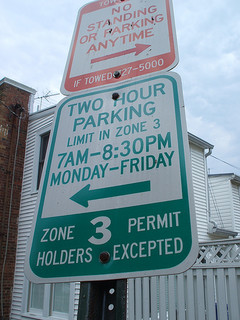 Photo by slack13
Today a D.C. Council committee held a hearing on what can often be the most controversial of local issues—parking. While focused on two bills that would make it easier for contractors to get temporary on-street parking permits and for caregivers of disabled or handicapped residents to park in front of the homes of their patients, a number of witnesses more broadly floated ideas for long-term parking solutions.
One of those was to get rid of the current residential parking system—created in 1974—which aligns parking zones with the city’s wards. If you live in Ward 1, you’re entitled to a Ward 1 residential parking permit. If you’re in Ward 4, it’s Zone 4, and so on. Greater Greater Washington’s David Alpert, Ward 3 ANC Commissioner Anne Bairstow and others encouraged councilmembers Mary Cheh (D-Ward 3) and Tommy Wells (D-Ward 6) to rethink the zoned parking system altogether by looking at it by neighborhood clusters instead of entire wards.
The logic? Wards are too big, they inevitably get redistricted and people within wards can find creative ways to employ their parking privileges. Take Wells’ own bailiwick, Ward 6. You could live on H Street NE yet still enjoy a residential parking permit that allows you to park down by the baseball stadium on game days. In Ward 3, Bairstow said, residents would drive to Woodley Park and jump on the Metro from there. All told, the current zone-based parking system doesn’t really do much to dissuade driving—or at least try and recover the costs of having people try to park on the street.
This certainly isn’t a new idea. Almost a decade ago, a parking taskforce created by Mayor Anthony Williams said that aligning wards with zones just didn’t make sense. “The current ward-based residential parking program (RPP) boundaries are far too large for effective management of parking in the District. Neighborhood-based boundaries are recommended,” it said.
Instead, it proposed 39 new neighborhood-based parking zones. Kalorama Heights, Adams Morgan and Lanier Heights would be Zone 1, while Columbia Heights, Mt. Pleasant, Pleasant Plains and Park View would be in Zone 2, for example. If you lived in Zone 1, you could park on residential streets for as long as you liked. But if you drove into Zone 2, different rules would apply—likely the existing two-hour limit.
The idea wasn’t to make driving and parking impossible, but to prioritize it for those who most need it, said the working group. The urbanists testifying today said much of the same.
Obviously, it’s not an idea that will glide through the D.C. Council unopposed. It’s been floating around since 2003, after all, and hasn’t yet been implemented. The problem is that people who currently enjoy the benefits of big parking zones will complain. Changing something that benefits many and isn’t a problem for all is always an uphill battle, after all.
At the hearing today, though, D.C. Department of Transportation Director Terry Bellamy asked for comprehensive parking reform for the city—not piecemeal approaches. That means that if new parking zones will come to pass, they’ll be wrapped into much broader changes that could included everything from more expensive meters to new rules for guests to higher fees for residential parking permits.