Martin Austermuhle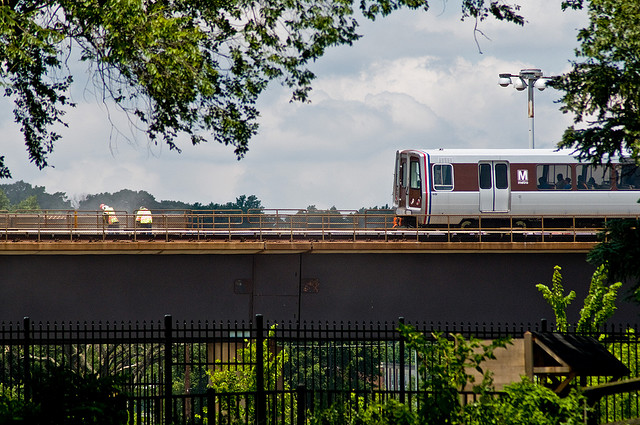
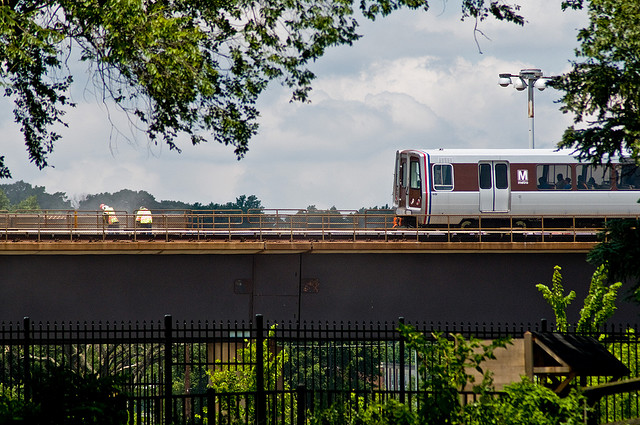 Photo by Brian Mosely
After the 2009 Red Line crash that left nine people dead, the National Transportation Safety Board renewed a longstanding complaint—no federal safety standards existed for mass transit like Metro, leaving instead a patchwork of state oversight agencies to ensure that people riding trains and buses would be safe. Under a new transportation bill making its way through Congress, that will change.
The bill, which is likely to receive final approval today, will allow the Secretary of Transportation to draft minimum safety standards for any transit system—like Metro—that receives federal funding. Additionally, performance standards will be created for vehicles used by transit agencies, federal and state employees who conduct safety audits will be trained and transit agencies will be required to establish comprehensive safety plans.
After the 2009 incident, the NTSB identified a number of systemic failures that could have prevented the deadly crash. Since then, the Obama administration and members of the region’s congressional delegation has pushed legislation granting the federal government increased oversight over transit agencies and their safety standards. Up until that point, it was left to 27 disparate state-level agencies to do the job; our own local Tri-State Oversight Commission was long prevented from doing its duties in helping keep Metro safe.
Safety advocates and the Obama administration got the majority of what they wanted, but had to give in on one point that Republicans fought over—smaller transit agencies will be able to rely on their states to craft safety standards, instead of having the federal government do so. Additionally, the Department of Transportation won’t have direct oversight over Metro and other transit systems—that will be left to state safety agencies.
The full description of the program is below.
Sec. 20021, 49 U.S.C. 5329, Public Transportation Safety Program
Establishes a National Public Transportation Safety Plan to improve the safety of all public transportation systems that receive Federal funding. The Secretary will develop minimum performance standards for vehicles used in public transportation and establish a training program for Federal and State employees who conduct safety audits and examinations of public transportation systems.
Requires public transportation agencies to establish comprehensive safety plans, thus encouraging a “culture of safety” in which each employee completes a safety training program that includes continuing safety education and training. The Senate receded to a House request to give smaller systems the option to rely on states to prepare these plans.
Improves the effectiveness of State Safety Oversight Agencies and increases federal funding for safety. States will submit proposals for state safety oversight programs for rail fixed guideway public transportation systems to the Secretary, and upon approval, receive funding at an 80 percent Federal share. The Act builds on the existence of State safety oversight agencies and requires them to be legally and financially independent from the rail fixed guideway systems they oversee, and have the authority, staff training and expertise to enforce Federal and state safety laws.
At the request of the House the conference changes the nature of the enforcement powers contained in the Senate bill. Instead of direct oversight of public transportation agencies, the program relies on State Safety Oversight Agencies to provide direct oversight of rail fixed guideway public transportation providers.