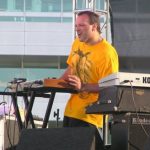
Federico Gonzalez Peña.
Today’s freelance musician needs to be a true all-rounder to make a living. A jazz pianist might have to find work playing keys with a rock group; a classical singer can’t be afraid of singing the occasional show tune. Of the many area players that embody this multi-faceted approach to musicianship, one that stands out is keyboardist Federico Gonzalez Peña.
Peña was born in Montevideo, Uruguay and raised in Buenos Aires, Argentina. His first piano was left to him by his grandmother, an accomplished pianist and organist. After two years with a local teacher, his parents saw that Peña had a talent and sent him to renowned classical pianist Antonio De Raco, with whom Peña spent seven fruitful years. Feeling constrained by the rigidity of classical music, Peña began to branch out and play recording sessions with many of the finest musicians in Buenos Aires, though he was still just a teenager. He began exploring other styles of music like the funk of Earth Wind & Fire, the classic prog rock of Rush and Genesis, as well as the jazz-rock fusion of Jean-Luc Ponty and Herbie Hancock.
In 1984, at 18-years old, Peña made the move to the States, attending the Berklee College of Music for one year before settling in Washington, D.C. He landed gigs with the city’s best go-go bands and began to spread his wings from there. His skills on both the acoustic piano and electric keys have led to tours and recordings with some of the world’s most accomplished artists. This weekend, Peña will lead his own quartet at the historic Bohemian Caverns.
DCist interviewed Peña to get his thoughts on music and a preview of his upcoming sets at the Caverns.
You’ve played as a sideman with some really impressive artists. Who are some of your favorites, and why?
Obviously Meshell [Ndegeocello] occupies a very special place, and not just because of her personally, but also because our time together encompassed an era of great importance in my life. Meshell and I go way back to our go-go days together, she played in the band, Prophecy, and later we played together with Little Benny. Those years represented a time of infinite musical and personal possibility, a time of incredible growth, and a forging of amazing friendships. I’m thinking of my relationship with [drummer] Gene Lake here, who is like a brother to me and with whom I’ve shared a great deal of life and music with.
I acted as co-musical director in the band and always saw my ideas implemented within the band, which was one of the biggest reasons why I never felt compelled to move to New York or L.A. Why leave D.C.? What was I chasing? And to boot, we were one of the funkiest, baddest bands on Earth! We recorded with Chaka Khan together, played with Herbie, opened for Sting, opened for The Who at Madison Square Garden. You name it, we did it.
When I wasn’t on tour, I was here at home playing with Sean Rickman, who is one of the most amazing drummers to ever sit behind a drum kit, and Marshall Keys. We were experimenting deeply in what was one of the most buzz-worthy underground gigs around, our Wednesday nights at [the now defuct] Cafe Lautrec in Adams Morgan. One night, Prince’s band would be there to check us out. Another night Oteil Burbridge would stop by and play with us. You just never knew who would fall by. I had the best of both worlds on the road and at home. I remember those years fondly.
I have to mention Maxwell too. I worked in a lot of his records and knew right away during the recording of his first record that he would be a star. Obviously, working with Marcus Miller is a great experience, as he’s turned me onto different situations, affording me the opportunity to tour and make music alongside early heroes of mine such as Stanely Clarke, George Duke and David Sanborn.
You straddle the line between being an electric keyboardist and an acoustic pianist as well as anyone. How did you get into synthesizers and what approach do you take to mixing the two sounds?
I’m happy to see you notice this! I’ve been lucky to adapt quickly to the synth coming from the piano and don’t think much about the approach. I don’t really separate the two because neither feels alien to me. I also love when I play nothing but piano. To show up at a gig and just sit and play, there’s something really cool about that. When I’m doing both though, like on the gig coming up at the Caverns, I think of the piano and synths as all one thing. It’s just different colors that come in and out according to what the music dictates.
Who will you be playing with at the Caverns? Why did you choose these particular musicians?
The great Alfredo Mojica on percussion, Quincy Phillips on drums and bassist Romeir Mendez will be rounding out the quartet at the Caverns. I sometimes am a bit befuddled as to which approach to take when presenting or recording my own music. Instead of letting that take me to a place of indecision and inaction, I decided to call on guys that would be fluid enough to allow the music to go in different directions.
Quincy is a beautiful spirit and a tremendous musician. I first became aware of him through his Cafe Nema stint with The Young Lions. Last year we did it with Tarus Mateen on bass. Tarus wasn’t available for this one so I called Romeir and I was lucky he said yes. Alfredo, what can I say about my brother? I’ve seen Alfredo bring a house to it’s feet off a triangle solo.
What can the audience expect as far as the material you’ll be playing?
We will be crossing boundaries stylistically and sonically, of this I’m sure. I’m probably going to play quite a bit of original music but will also throw in different composers for whom I feel an affinity.
How would you describe your writing process?
One word that comes to mind when thinking about the approach I take to writing is “open”. What I mean is that I’m open to any which way a piece of music reveals itself. I believe music and compositions have a life all their own, so when the seed of an idea comes, I’m careful to remain open to what the music is asking for instead of imposing my own will on it.
Do you have any plans to record your original music?
I do plan on recording soon, God willing. My goal is to have a record in the can sometime next year. You have to be careful though because anyone can make a record nowadays, so it’s important to have intentions that are based on one’s truth. There has to be a strong belief in what one’s doing, at least in the initial impulse. If I miss the mark that’s okay, at least my heart was in the right place.
What do you hope the audience walks away with after hearing your band play at the Caverns?
I would like for people to walk away and feel that we touched them. If we can surprise them a bit and enrich their lives in some small way, then I’m good. I’d also like for the people to realize that there are great musicians everywhere and not just in L.A. and New York. I think there’s an unconscious belief in the public at large — and not everyone of course — that just because we choose to live here, we’re “less than.” That whole “local” label really bothers me. Everyone is local from somewhere!
Federico Gonzalez Peña playing with the Grégoire Maret Quartet during a 2010 concert in Switzerland:
Federico Gonzalez Peña will lead his quartet through 8:30 and 10:30 p.m. sets on Friday and Saturday at Bohemian Caverns. $18.