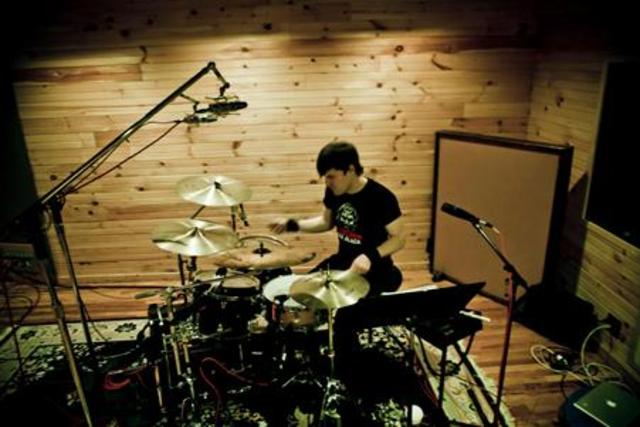
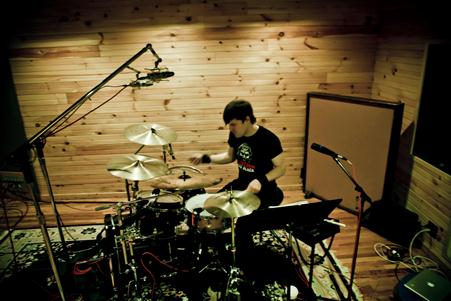
 Mike Smirnoff.
 The District has no shortage of talented drummers, and many of them wear a number of hats because nly the most rare of working musicians can be limited to one genre. The bills need to get paid, after all. So it’s common for percussionists to play a jazz gig on a Friday, back a singer-songwriter on a Saturday, and then maybe play with a church choir on Sunday. On such example is drummer Mike Smirnoff. Formally trained in jazz, Smirnoff has become one of the area’s first-call players for songwriters looking to form bands or record some tracks.
Though his regular work is impressive, it was Smirnoff’s most recent solo effort that caught our eye. Photovoltaic is an album built entirely around percussion. Using overdubs and loops, each track is built with layers of eclectic sounds, ranging from found sounds to classical percussion instruments. An ambitious effort to say the least, Photovoltaic has caught the eye of the drumming community, gaining recognition from Modern Drummer, the percussion world’s most prestigious trade magazine. Mother Jones has also been using tracks from the album for its online political convention coverage.
Smirnoff’s studied classical percussion and jazz at the University of Maryland, where he earned both undergraduate and graduate degrees. Upon graduation, he made the rounds in the area’s jazz clubs, eventually leading his own quartet through weekly gigs at Twins Jazz and various spots in Adams Morgan. His jazz life started waning off five years ago, when Smirnoff first started recording and touring with rock bands, and earning a reputation as a drummer who put the song first, and ego second.The list of local acts with whom Smirnoff has played is impressive, and includes Fighting Gravity’s Schiavone McGee, Justin Jones and the Driving Rain, We Were Kings, Justin Trawick and Bellflur. In addition to regular live performances, he has recorded as a session musician for ESPN, PBS and the WB’s The Lake.
DCist interviewed Smirnoff about Photovoltaic and his career thus far.
What was your initial concept behind Photovoltaic? And did that concept hold up through the entire process?
I wanted to take a snapshot of my playing to find out who I was as a player, and what I’d have to do to improve. The pieces borrowed from various styles like Japanese, African, and Brazilian drumming, mixed in improvisation, asymmetry, and a bit of indeterminism. Photovoltaic means “a conduit that turns light into electricity,” and to me it was about channeling the inspiration, and turning it into something new. Playing the support role and being tasteful is a challenge, and in order to keep playing that role with my bands I had to create something on my own.
How did you develop the material on the album?
I read somewhere that for The Downward Spiral, Trent Reznor would record himself playing guitar for 45 minutes straight, and from that, he’d keep maybe one fifteen second idea. I would record myself improvising for 45 minutes, trying out combinations of drums that you don’t find conventionally. I’d listen to the recordings on my way to work and make note of the parts that were worth keeping. Late at night I would sit away from the instrument and compose the rough ideas into a cohesive piece, often with sleep deprivation inspiring ideas that I wouldn’t have thought of otherwise. Many things influenced the music — Stravinsky’s cut and pasting, the polytonality of Shostakovich’s 10th Symphony — but mostly what I wanted how the drums sound to me while playing to come across, powerful, and complex with the natural overtones you hear when you don’t have to control them behind songs.
What was the recording process like?
I booked the studio time for three days around my birthday and brought a truck load of drums and percussion. I played each part of the ensemble pieces, so as the session progressed the parts slowly coalesced. Jason Chmiola [of Blue House Productions] and Chip Johnson [of Alpine Red Studio] were at the helm at the two studios, and were very patient with my “let’s try this” style of recording. For example, we gathered and played fallen branches from outside Chip’s studio for a part in “Ensemble #1”, using the branches in bundles to replicate the looseness of ensemble drumming.
Is there a possibility that Photovoltaic can be translated to live performance?
I would love to be involved with a large drumming ensemble, but unfortunately for me the best one in D.C., Batala D.C., is only for women!
My friends who I’d like to play with in an ensemble are too busy with their own schedules to get something like that off the ground. I didn’t want to spend all my time handling logistics, so I just figured I’d record it all myself. If it was composed through I could be the architect and perform all the parts. Now that the record is finished I am too busy touring with Justin to really put something live together. But who knows?
What are your plans for the project?
Having played the support role in twenty different bands, I wanted to create something that was just mine. I continue to write and record drumming music, but the next big project will have to be totally different. In order to challenge myself I’ll need explore melody and harmony, so I’ll probably write for a bebop quartet, or a chamber group.
Do you have any notable gigs coming up?
I’m touring with Justin Jones all summer, and in early October we’re playing the Austin City Limits Festival. Bellflur’s new album, Twelve Vagrant Monologues from the Last Living Star, will be released on vinyl soon, and we’ll have a record release show. All the dates will be up on my website.
How do you see a project like Photovoltaic fitting within D.C.’s music scene? Is there an audience for a recording like this?
The people that will enjoy this are fans of my bands, of avant-garde music, or just drumming fetishists.
What are your thoughts on the local scene?
I don’t see shows often because of my performance schedule, but I make sure to check out Janel & Anthony, the DC Jazz Composers Collective, or bands like Title Tracks, or if These United States is back in town.