Martin Austermuhle
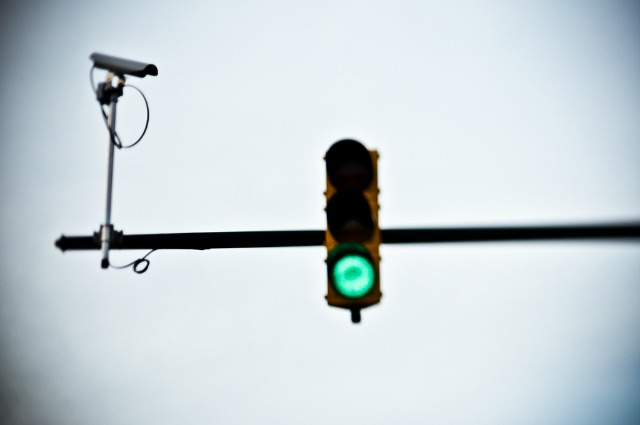 Photo by Chris Rief
Sky-high fines for traffic camera violations may eventually be a thing of the past under a new bill that will be introduced in the D.C. Council today.
As part of the Safety-Based Traffic Enforcement Act of 2012, Councilmembers Tommy Wells (D-Ward 6) and Mary Cheh (D-Ward 3) propose that traffic camera fines for most moving violations not exceed $50, a substantial decrease from the existing fine schedule that starts at $75 and can hit $250. If the fines are lowered, D.C. would be close to on par with Maryland, which charges $40 for speeding camera violations.
Under the bill, which is being co-introduced by Councilmember Marion Barry (D-Ward 8), the $50 fine would apply to speeding between 11 and 20 miles and hour over the speed limit and a number of other violations, including failure to yield to pedestrians in a crosswalk and failure to stop at a stop sign. (According to MPD, most speeding violations fall between 11 and 20 over the limit.) Red light camera fines, though, would remain at $150.
The legislation, crafted from discussions by a task force over the last two months, would also direct 50 percent of all traffic cameras revenues to “improved traffic enforcement, traffic safety education, and capital investments safer road designs,” codify a 30-day warning period for cameras and require D.C. to assess whether posted speed limits are appropriate for the roads they’re on.
During the task force’s meetings, Wells, an avid cyclist and advocate of public transit, said that he worried that the high fines were making drivers feel that the cameras served as revenue generators instead of a means to promote safety. In a statement released today, he echoed that sentiment.
“Most people I talk to are convinced that our automated traffic enforcement cameras are mostly about raising revenue,” Wells said in a press release. “This must change—particularly as MPD prepares to expand the number of enforcement cameras and increase the types of moving violations that will be enforced with these cameras.”
As part of his 2013 budget, Mayor Vince Gray expanded the city’s network of traffic cameras, focusing them not only on speeding and red light-running but also failure to yield to pedestrians and running stop signs in front of schools. While city officials say that the cameras help keep pedestrians and cyclists safe, they also provide a nice revenue bump—D.C. expects to raise $91 million from traffic camera fines this year, up from $55 million in 2011. Should Wells’ bill pass, legislators would have to find money to cover what the city’s cameras are expected to draw in based on current fines.
“Data is conclusive that drivers slow down wherever we put these speed cameras in place—and all of us want safer traffic in our own neighborhoods,” said Wells. “The fact that traffic cameras can be so valuable for safety and quality of life is precisely why it’s so important to deploy them responsibly, in a manner that protects the public trust.”