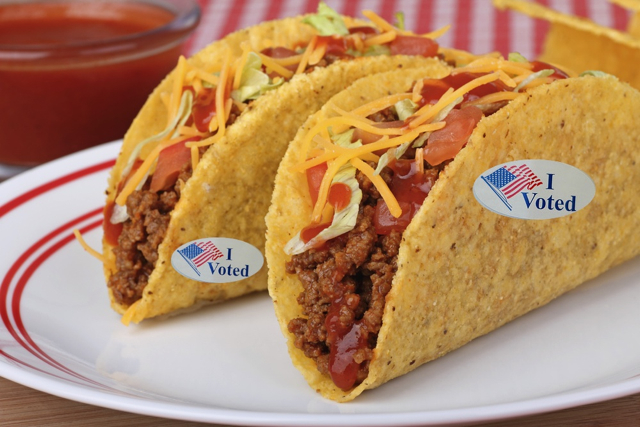
 Tacos photo via Shutterstock
There was a brief stir last month when Capitol City Brewing Company, a local chain of brewpubs, said it would be offering a free mug of one of its house-made beers on Election Day to any patron sporting an “I Voted” sticker. Free beer for the simple act of civic participation seemed like a swell idea sure to entice even the most apathetic voter to drop by the ballot box.
The promotion seemed like a good idea, but it was rescinded when it was realized that rewarding people for their votes is illegal. Even though Capitol City Brewing Company didn’t endorse a candidate, paying people—whether with money or something else—to vote is against the law.
But a pair of local fast-food chains might not have gotten the notice. California Tortilla and Z-Burger are both promising to give away free menu items next Tuesday to anyone who walks into their restaurants and stating that they took part in the election. However, that, too, could land them in a legal pickle.
On Election Day, people arriving at California Tortilla with one of those stickers can get a free taco, while those going to Z-Burger can get a free hamburger. At least, that’s what’s being offered. But those companies might want to rethink their offer after reading Section 597 of Title 18 of United States Code:
Whoever makes or offers to make an expenditure to any person, either to vote or withhold his vote, or to vote for or against any candidate; and whoever solicits, accepts, or receives any such expenditure in consideration of his vote or the withholding of his vote—shall be fined under this title or imprisoned not more than one year, or both; and if the violation was willful, shall be fined under this title or imprisoned not more than two years, or both.
As discussed during the not-so-free-beer fiasco, Ben & Jerry’s ran afoul of this provision in 2008, when it attempted to give away free ice cream cones to anyone walking into one of its shops on Election Day while wearing an “I Voted” sticker. Rick Hasen, a professor at the University of California, Irvine, raised a stink when Ben & Jerry’s announced the giveaway. The company instead turned Election Day into a free cone day for all comers.
California Tortilla thinks it has found a way not to be guilty of electioneering in a federal race. Michael Schaffer, a spokesman for the company, tells DCist that customers next Tuesday won’t in fact need one of the “I Voted” stickers, even though the original announcement implied that they would.” Instead, anyone who tells a cashier that he or she voted—regardless of whether or not they actually cast a ballot—will get a free taco. Kenny Fried, a publicist for Z-Burger, says the same goes for the hamburger deal
But California Tortilla’s and Z-Burger’s decisions to open their promotions to all who claim to vote, liars included, won’t keep it legal on Election Day, Hasen tells DCist in an email.
“It is illegal to pay people to turn out to vote when there are federal candidates on the ballot,” he says. “This looks pretty close to the line of illegality.”
Much as it might make heavily Democratic D.C. gag, if California Tortilla and Z-Burger want to keep it clean on Election Day, they might look to something Mitt Romney’s primary campaign did in April. On the day of the Wisconsin Republican primary, Romney and a local surrogate—Rep. Paul Ryan, of all people—handed out free subs at a Waukesha sandwich shop. Democrats tried to make a fuss, saying Romney was guilty of bribing voters for their support by plying them with food, but as Hasen pointed out when he analyzed the situation, Romney, Ryan and the sandwich shop were playing fair:
So did Romney violate the law? It sure doesn’t seem like it from these facts. No one had to prove they had voted to get the sandwich. No one apparently promised to vote to get the sandwich, nor did Romney ask for such a promise.
So, perhaps that’s how California Tortilla and Z-Burger should play it on Election Day next week. Because right now, asking customers to declare that they voted—even if the customers are lying—could be verboten.