Martin Austermuhle
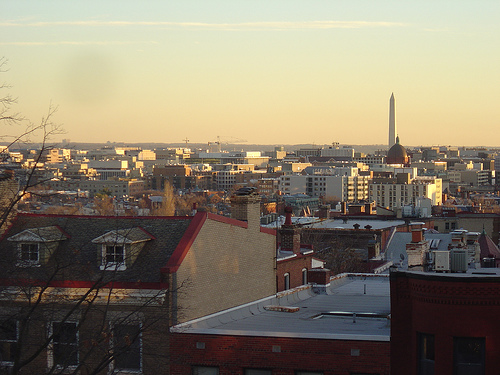 Photo by Cickatoes
Never thought that Congress would move on allowing taller buildings in D.C.? Well, a Republican legislator today announced that it will at least study the idea.
Rep. Darrell Issa (R-Calif.) announced today that he and D.C. Del. Eleanor Holmes Norton have asked that the National Capital Planning Commission and D.C. government conduct a study of changing the Height Act of 1910, the longstanding legislation that has—depending on who you ask—maintained the city’s open skyline or stunted the city’s economic development potential by limiting how tall buildings in the city can be.
“Congress has a clear and appropriate interest in preserving both historic characteristics of our nation’s capital and ensuring that longstanding rules and regulations still pass the test of common sense,” said Issa in a press release. “As time has elapsed and opportunities for economic growth in our nation’s capital continue to present themselves, this study will help Congress and local leaders evaluate the case for expanding existing boundaries for vertical growth.”
According to Issa’s office, the study, which will begin in December and end next September, would explore raising height limits outside of the federal core. In a letter to Mayor Vince Gray in October, he wrote: “The Committee encourages the exploration of the strategic changes to the law in those areas outside the L’Enfant City that support local economic development goals while taking into account federal interests, compatibility to the surrounding neighborhoods, national security concerns, input from local residents, and other related factors.”
Issa joined some D.C. officials in April in advocating that the idea at least be explored. During a congressional hearing in July on the matter, D.C. officials said that they weren’t looking for much more than some flexibility in allowing existing buildings to use their rooftops for restaurants, lounges and human habitation. For D.C. Chief Financial Officer Natwar Gandhi, allowing buildings outside the city’s federal core to rise a little higher would help balance off the fact that the city cannot tax income at its source and forgoes property tax from land owned by the federal government, hospital, universities, and embassies.
The idea—which Norton has sounded lukewarm over in the past—has attracted opposition from groups like the Committee of 100 for the Federal City, which say that the Height Act has helped create the city’s open skyline and vistas. They worry that even development outside of the federal core will distract from that.
This isn’t the first time that Issa has come to the city’s side. At the July hearing, he said he’d be open to holding a discussion on the city’s longstanding request that it be able to tax the incomes of non-residents who work here. In May 2011, he similarly caught city official off-guard when he said that he favored increased budget autonomy for D.C.