Martin Austermuhle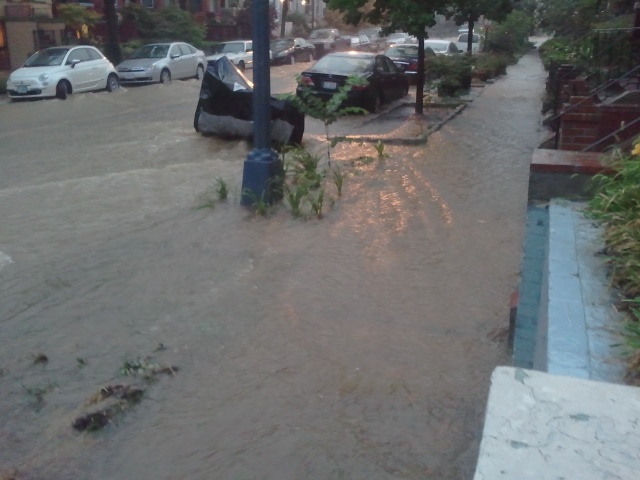
A task force created by Mayor Vince Gray to analyze the causes of repeated floods in Bloomingdale and LeDroit Park last year published its final report today, and one of its conclusions is that freakish weather and crappy luck—along with aging infrastructure—were to blame for the floods.
The report says what city officials already knew: the sewer lines that serve the neighborhood are too old to handle the types of severe storms that newer lines are expected to deal with. But it also stresses that 2012 was a bit of a freakish year when it comes to those exact storms.
According to data collected by D.C. Water, the city was hit by a 10-year storm and two five-year storms all in the span of two weeks in July, while a second 10-year storm hit in September. When compared against historical data, D.C. Water found that these multiple intense storms happen—albeit not often. “The comparison also found that storm events tend to be episodic in nature, with some decades (i.e., 1950’s) having many intense storms and others (i.e., 1990’s) experiencing comparatively fewer intense storms at longer durations,” said the report.
Another stroke of bad luck was where the storms really hit. In the first July storm, for example, Bloomingdale was pounded with two inches of rain, while Ronald Reagan Washington National Airport got just a shade over a half-inch. The same thing happened a week later, with the most intense parts of the storm essentially parking over the neighborhood that could least deal with it.
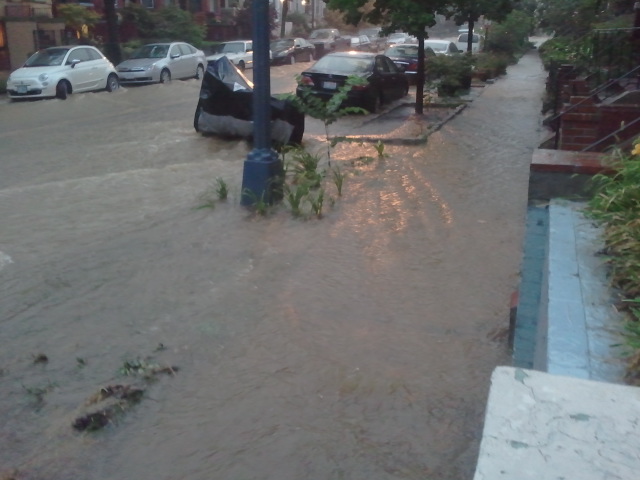
All told, the report says that some 200 homeowners were affected by the floods, over half of which suffered sewer backups that resulted in between $3,000 and $18,000 in damage. During the worst of the storms, it added, the area around Rhode Island Avenue and First Street NW saw up to 22 inches of pooled water; residents took to calling the area “Lake Rhode Island.”
By way of solutions, late last year Gray said that the city would build large holding tanks under the nearby McMillan Sand Filtration Site. Those tanks, to be completed by 2014, would hold six million gallons of water. Another tank under First Street NW would be completed in 2016, increasing capacity by another six million gallons. In the short-term, the report says that D.C. will work to install backflow preventers in affected homes; on the long-term, a new holding tank under the Anacostia River should be completed by 2025.
Late last year the D.C. Council created a $1 million relief fund to help cover the costs of repairs for those homeowners affected by floods; the fund will be paid for by a 30-cent increase in D.C. water bills.