Martin Austermuhle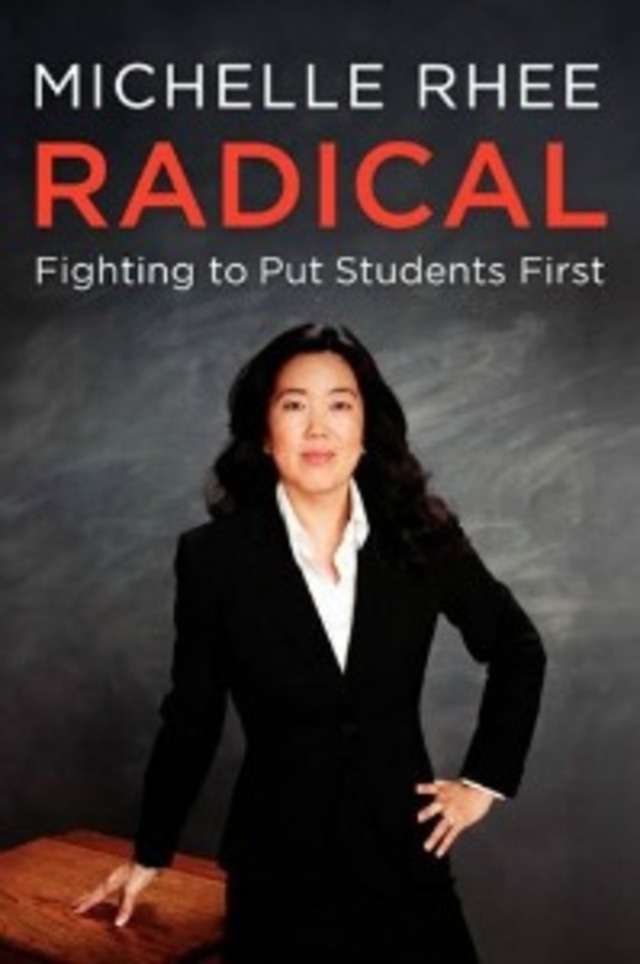
 Former D.C. Schools Chancellor Michelle Rhee appeared on The Daily Show last night, part of a media campaign coinciding with the release of her new memoir, Radical: Fighting to Put Students First. (Over the weekend she appeared in the New York Times Magazine and on ABC’s This Week.) During the interview, Rhee told Jon Stewart of her time in D.C., while Stewart pushed Rhee to explain why testing has become such a significant metric in judging how well teachers are doing.
Rhee only spoke briefly about her controversial tenure in D.C., saying that she closed under-performing schools (23 in 2008), slimmed the central office bureaucracy and fired ineffective teachers (400 have been let go since 2009) as a means to raise student achievement that by some measures ranked lowest in the country.
“I was a little shocked when people said, ‘Oh, she’s a lightning rod, she’s a radical,’ because I thought what I was doing was just bringing some order and reason to the system. At the end of the day, I feel like if bringing common sense to a dysfunctional system makes me a radical, then I’m OK being a radical and I think everyone should be one,” she told Stewart. (On ABC, Rhee said that while she did not regret firing ineffective teachers, firing a principal when a PBS news crew was in the room was probably a bad idea.)
During their conversation, Stewart pushed back on the reliance on standardized testing to both judge students and rate teachers, saying that tests can’t account for conditions out of the teacher’s control. Rhee conceded that teacher evaluations are an evolving tool, and that school districts are starting to expand upon the measures with which they rate educators.
“There has to be a balance. You don’t want an overemphasis on the tests, where that’s the only thing that people are concerned about, and yet you can’t have no accountability,” she said. Last year, Rhee successor Kaya Henderson made changes to the IMPACT teacher evaluation system, lessening the reliance on student tests and allowing teachers more time to improve.
Stewart also challenged Rhee on the growth of the charter sector, saying that if education reformers like Rhee know what it takes to create a good school, they should simply put that to use in public schools instead of allowing a separate sector of charter schools to pop up. To this, Rhee responded that charters can more quickly do what she tried to do with DCPS: slim down the bureaucracy and allow teachers to be more flexible in how they educate students.
Last month, PBS’ Frontline dedicated an hour to exploring Rhee’s legacy, focusing on her headline-grabbing reform attempts while noting that allegations of cheating on standardized tests took place while she led DCPS. As for her memoir, which is on sale now, most reviews have said that it’s a somewhat typical memoir: it reflects the best of what that person wants remembered about them while glossing over or ignoring the stuff they don’t.