Martin Austermuhle
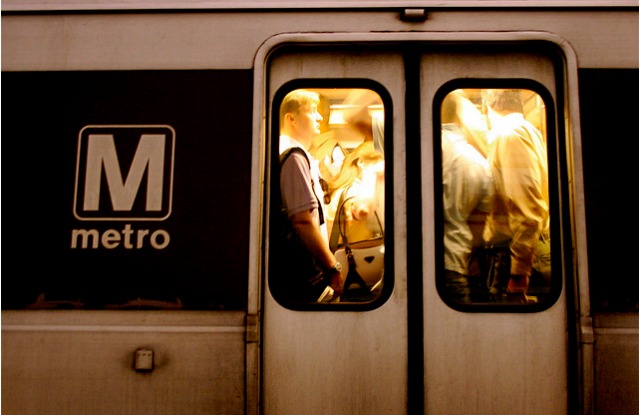 Photo by Samer Farha
Commuting on Metro isn’t just a matter of sitting or standing until you get to your destination. It can be so much more than that—an urban adventure requiring street smarts, a sharp eye, fast feet, and plenty of dexterity. Experienced commuters have mastered any numbers of moves to make their trips as quick and efficient as possible, while newbies walk slowly, wait patiently and otherwise seem to have no clue what this public transit thing is. Below we catalgue some of the vital moves and abilities that every Metro rider needs to master—and soon.
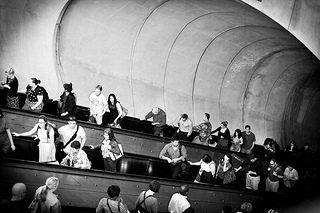 Photo by thisisbossi
The Escalator Escape: Sometimes you find yourself stuck on the right side of an escalator, slowly making your way out of a station while left-side walkers confidently zip past you. At most hours and at many stations, it’s an easy step to the left and you’re on your way. But not doing rush hour, and certainly not at the system’s busiest stations. Escaping the confines of the right side takes speed, precision, confidence, and excellent peripheral vision. You need to wait for just the right gap in walkers to make the transition; time it wrong, and the person dutifully coming up the escalator behind you has to stop and wait. It also takes a single fluid step that is both to the left and forward; once you hit that left side, you want to be in full stride. If performed well, it’s a beautiful sight to behold. If mangled, well, it’s a domino effect that would rightfully leave any commuter grumbling.
Train Tetris: There’s nothing more dispiriting than seeing a Metro train that’s packed to the gills pull up in front of you. You’re going to have to wait for the next one. Or are you? Experienced Metro riders know to look out for that last available space that invariably remains right by the door—and squeeze into it. We don’t have Japanese-style pushers packing people into trains by force, so this takes a quick eye and a confident move. You have to be willing to give up some of your personal space to make this one work, and yes, you’ll likely have to deal with irate riders who wonder why you had to be the guy (or girl) to wedge yourself into that last available spot. But when it works, well, you get home more quickly.
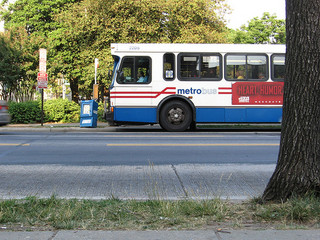 Photo by treevis
Bus Bolt: We’ve all been walking towards a bus stop and looked just down the road, seeing the very bus we want to catch barreling towards the very stop we’re heading for. You’re not missing this bus; oh no, you’re not missing this bus. The Bus Bolt isn’t about sheer speed though—you’ve got to be keenly aware of your surroundings, judging exactly when to dodge other pedestrians and clear an intersection without putting yourself in danger. Once you’re making that final dash for the bus, you also have to loudly proclaim your presence to the driver so he doesn’t just pull away. Wave your arms, scream, whatever it takes—just don’t let him pull away. The downside to the Bus Bolt is that if it fails, you look like a dumbass to everyone else around you.
Speedy SmarTripper: You used to be able to go pretty far into the red on your SmarTrip card, but recently Metro has limited how negative your balance can go. That means that you may eventually enter a station with no money left on your card—and only a minute before your train arrives. Most tourists and amateurs will spend at minimum five minutes trying to figure out how to put more money on their SmarTrip card; you, being the experienced commuter that you are, have got the practice down to a science. The quick swipe of the card, the rapid punches of the buttons, the smooth inserting (and removing) of your credit card—it’s all done in 30 seconds, just in time to get on the train.
Metro Muscles: There’s one point on every train car that is essentially a blackhole for places to grab on. You’re not close enough to the vertical poles near the doors, the railings on the ceiling are out of reach and you can’t hold on to a seat. To avoid awkwardly stumbling into riders around you, you’re forced to stand with a wide stance, allowing your body to both go with and fight the natural back-and-forth movements of trains and buses. If you pull it off, it’s a hell of a core workout. If you don’t, you’ll sheepishly have to pull yourself off of commuters around you.
Reading on the Rails: A corollary to Metro Muscles, reading while standing on a bus takes a certain amount of balance and concentration. Sure, things have gotten easier with Kindles, smart phones and tabloid newspapers, but there are experts out there that can still fold their full-size copy of the Washington Post into as compact a package as possible that they can hold it in one hand while holding on with the other. The real newspaper ninjas fold it in such a way that they can flip it over and have another article ready to read.
Entrance/Exit Expert: You’ve somewhat reached the pinnacle of commuting expertise when you exit a train—no matter which direction its going—and instinctively know where the station exit it. No looking around, no staring at signs in stations with multiple exits—you subconsciously steer yourself to where you need to go. The same applies for entering a station; you know which side of the platform to use without even thinking twice about it.