Martin Austermuhle
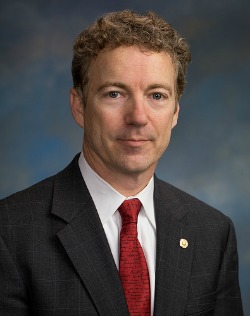 Sen. Rand Paul (R-Ky.)
Sen. Rand Paul (R-Ky.) walked into hostile territory this morning, so to speak, delivering a speech at Howard University about how the Republican Party really was friendly to the needs and desires of minority voters.
Despite a few gaffes—he did lecture an audience that knew plenty about black history on black history—the speech wasn’t bad; Paul strongly argued that he was in favor of doing away with the worst of the drug war, for one, which disproportionately affects young black men. He also indicated that school choice—charters and the such—gave low-income residents a chance at escaping dismal urban public schools, an issue that has obvious relevance in D.C.
Where Paul fell short, though, was on D.C. autonomy.
Let’s rewind: it was last year that the Kentucky senator added three amendments to a bill that would have granted D.C. budget autonomy. One amendment would have allow residents to carry concealed weapons, one would have formalized the prohibition on the use of local funds for abortions and a third would have prohibited discrimination for jobs based on membership in a union. Needless to say, the bill quietly died thereafter.
After today’s speech, Joshua Matfess, a D.C. Vote volunteer from American University, asked a relevant question: how did these three amendments gel with Paul’s insistence that the Republican Party is all about letting people govern themselves?
Paul started by claiming that his amendments weren’t meant to kill the bill. “I didn’t kill any D.C. autonomy bill,” he claimed. “They could have had a vote at any time, I had no power to stop any legislation. I’m in the minority, and I put on amendments that they did not want to vote on. So they perceived that as killing the bill, but my intention was to get votes on some amendments.”
Sure, but Paul knew then and knows now that he’d probably have gotten the votes for the amendments (with conservative Democrats siding with him), therefore making the bill unpalatable enough to enough senators that it wouldn’t beat a filibuster. This happened before, when Sen. John Ensign (R-Nev.) added a gun amendment to a bill that would have given D.C. a voting seat in the House, effectively weighing down the bill and eventually killing it.
On D.C. autonomy more broadly, Paul said: “I’m of two minds. Do I think maybe D.C. could have more autonomy? Maybe. But I also know that the Constitution puts D.C. under Congress’ purview, and that we give D.C. money from the rest of the country, from the tax receipts. So I think that oversight on the money that we spend, it is incumbent, it’s a responsibility of the Constitution, that we have oversight of the money that we spend from the U.S. Treasury in D.C.”
You know, we don’t actually disagree with this. The federal government does put money into D.C., much like it puts money into many states. President Obama’s budget, released today, include $15 million for security expenses related to the federal government, as well as money for vouchers and the city’s pension fund. But according to this list, Kentucky gets its fair share of federal tax largesse; it’s sixth in the nation, in fact.
But Paul seems to forget that the federal payment to D.C. was ended years ago, and that a good chunk of the city’s budget is now raised locally. That’s what D.C. has said it wants to control—its own money, which is now awkwardly tied up in the federal budgeting process that forces D.C. to submit its spending plan to Congress only to have its money appropriated right back.
Finally, the issue of what the Constitution says. Yes, D.C. is under Congress’ purview. We’re not going to quibble with that. But for a Tea Partier like Paul, he should know that the principle of local rule should stand above the mere fact that he can legislate for us if he chooses. He might not like abortion, but does that mean that D.C. residents can’t think it’s something they should be able to spend money on? And he might love an unencumbered Second Amendment, but it’s odd for a small government partisan to assume that everyone in D.C. wants to carry guns everywhere they go. He hasn’t even asked, unless he’s been calling around and hasn’t gotten to DCist HQ yet.
Paul may have gotten some credit for speaking so candidly to a skeptical audience, but he’s still got a ways to go to understand why D.C. might be a little peeved.