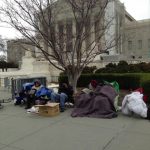
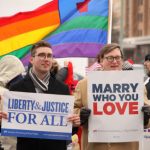
A massive crowd lining both sides of First Street NE erupted into cheers, applause, and hugging when the U.S. Supreme Court issued its rulings in two landmark cases that advance the cause of same-sex marriage. On a sweltering, D.C. summer morning, few seemed to mind that they were drenched in sweat while waiting out verdicts that bring gay Americans closer to full equality under the law.
The first case, U.S. v. Windsor, struck down a part of the Defense of Marriage Act, or DOMA, a 1996 law that prohibited married same-sex couples from receiving federal benefits extended to spouses. The Justice Department said in 2011 that it would no longer defend the law, leaving it to be defended by a private attorney hired by the U.S. House of Representatives.
Section 3 of DOMA, which blocks same-sex couples from enjoying full federal benefits, was struck down in 5-4 decision written by Justice Anthony M. Kennedy. “The federal statute is invalid, for no legitimate purpose overcomes the purpose and effect to disparage and injure those whom the State, by its marriage laws, sought to protect in personhood and dignity,” Kennedy wrote. (The ruling does not affect Section 2 of DOMA, which allows states where same-sex marriage is not legalized to not recognize same-sex couples wedded where it is legal.)
“Marriage is in the purview of the states,” said Jimmy LaSalvia, a conservative strategist and a co-founder of GOProud, a political organization of gay Republicans. “The Supreme Court affirmed that.”
Moreover, La Salvia, pointed to the distinctively personal reach of the Windsor decision. “Very, very few times in our history has the Supreme Court decided issues that affect so many people in such a personal way,” he said at the footsteps of the Supreme Court’s sweeping marble plaza.
“This was discrimination enshrined in law,” President Obama said in a statement released by the White House shortly after the ruling. “It treated loving, committed gay and lesbian couples as a separate and lesser class of people. The Supreme Court has righted that wrong, and our country is better off for it.”
Obama added that he will order his cabinet to begin reviewing federal statutes to bring the government in compliance with the court’s decision
A second wave of applause cascaded over the crowd when the court issued its ruling in Hollingsworth v. Perry, effectively voiding California Proposition 8, a voter referendum passed in 2008 that stopped the issuance of same-sex marriage licenses in that state. In another 5-4 decision, Chief Justice John G. Roberts wrote that the law’s defenders did not have proper standing to appeal a lower court’s previous verdict striking it down, effectively nullifying Proposition 8 for good. With the ruling, California is cleared to join 12 states and the District of Columbia in offering full marriage equality.
The first speakers to a cluster of microphones, though, were conservative religious activists who decried the rulings. “The Supreme Court has no authority when it comes to marriage,” the Rev. Rob Schenck of the Evangelical Church Alliance said to a cluster of sweat-dripping reporters.
Jennifer Kerns, who had been a spokeswoman for the Proposition 8 campaign in 2008, followed Schenck, saying she represented “seven million voters to express our disappointment.”
But for the most part, the statements by the opponents of same-sex marriage were drowned out by choruses of cheers, especially when the plaintiffs in Hollingsworth v. Perry emerged from the Supreme Court’s entrance. “It’s a wonderful day for America,” said David Boies, the attorney who represented Kris Perry and Sandy Stier, one of the couples who filed the original lawsuit against Proposition 8.
“Now we will be married and be equal to every other family in California,” Perry said, standing next to Stier, her partner of 16 years.
Chad Griffin, the president of the Human Rights Campaign, noted the legal timeline that led to the downfall of Proposition 8 and what the renewed legalization of same-sex marriage in the nation’s largest state might portend for the rest of the United States.
“It took less than five years to strike down Proposition 8,” Griffin said. “Within five years, we will bring marriage equality to all 50 states. Today, American values have prevailed.”
Griffin acknowledged he was setting a lofty goal. With Californians of all orientations once again allowed to marry, there are still 37 states where same-sex marriage is not permitted. “Tomorrow is a new day, but the sun will still rise on an uneven country,” he said.
After the celebratory press conference, the Griffin, Perry, Stier, and the other plaintiffs proceeded to MSNBC’s island for a live interview. But the segment was quickly interrupted when they Griffin’s phone received a call from an unknown phone number. It was Obama, calling from Air Force One en route to Senegal. “We’re proud of you guys, and we’re proud to have this in California,” Obama said during the call, which aired on television.
Still, the end of the press conference was marked by perhaps the day’s sunniest moment when another plaintiff in Hollingsworth, Paul Katami, proposed to his partner of 15 years, Jeff Zarrillo. “Today I get to look at the man I love and say, ‘Will you marry me?’,” Katami said.
More applause.