 Photo by Benjamin R. Freed
Three-dimensional printing is the next wave in small-batch innovation, right? But even as the technology becomes increasingly common, we’re still a long way off from everyone’s house looking like a photo spread in Wired, with a $2,800 MakerBot Replicator 2 in every home office and a printing press in every garage.
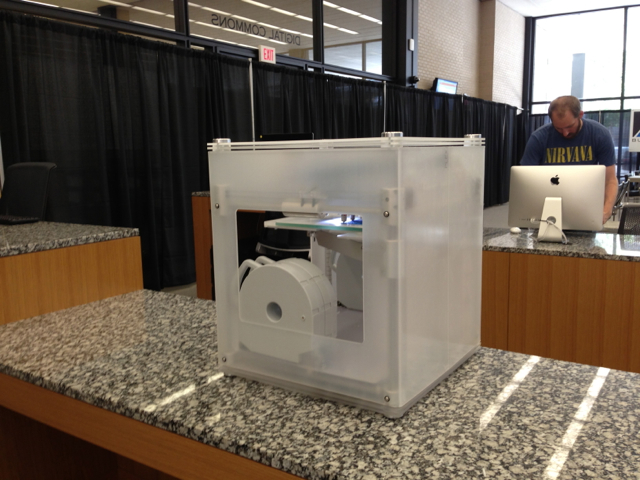
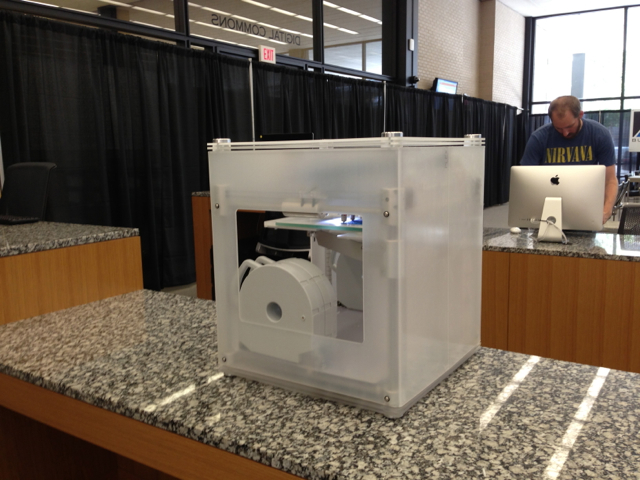
But those devices are now available to members of the D.C. Public Library system, which today is opening the Digital Commons at the Martin Luther King Jr. Memorial Library. The new facility, in a renovated 11,000-square foot section of the library’s ground floor, contains a 3-D printer, an Espresso Book Machine that churns out tomes on-demand, an array of tablet devices, rows of computer terminals, and several meeting spaces outfitted with some of the newest productivity technology.
“We’re changing as the world is changing,” Ginnie Cooper, D.C.’s outgoing chief librarian, says during a tour of the space. Cooper and Nick Kerelchuck, who manages the first floor of the MLK Library, start with the 3-D printer, which they’ve already used to churn out several toys and tools made from plastic filament according to user-generated computer designs.
Cooper and Kerelchuck show off a few sample prints, including a miniature Washington Monument and a bust of George Washington, and more practical items, such as a thick screw and a sliding wrench. While the latter two have all the heft and feel of a cheap toy a child would choke on, Kerelchuck says they are actually quite dense and able to withstand great amounts of pressure. The 3-D printer might also be used to construct spare appliance parts, prototype models, and other tools. For some, the library could become the new hardware store.
“We know this is an area for tech entrepreneurs,” Cooper says. “It fits well with the library’s mission. We’re the place where people find the next new thing.”
The Digital Commons includes a row of iMacs set up with design software—AutoCAD is a popular title—that send users’ designs to the 3-D printer. But don’t come in expecting to print just anything. The printer itself will be operated by the library’s staff, so, yes, they’ll spot anyone who wants to render a weapon. (Meanwhile, the D.C. Council has legislation that would ban such functions.)
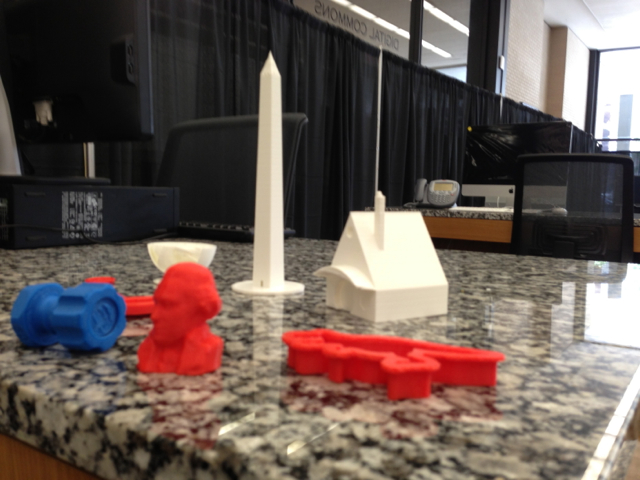 Creations of the D.C. Public Library’s 3-D printer. (Photo by Benjamin R. Freed)
And just as it charges per page for print-outs and photocopies, the 3-D printing services will charge per ounce of plastic material. Products take a few hours to harden, depending on their height and density. (A dinosaur-shaped cookie cutter took about an hour to set, Kerelchuck says; the Washington Monument replica needed about four hours.) At five cents an ounce, people can come in, submit their designs, and browse the library while their creations congeal.
Next to the 3-D printer is a countertop full of tablet computers and ebook readers, devices on which DCPL finds an increasing percentage of its membership. Every major brand is represented—Apple, Samsung, Amazon, Barnes & Noble, Microsoft—in what Cooper bills as something of a test counter. More and more, library members are loaning volumes on their devices rather using software like Overdrive for books or Zinio for periodicals. (Cooper says over 5,000 library members are using Zinio for public magazine subscriptions; the most popular title is The Economist.)
In fact, Cooper says that if digital loans were counted as a separate unit, they would make up the second-biggest branch in the entire library system. That figure should only be bolstered by the installation of 76 general-use computer terminals, 60 Windows machines and 16 iMacs. While Cooper says many flock to the library’s computers because it is their best option to conduct important personal business, such as applying for jobs or corresponding with distant friends and family, it extends the library’s primary mission.
“The more you use the library digitally, the more you come in,” she says.
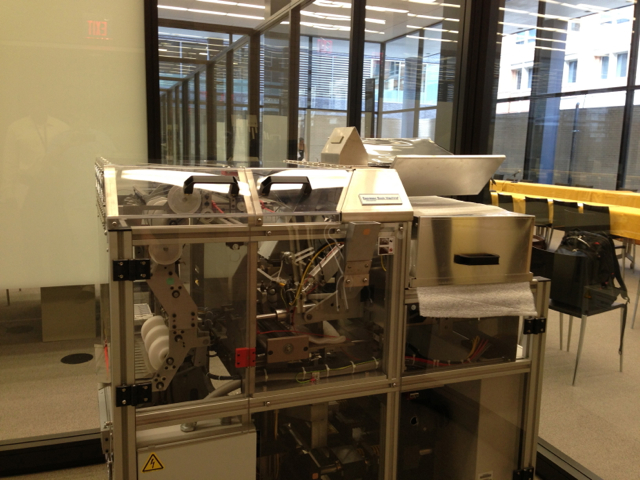 Espresso Book Machine. (Photo by Benjamin R. Freed)
Then there is the Espresso Book Machine. Printing books or magazines is not an inexpensive venture, but for the hopeful self-publisher, or someone desperate to obtain a tactile version of an out-of-print volume (sorry, Dream City won’t enter the public domain for many more decades), this small press is an affordable solution. Cooper envisions school classes printing books of essays, people compiling family recipe books, or just aspiring authors yearning to see themselves in print.
George Williams, a D.C. Public Library spokesman, says the project cost $3.4 million to build out. Cooper says the biggest expense wasn’t any of the new devices, but actually trenching out the floor to install hundreds of new electrical outlets. The Digital Commons is housed on the western end of the first floor, which formerly held the library’s science and technology collection. (It has been moved upstairs.)
The Digital Commons’ other major component is what DCPL calls the “Dream Lab.” About one-third of the space is carved up into meeting spaces and cubicles outfitted with various devices for collaborative work. Cooper is expecting to attract a long list of startup companies and community organizations that might not have permanent offices of their own, but still need resources like wireless Internet access, DVD players, visual projectors, and Smart Boards, interactive whiteboards that feature speakers, projectors, and, niftiest of all, styluses that leave trails of digital ink the way one would use a dry-erase marker on an analog board.
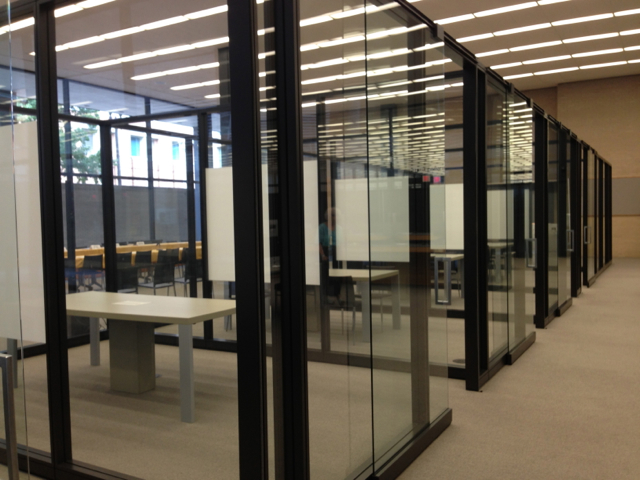 Dream Lab. (Photo by Benjamin R. Freed)
Organizations that join the Dream Lab are also expected to give back, and the several dozen companies that call the startup “accelerator” 1776 their home base are on board. All the library asks in return is that Dream Lab members give back by offering at least one hour per month of public classes about information technology or digital literacy.
“This is MLK,” Cooper says. “He has a dream, you have a dream, I have a dream. This is where we make it happen.”