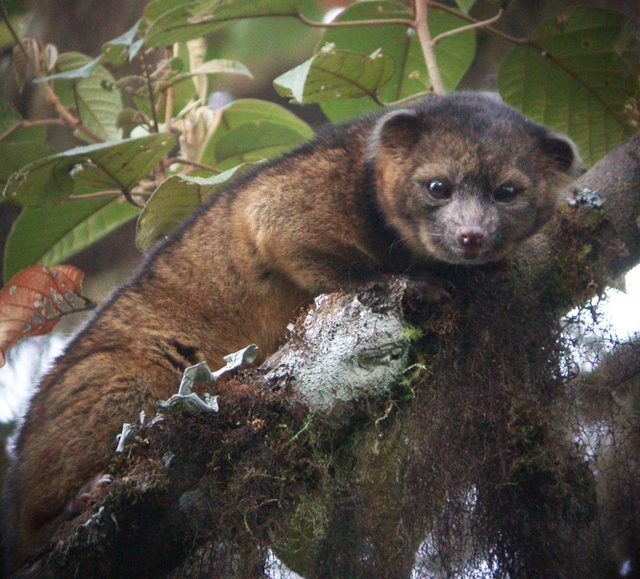
The Smithsonian Institute today announced the discovery of a new mammal species. World, meet the olinguito.
In a live-streamed press conference this morning, Smithsonian secretary G. Wayne Clough introduced Dr. Kristofer Helgen—curator of mammals at the Smithsonian National Museum of Natural History and the chief scientist behind the discover of the olinguito—who explained the bizarre events that led to the discovery of the unusual animal. Turns out, the olinguito has been right under our noses for years, but no one thought to take a closer look.
A “victim of mistaken identity for more than 100 years,” according to a press release from the Smithsonian, the olinguito has eluded scientists because it bears such close resemblance to the olingo—a small procyonid that dwells in Central and South American rainforests. It wasn’t until Helgen started to study olingos more closely that he soon realized that some of the olingo specimen he found in museum cabinets had some distinctly different qualities than others. What began as a closer look turned into a 10-year study concluding that there is indeed an entirely different, undiscovered species of mammals that have been classified under the guise of the olingo for decades.
Described by Helgen as a “cross between a teddy bear and a house cat” (awwww), the olinguito mostly lives in “in a cloud forest on the western slopes of the Andes.” Through years of field research, Helgen and his team have uncovered quite a bit about the animal: Though technically carnivores, the olinguito eats mostly fruits; it’s a canopy dweller; and it’s about two-and-half feet long and weights around two pounds. They even discovered several subspecies of olinguito, Helgen says: “We uncovered four different kinds of subspecies. We’re not only naming a new species today, but four different subspecies.” And perhaps the most promising news of the discovery: “The species itself we’re not classifying as an endangered species.” Mostly because so many of them have existed for so long under the misidentification as olingos.
Today’s announcement marks the first time in 35 years that a new carnivore species has been discovered in the American continents. Way to go, science!
Update: And here’s what the olinguito looks like wearing a tiny jacket. Way to go, Internet!
ok igor ok then RT @igorbobic: Call me when that Olinguito’s wearing a tiny jacket http://t.co/fyeWU2PJGX
— snoopdarth lion™ (@darth) August 15, 2013