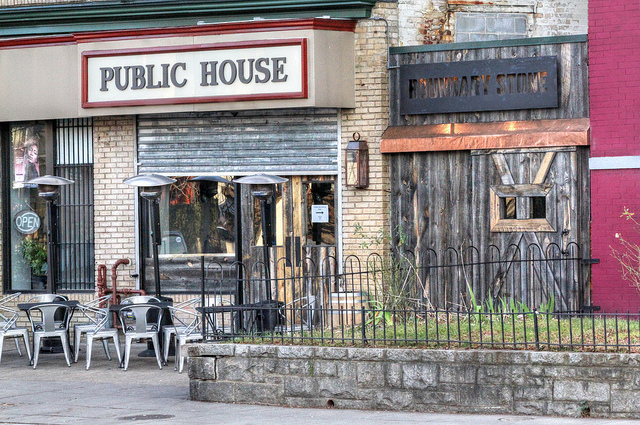
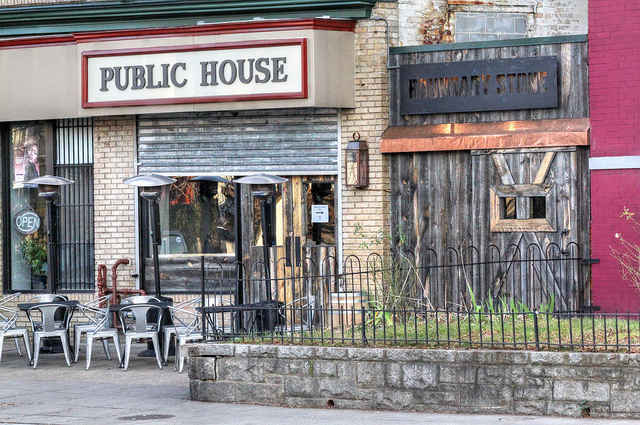
 Photo by Ronnie R.
Boundary Stone—the popular Bloomingdale public house—found itself at the center of a some serious Twitter hate yesterday. After posting a tweet urging followers to sign the Restaurant Association of Metropolitan Washington’s petition to defeat the D.C. Council’s tipped minimum wage bill, supporters of the move lambasted Boundary Stone on Twitter, causing something of an Internet shit storm, with someone even starting a petition to get the eatery to apologize and stop opposing the bill.
The petition, which was started by RAMW, urges the D.C. Council to scrap their proposal to increase the minimum wage for tipped employees to $8.25 an hour. The current minimum wage for tipped employees is $2.77 an hour. According to the petition, the RAMW, which has over 850 members in the D.C. area, feels that the current system doesn’t need to be fixed. From the petition:
We have witnessed a spectacular growth in employment in the restaurant industry and sales taxes paid by hospitality businesses have skyrocketed. Our workers, especially our tipped workers, are very well compensated. We know of no tipped restaurant workers who earn less than the current overall minimum wage of $8.25 an hour. Restaurant employers pay their tipped employees $2.77 per hour as base minimum wage and then employees earn tips. The average hourly wage for tipped workers nationally is $16 to $22 per hour, and is higher in the District. On the very rare occasion that a tipped employee does not make enough tips in a work week to equal $8.25 per hour, the employer pays the employee to make up the difference.
The blowback on Twitter from Boundary Stone’s tweet cuts to the center of what the restaurant industry sees as a lot of misinformation about the bill: Restaurants are already required to pay their employees the minimum wage of $8.25 an hour. If a tipped employee’s weekly salary, that is $2.77 an hour before tips, does not average out to $8.25 an hour, restaurants and bar owners are legally required to pay the difference to make it so. However, Gareth Croke, Boundary Stone’s owner, writes in a Facebook post that they’ve never had to do that and, after tips, most employees are earning well over the $8.25 an hour minimum.
The problem RAMW, Boundary Stone, and hundreds of other businesses see with the bill is that, if they are required to pay a minimum base salary of $8.25 instead of $2.77 before tips, that could have a detrimental financial impact for a given restaurant or bar’s future.
In the apology Croke posted on Facebook in relation to the tweet he fired off (the tweet has since been deleted), he says “we do not stand in opposition to a bill for fair wages; we want all workers to be treated fairly and earn a wage which gives everyone a quality of life.”
Kyle Rees, a spokesperson for RAMW, emphasized to DCist that they are in no way opposed to an overall minimum wage increase in the District, just that the language surrounding an increase for tipped employees would do more harm than good for local restaurants and bars.
Proponents of raising the tipped minimum wage, however, say that the “tipped credit” system is “rarely enforced.”
As former Council candidate Elissa Silverman of the D.C. Fiscal Policy Institute wrote:
Raising the minimum wage for tipped workers, along with other workers, is important for several reasons. Some servers work in low-price establishments where tips can be very low. Restaurant business can vary from week to week or shift to shift, so that a worker relying mainly on tips could face very uneven income despite having the same bills to pay every month. And freezing the tipped worker minimum wage for a long period of time means that the balance of who pays servers changes over time from owners to patrons. Most of us who eat at restaurants would like to think that tips are adding to our server’s wages, not filling in for low and stagnant pay.