 Photo by Sarah Anne Hughes.
As members of a homeless-led advocacy group protested outside a Ward 7 middle school, Mayor Vincent Gray announced initiatives to place people in homes and create more housing during his State of the District address.
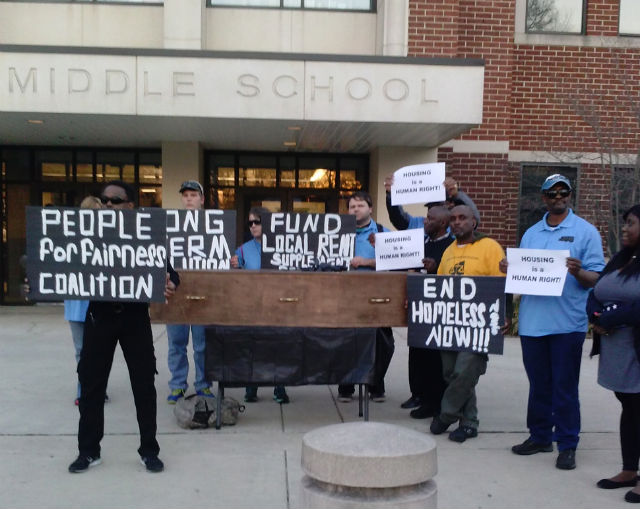
Members of the People for Fairness Coalition began their demonstration with a funeral march, carrying an empty, black coffin to represent those who have died on the streets during Gray’s term.
“We trying to send a message to the mayor and the people running for the mayor’s office that we need low-income, affordable housing,” member John McDermott said. “We also want to send a message: Housing is a human right.”
McDermott said he’s been frustrated with the response from the city and the Department of Human Services to what he says is a worsening problem. “If you fund housing first — housing first is the greatest program in the city right now. I’m in housing first,” he said. “If it wasn’t for housing first … I would have died.”
While Gray delivered the address, messages authored by the Fair Budget Coalition were projected on an exterior wall of Kelly Miller Middle School. “Tonight we ask you, Mr. Mayor, to acknowledge that there is a homelessness crisis in D.C.” one slide read, while many others quoted statistics: “As of February 1st, there were 2,547 students in DCPC confirmed to be homeless.” “Homeless adults have an average life expectancy of 64 years.” “There are approximately 70,000 households on the wait list for affordable housing. The average wait to obtain a voucher is 20 years.”
Inside, Gray took additional steps to rectify this, announcing another $100 million commitment in affordable housing, mainly for the Housing Production Trust Fund, but also for Councilmember Anita Bonds’ property-tax relief bill for seniors. The mayor also highlighted the work of Veterans NOW, an effort by local agencies and groups to end veteran homelessness by 2015 that has thus far been a success.
“When it comes to combating homelessness, talk is cheap. Actions matter,” Gray said. “On my watch, spending on homeless services has increased by 41 percent and local funding for permanent supportive housing has increased by 127 percent. We now spend more than $120 million a year to help people who are homeless. But we need to do more — and not by throwing more money at the problem.”
To combat the dramatic spike in family homelessness, Gray announced the launch of the “500 Families, 100 Days” campaign, a city collaboration with the Community Partnership for the Prevention of Homelessness and the Transitional Housing Corporation. Between now and June, the campaign “will identify and lease at least 500 apartments for homeless families using either Rapid Re-Housing or Permanent Supportive Housing vouchers.”
Landlords able to contribute units to the campaign are asked to email housethehomeless@dc.gov.
Another part of this plan is the “One Congregation, One Family” program, which asks “each house of worship in the District — every church, synagogue, and mosque — to take on one family and provide emotional, social, and spiritual support to help them succeed in getting on their feet.”
“This model is based on the belief that it takes a village not only to raise a child, but even more so to support a struggling family,” Gray said. “By partnering with the faith-based community, we can engage the tremendous healing power of faith. By bringing to the table all the different resources needed to tackle this thorny problem — government, community-based organizations, the private sector, and the faith community — we can get this done.”