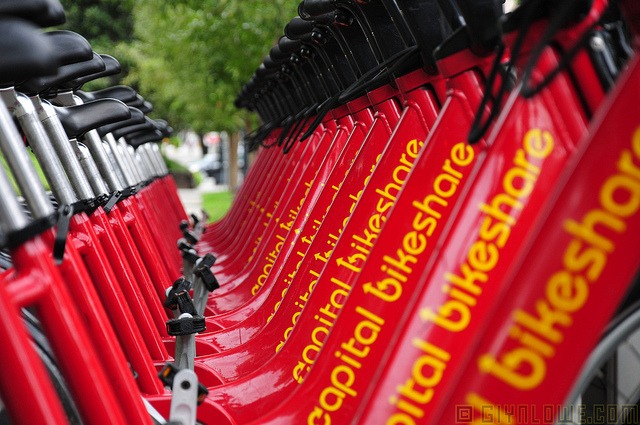
 Photo by Glyn Lowe Photos
Since 2008, Capital Bikeshare has rapidly expanded, from just ten bikeshare stations to hundreds around the D.C. area, including the Maryland suburbs and Northern Virginia.
It’s no secret that Capital Bikeshare has changed the way Washingtonians commute around the D.C. area, but just how much of an impact has it made? CityLab has a cool article that makes a compelling case that bikeshare serves as public transit. In it, contributing writer Eric Jaffe pulls date from a soon-to-be-released study conducted by Berkeley researchers Elliot Martin and Susan Shaheen, in which they take a “close geographic look at the changes in commute modes made by bike-share members in the two test cities.” One of those cities, of course, is D.C., while the other test city is Minneapolis.
Of the more than 4,800 Capital Bikeshare members surveyed in D.C. for the study, 47 percent said that Bikeshare has decreased their use of the Metro, which “suggests that in a city like D.C., bike-share acts as a substitute for short rail trips—no doubt relieving crowded subway cars in the process.”
Moreover, 39 percent said it decreased how often they take the bus—whether it be Metrobus or Circulator, which also suggests that “bike-share trips [are] quicker than short bus rides.”
The main takeaway from the study is that dense urban cities should embrace Bikesharing systems as a way to explore new commuting options in place of old ones. From CityLab:
Overall, the maps suggest that bike-share, at least in Minneapolis and Washington, is making the entire multimodal transit network more efficient. For short trips in dense settings, bike-share just makes more sense than waiting for the subway—it’s “substitutive of public transit,” in the words of Martin and Shaheen. For longer trips from the outskirts, bike-share access might act as a nudge out of a car—it’s “complementary to public transit.”
Martin and Shaheen, in their study, conclude that bikesharing, at least in cities like D.C. and Minneapolis, “appears to be improving urban mobility and lowering dependency on automobile travel.”
Please, nobody tell Courtland Milloy.