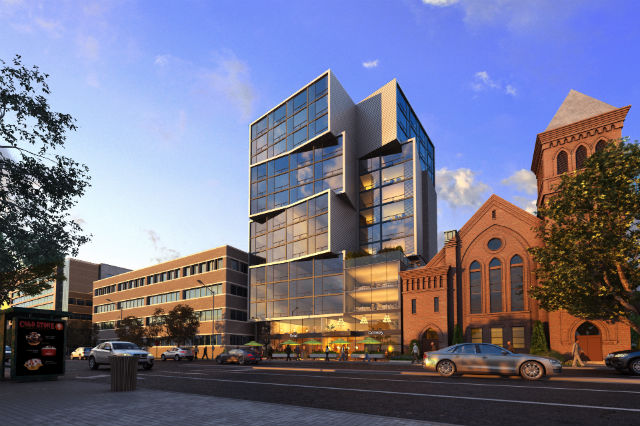
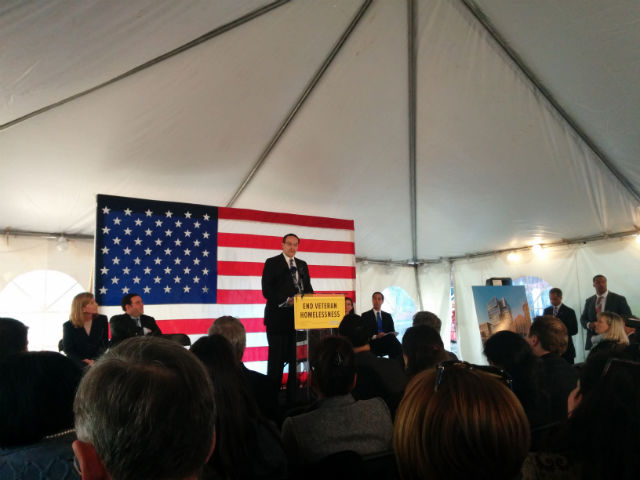
 Photo by Sarah Anne Hughes.
Mayor Vincent Gray, Housing and Urban Development Secretary Julián Castro and private partners gathered today at the future site of a 124-unit building in NoMa that will house homeless veterans.
The $33 million needed to build the John and Jill Ker Conway Residence was provided through ten private and public sources, including $17 million in subsidies from the D.C. Housing Authority. Other partners included McCormack Baron Salazar, Chase Community Development Banking, A Wider Circle and HUD.
Rosanne Haggerty, president of Community Solutions — a non-profit that helps communities create permanent supportive housing and co-developed this project — said both the “glory and the challenge” of the project was the multiple sources of funding that needed to come together. “It’s fantastic that so many different entities pulled together and contributed what they had, but that’s also the challenge,” she said. But now that the pieces are in place, the model can be used again.
“Not only will this transform lives of people who are homeless, but this will save the local and federal government a fortune,” she said.
“We hope … that this will be the first of many types of these projects,” said Richard Baron, CEO of McCormack Baron Salazar, a co-developer of the building. “This should be a beginning and not an end.”
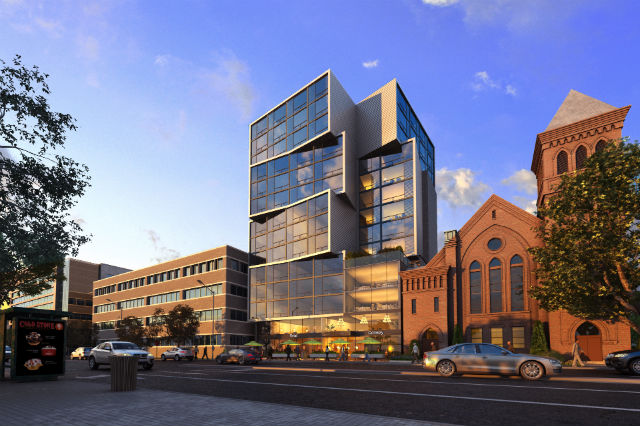 Courtesy of Sorg Architects.
As of the last point-in-time count, there were 408 homeless veterans in D.C., a number that has been steadily decreasing over the past few years. The groundbreaking at 1005 North Capitol Street NE took place on the Monday before Veterans Day, a fact not lost on those who spoke.
Mayor Vincent Gray said that, while America is “proud nation,” “We can’t be proud when we have people who go out and serve our nation … come back to a situation in which they have no job or in which they have no place to live.”
“There is more to be done, and this is such a worthy project,” Gray said of the city’s affordable housing investments. The mayor said the project should be studied to show “how to make a bureaucracy work for people with great needs.”
Adrianne Todman, executive director of the D.C. Housing Authority, said the “emphasis on place-based services,” as opposed to scattered sites, is what makes the Ker Conway Residence a real model. “This is one of the few times when the services and the veterans will all be in the same building,” she said. “I’m hopeful that this is something we’ll replicate,” adding that when veterans have peer support they can be more successful.
Sixty of the units will be reserved for permanent supportive housing for homeless veterans, while 47 units will be “prioritized” for households making no more than 60 percent of the Area Media Income ($45,120 for an individual in 2013) and 17 for households making no more than 30 percent of the AMI. Construction is expected to be completed in December 2015.
The building’s proximity to the Capitol — one mile away and visible from the front — was also mentioned by several speakers.
“The reason [this project] could happen again is because the [Veterans Affairs Supportive Housing] program, the voucher program helping to support this, it’s one of the few programs with bipartisan support in the Congress,” Todman said. “You can do this over and over and over again as long as the men and women down the street send some stuff down this street.”