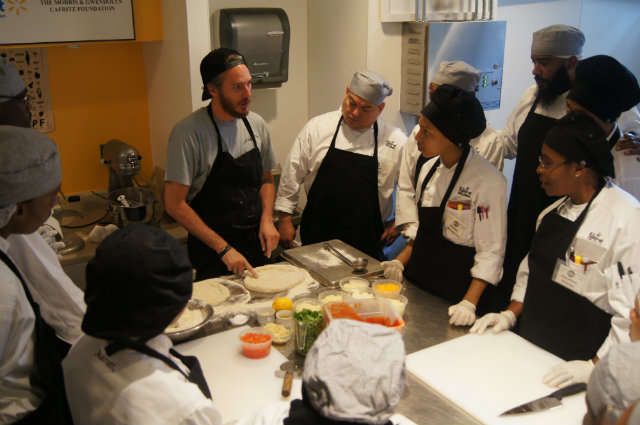
 Photo via DC Central Kitchen.
The first thing Larry Pittman wanted to do when he got out of prison was to win his family’s respect back.
Pittman had been in the system—primarily at D.C. Jail—for most of his adult life. He served 33-and-a-half years, during which he worked hard to turn his life around. At 61, he is a prime example of how, under the right circumstances, the prison system can actually rehabilitate inmates and inspire them to change.
“It was a wake-up call for me and I had the chance to get things that I wanted to do—like finish school, go to college—done,” he says. “I had the opportunity to do [those things].”
But life outside of prison, he realized, wasn’t easy. He found a job working at The New York Avenue Presbyterian Church in downtown D.C., but it didn’t last long. He had a setback that cost him his job: his parole officer cited him for drinking a beer on his 58th birthday and he was sent back to D.C. Jail for two-and-a-half months. That stint in jail also cost him his home.
When he got out for a second time, he was staying with some friends when he found a job working for Bread for the City. It wasn’t the most glamorous job—he was working in the clothing room—but it was a steady paycheck that put food on the table.
A few months later, while at work, Pittman bumped into a cousin who had just gotten out of prison. He was headed to sign up for the Culinary Job Training program that DC Central Kitchen offers.
“I said, ‘man, I think I’ll try that,’” he recalls after that encounter with his cousin. “That same week I went down and got the paperwork and filled it out, and turned it back it … from there, there was no looking back.”
He graduated from the program late last year and was hired by DC Central Kitchen in February as a staff member for its Fresh Start Catering program. He’s one of more than 1,500 graduates of the program, which will hit a major milestone today when its 100th class graduates at the Ronald Reagan Building and International Trade Center. Mayor Muriel Bowser is among those scheduled to attend.
 Photo via Flickr user Booz Allen Hamilton.
The story of DC Central Kitchen has been told many times over—there have been at least two books written about it (one by its founder), and countless articles over the years about its business plan, economic structure, numerous programs, and impact on the city. But today’s milestone warrants one more history lesson.
The Kitchen was founded in 1989 by Robert Egger, a nightclub manager who was inspired by his experience volunteering to help feed D.C.’s homeless. The inspiration wasn’t to just keep feeding the needy—that much was apparent—but to create an organization that better served the District’s homeless population.
“At that time, charity was really seen as a noble effort, but something that was done just to help people get by,” says Michael Curtin, DC Central Kitchen’s chief executive officer. “It was really based on using things that were left over in not terribly creative ways.”
And in that, Egger hatched the idea for DC Central Kitchen—a community service that takes leftover food from local restaurants, caterers, and hotels and recycles it into meals to be distributed to agencies around the city. But it’s flagship program—the culinary job training program—didn’t launch until several months after The Kitchen started, when it scored its first kitchen space in a Florida Avenue Rowhouse. Egger’s idea, born out of his volunteer experience, was to train the people he had helped feed to land jobs so that they could feed and take care of themselves.
Recruiting trainees from homeless shelters and halfway houses, the three-month program was designed to be intense, but manageable: more formal than most job readiness services available, but less of a time commitment than cooking school. Using donated leftover food, students in that first class were learning culinary skills that they’d then put to use preparing meals that would eventually be delivered to some of the same housing programs they came from.
But Egger’s vision, Curtin explains, wasn’t just noble charity. There was a real plan to develop it into an economically sustainable enterprise.
“There wasn’t a vision at the time, or it certainly wasn’t widespread, that nonprofits could actually play a significant role in economic development, and really be part of the economy, instead of just being a cute afterthought in the basement of a church or a shelter,” he says. “So the Kitchen, what we’ve become in the work that we’re doing now—and the breadth of the work that we’re doing now is very staggering—but what’s really, really cool about the Kitchen is that you can go all the way back to that first day, and everything makes sense.”
Today, DC Central Kitchen doesn’t just boast a wildly successful job training program, it has its hand in just about every corner of the city where food and outreach intersect: there’s the meal distribution program, which, in 2014, turned recovered food into 5,000 healthy meals delivered among 80 agencies it partners with in the D.C. area; the Healthy School Food program, which does just that—delivers healthy meals to low-income students; the Healthy Corners program works to address the problem of D.C.’s food deserts by delivering healthy food options to the low-income communities where they’re not available; and about a half-dozen other social enterprise programs that help to rebuild the city’s urban food system.
But just about every aspect of what DC Central Kitchen does stems back to its Culinary Job Training program.
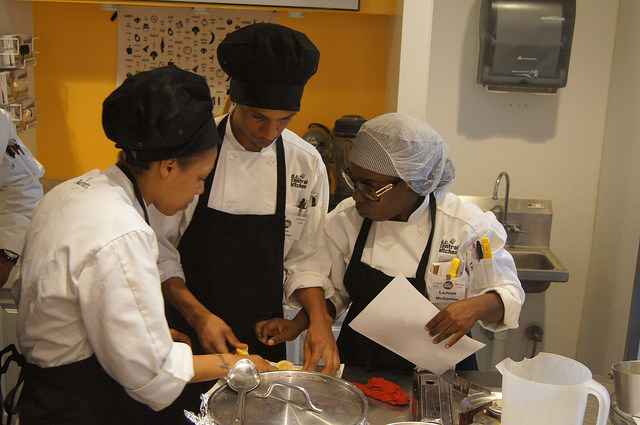 Rosita Musgrave, Adam Muhammed, and LaJuan McGowan prepare their cook-off winning jambalaya. Photo via DC Central Kitchen.
It’s a balmy afternoon in May and the students of Class 100 are hard at work putting the final touches on their dishes. Divided into small teams, the 16 men and women have spent days preparing for today’s jambalaya cook-off. It’s the first chance for them to put the skills they’ve learned to use for an outside audience.
For Adam Muhammed, 29, Rosita Musgrave, 22, and LaJuan McGowan, 29, that meant a kind of unconventional take, but without neglecting the key ingredients that define the classic New Orleans dish—spicy but not overwhelming so, with a variety of unique herbs and garnishes punctuated by lemon zest.
Each team has put their own signature spin on the dish, which is then critiqued by a panel of judges. It’s no ordinary panel—the judges for this cook-off are a who’s who of established, respected area chefs and culinary professionals: Al Tiramisu chef/owner Luigi Diotaiuti; Queen Vic chef/owner Ryan Gordon; Great Taste Personal Chef Service chef/owner Danielle Turner; Michael Sternberg, President and CEO of Sternberg Hospitality; and Peter Smith, Director of Culinary Design and Development for Marriott International.
Muhammed, Musgrave, and McGowan’s recipe, which was the first to be presented to the judges, proved to be their favorite.
“i’m crying of joy,” McGowan says as she fights back tears. It’s the second time she’s done this cook-off. Shortly after participating in her first cook-off, she missed a few classes and was forced to drop out of the program. It crushed her, which is why she came back to finish what she started.
It’s not that uncommon for students to drop out. The program may be short, but it’s intense and, for some students, life gets in the way. But they know that it’ll be worth it, which is why students like McGowan come back when they couldn’t finish the first time.
In 2014, 89 percent of the program’s 89 graduates found jobs after graduating from the program. And since the 2008 recession, the program has a staggeringly impressive 90 percent job placement rate among 600 graduates. DC Central Kitchen itself currently employees 60 graduates from the program with full-time salaries and benefits.
So even though the program may prove to be a trying experience for students—highlighted by hands-on kitchen training by professional chefs, preparation for on-the-job readiness skills, and, most importantly, self-empowerment lessons—they know it’s worth it.
“A couple times I went to my locker and got my things, making them think I was taking a smoke break, but I would keep on going,” Pittman recalls about his time in the program. “And then I said to myself “Aw hell nah. I’ve been giving up too much of my life, I’m not running no more.’”
For most, the program grounds them when everything else in their life is consistently unknown. It gives them hope for their future.
 Photo via DC Central Kitchen.
Yesterday, on the eve of their graduation, José Andrés—who used to be on the Board of Directors for DC Central Kitchen—hosted a special lunch for Class 100 at his Zaytinya restaurant. It was the first time the students got together since breaking off into their internships.
During the last few weeks of the program, each student is placed in an internship, where they not only test out the skills they’ve learned, but more crucially, gain experience working in an actual kitchen. This morning, during a pre-graduation brunch, the students will discuss what they’ve learned from their internships with Curtin, and more broadly, reflect on how they’ve changed as people over the past 14 weeks. But they also get to talk about the future and how they can move forward with their lives from the skills they acquired in the program.
“When the students come back from their internships towards the end of the class cycle, I always meet with them and talk about those experiences, not necessarily from a CEO position, but from a recovering restaurateur position,” Curtin says. “I get what they’re going through and I can speak to some of the frustrations they may have encountered.”
Today’s graduation may be a monumental occasion for the Kitchen—it’ll be attended by Bowser, Tavis Smiley, Andrés, and others—but for Curtin, it’s no more monumental than every previous graduation he’s been to.
He recalls the first graduation he attended, where he watch a student in his 60s graduate with his entire family in attendance. “I’ll never forget: I leaned over to Robert and said ‘Dude, you must be so proud, this is incredible,'” Curtain says. “And he leaned over and goes ‘Bro, this shit never gets old.'”
And even those who have moved on from the program are transported back to that moment of pure joy and pride they experienced when they attend graduations.
“It was a beautiful feeling,” Pittman tears up as he recalls. “Every time I get the chance to go to a graduation, I relive it again. That was beautiful moment. To see my mother see me do something.”