 Photo courtesy of Number 1 Sons’ Facebook page.
By DCist Contributor Bridget Dicosmo
It didn’t take long for my homebrewed kombucha experiment to spiral out of control. This little DIY project began innocently enough. I wanted to save a few bucks on my Whole Foods bill for the tangy fermented tea. And so I ordered the S.C.O.B.Y.—that is, symbiotic colony of bacterial yeast; one of the more adorable acronyms I’ve heard—from Amazon Prime and started brewing.
I was not ready for the commitment, as it turns out. Within a few weeks, I was churning out bottles of kombucha faster than I could drink the stuff (impressive, considering my penchant for downing other fermented beverages). And the darn S.C.O.B.Y. kept replicating itself until I had four of them.
Fortunately, I could cheerfully bag the whole thing, and be grateful that the D.C. area is brimming with options for fans of kombucha, kraut, pickles, kimchi, and other briny goodies. And for those of us with more fortitude for fermenting than I apparently possess, there are also resources for learning to make your own briny goodies.
We have several kombucha breweries in the District now, including Capital Kombucha and Craft Kombucha, selling flavors like mint lime and mango chili that are probably far tastier than my humble efforts.
And No. 1 Sons, a fermented foods producer which sells to nearly two-dozen local farmers markets, earlier this year began brewing kombucha, and it will be on sale later this summer. (And given their track record of making delicious fermented foodstuffs since 2012, they are likely to stick with it longer than I did.)
“Humans have been doing this for centuries and centuries,” says Caitlin Roberts, who runs No. 1 Sons with her brother, Yi Wah. And those centuries of lacto-fermentation have occurred under all sorts of conditions—meaning even the sweltering D.C. temperatures of the past few weeks are unlikely to derail home fermentation efforts. “With the D.C. humidity, in the summer, up your salt,” Roberts suggests, pointing out that most of us lack a cellar or other cool, dark space capable of keeping a pickle barrel comfy.
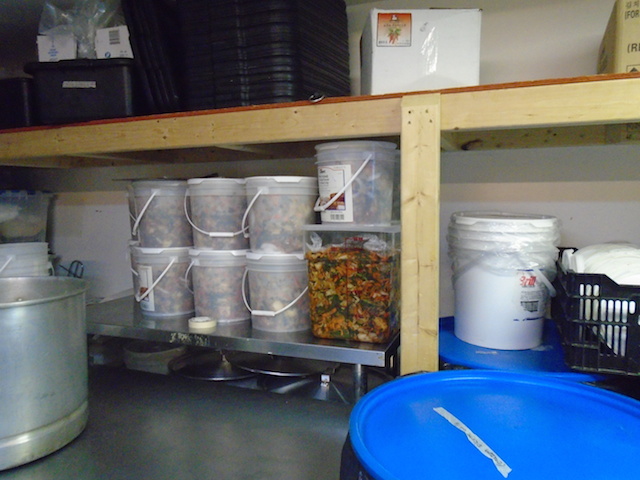 Vats of kimchi and other fermented goodies at No.1 Sons production facility (Bridget Dicosmo).
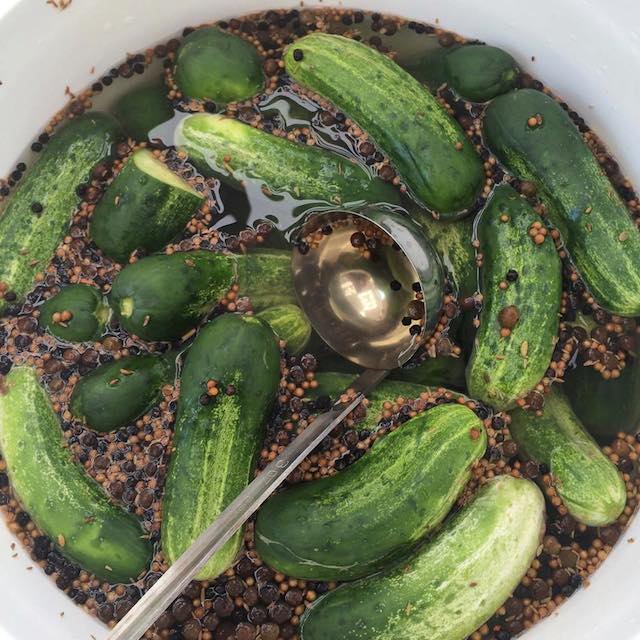
Peek into the barrels at No. 1 Sons’ Arlington production facility and you’ll find nestled under the spiced, briny water a range of fermented specialty products. It could be their hot-sweet Rippin Rose-tido Kraut, District Dills, or Kale-chi—kimchi’s hip younger cousin. No. 1 Sons also carries a range of fermented specialties like the salsa-so-verde (try it on grilled chicken), pickled garlic (my new favorite thing, great for warding off colds), and ginger giardiniera. The products change with what is seasonally available, a major consideration for the company which sources locally as much as possible.
Space limitations for storing an ample supply of seasonal veggies can make that part challenging, Roberts says, but buying locally is also “truly practical for pickling” because less time in transit means “you get the freshest and crunchiest cucumber pickles.”
People across a vast array of time periods, climates, and geographic regions have long taken advantage of the metabolic conversion process that is lacto-fermentation. Kefir, a fermented milk beverage, hails from Eastern Europe; miso, fermented soy, from Southeast Asia; chichi, fermented maize, from South America—to name a few. And let’s not forget that wine, some cheeses, leavened bread, and beer (in short, my favorite food groups) are all fermented foods.
So why is it only in recent years that we’ve seen such a fervor in U.S. cities developing around fermentation? It like there is a bit of mystery surrounding probiotics—the magic little microorganisms that inhabit fermented foods. We’re told eating plenty of probiotics help our gut flora (call them microbial cultures if you want, but I prefer gut flora) flourish.
As Anne Mauney, a Northern Virginia-based registered dietitian, explains, our own, naturally occurring microorganisms help digest food and keep everything running smoothly. They also guard against harmful pathogens and provide some level of detox. When our systems are stressed, we become sick or run down, or are taking antibiotics, our internal microbiomes can get thrown out of whack. This can inhibit nutrient absorption and sometimes cause gastrointestinal distress.
“Historically, most of our probiotics came from one of two sources: dirt or food,” Mauney writes. “But as the world becomes cleaner, antibacterial products boom, diets decrease in quality and food is more likely to be pasteurized, it can be harder to get probiotics naturally.”
Unfortunately, for instance, pasteurization filters out the probiotics in wine, and beer, Mauney points out, while the good bugs in sourdough bread are killed during baking. She recommends eating non-pasteurized fermented foods, such as kefir, yogurt, sauerkraut, kombucha, or buttermilk, at least a few times a week. Or you could always make like Barracks Row’s Café Kimchi (751 8th Street SE) and slip some spicy fermented cabbage into a grilled cheese and bacon sandwich, thus creating a Holy Trinity of amazing foods.
As for pickling and how it fits into the whole fermentation conversation, pickles are preserved by acidity. You can quick-pickle, using vinegar to preserve vegetables with heated brine, or you can use the lengthier fermentation process to create live lactic acids.
In fact, quick-pickling is what local chef Matt Finarelli, who taught the pickling class at LivingSocial’s 918 F Street, suggests for first timers to “get their feet wet” on the concept of preserving vegetables at their freshest. You need no special equipment: just a clean glass jar, vinegar, water, sugar, a lime, and some spices.
If you want to give it a try, recipes for Finarelli’s pickling liquid, tomatoes, and giardiniera are below. He suggests trying the pickled tomatoes in sandwiches or over seafood. The giardiniera is “great on its own, makes a great spread, or can go with any number of other dishes.”
And for those who want to take it to the next level with naturally fermented pickles, Finarelli says, you use pretty much the same equipment you would use for canning. You’d need bell jars and a large canner-style pot to sterilize them. Sterilizing the jars is an important step because “the pickling is done by breeding bacteria that will create the acid that will do the pickling,” Finarelli says. If you’re game, here’s a simple recipe from the blog MyHumbleKitchen to get you started.
And if not, well, we’re not quite at Portlandia level of pickling passions, but the District has no shortage of options. Gordy’s Pickle Jar sells craft pickles, pickled okra, thai basil jalapenos, and other spicy noms. Or scoop up some half sours from In a Pickle at Eastern Market. Just be sure to save the brine for some picklebacks.