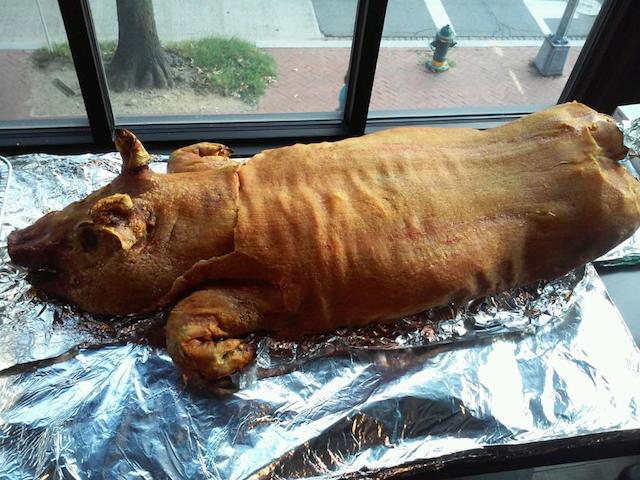
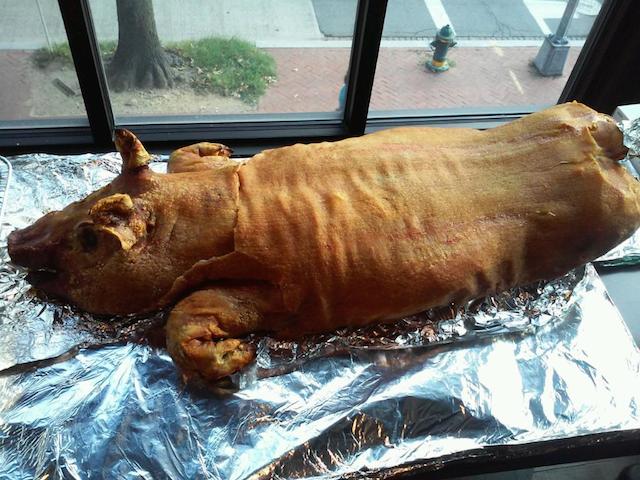
 Photo courtesy of Chaplin’s Restaurant.
Each month The Federal Forager explores some of the perks, puzzles, and pitfalls of eating and living more organically, locally, sustainably, and creatively in the D.C. region.
By DCist Contributor Bridget Dicosmo
The word “roast” is comforting. On its own, it evokes wholesome images of rustic kitchens, savory aromas, and families gathered around the dinner table. But tack on qualifiers like “pig” and “lamb,” and specify that you’re getting the whole beast, nose to ears to tail, to share with more than a dozen of your closest friends, that’s when things get really good. And D.C. has some great options for enjoying every last bit of your bacon.
“People love seeing that whole pig on the table, it’s a big hit,” says Aung Myint, a chef at Chaplin’s (1501 9th St NW). Chaplin’s offers tableside family roasts at a per person market price for parties of six or more, featuring suckling pig (for a minimum of 10 people), lamb, duck, and goat.
A number of D.C. area restaurants offer “whole animal roast” options, for groups ranging anywhere from six people to dinner parties of up to 100. Others offer menus that take advantage of the entire animal, organs and all. Starting with a whole pig, lamb, or goat delivered to the kitchen’s back door and turning it into a feast fit for the dining room gives chef a chance to show off their skills at breaking down all of the tasty bits. It also cuts down on a good bit of food waste by using as much of the animal as possible.
Birch & Barley (1337 14th Street NW) offers a “Beast Feast” featuring smoked pork trotters and barded tenderloins. At Poste (555 8th Street NW), parties of 10 can enjoy the Poste Roast, a whole-animal roast accompanied by soup or salad, three sides, and dessert.
Christin Fernandez, with the National Restaurant Association, points out that using the whole animal reduces the amount of meat that is thrown away. In the process, chefs have the chance to expose diners to new and delicious culinary options, such as previously overlooked and underappreciated cuts of meat that “may not be as expensive as more ‘main-stream’ cuts.”
Fernandez says the association has found as “diners become more interested in knowing what is on their plates, the idea of nose-to-tail dining has really taken off.” Their annual survey finds that chefs are increasingly “using every part of the animal,” a resourcefulness that could be partially spurred by the rising cost of beef and other meats, Fernandez says.
“When these animals are raised honestly, with good intentions and practices, you don’t actually want to see anything go to waste, so nose to tail becomes the term for extracting every gram of flavor from any given protein purchase,” says Brady Lowe, founder of Cochon 555, a traveling chef competition showcasing heritage breed pigs. (The Cochon Heritage BBQ festival comes to D.C. ‘s Union Market on Oct. 4.)
Lowe believes chefs have taken up the challenge of cooking the whole animal “because it is best way to respect the life given.”
Indeed, this type of cooking is about more than reducing food waste and doing some fancy things with pig ears, explains Brian McPherson, chef at Jackson 20 (480 King St) in Old Town Alexandria. When you get a whole animal, you’re also getting a good deal of information about its history, McPherson points out.
“It’s more about knowing that animal’s story,” whether it was grain-fed or given wooded or pastured land to forage, which can give clues about its fat content, McPherson says. “When you’re getting the whole animal, you can see the muscle structure,” which provides data not only on the quality of the meat but how to best prepare it.
Ed Scarpone, chef at DBGB (931 H Street, NW) says, for example, when you buy a suckling pig from a Pennsylvania farm, “slaughtered to order, you know exactly where it’s coming from.”
DBGB offers a “whole hog” option at $495 for up to eight people: a Pennsylvania Green Village Farms slow-roasted suckling pig stuffed with pork loin, onion, chestnuts, wild mushrooms, and swiss chard, plus appetizer, sides, and dessert. And the “Rib To Tail” family style menu, at $125 per person, highlights some of the ways Scarpone makes use of the various portions of the animal. “You get to see how each piece can be prepared in a totally different way,” Scarpone says.
Jackson 20’s private dining feature includes whole pig roasts at $38 per person. “Every single thing is used,” says McPherson, who uses some of the organs in dishes like scrapple, deviled kidneys, and grilled liver, in addition to hand-crafted charcuterie. The bones get boiled down for soup and broth.
“This is my favorite way to cook, it takes so much talent and love,” says Scarpone, who attributes the whole animal trend, at least in part, to a desire to “get back to the family meal.”
And Cochon 555’s Lowe notes that the pork festival provides a platform for consumers to understand and trust chefs’ creativity with various cuts. “Creativity comes along with utilizing the whole animal, customers are getting the rewards through education,” Lowe says. “It’s pretty exciting for those who know what special things chefs are creating and don’t get grossed out by hearing the word ‘blood’, or ‘kidney’.”
At The Pig (1320 14th St NW), executive chef Michael Bonk dedicates the menu to the whole animal, relying on centuries-old techniques for breaking down the various offal and other bits. Kidneys, for example, are tricky and often blended with the liver, heart, snout, and ears for the in-house scrapple.
“I think all animals are beautiful creatures,” Bonk says, noting that they eat, breathe, and have their own personalities. “Unfortunately for them, they are also tasty,” he says, so he takes care to ensure no part goes to waste out of respect for the animal. And from a financial standpoint, the heritage breed served at the Pig is costly, so having the cooking skills to “squeeze every dollar” out of the meat helps stretch the budget.
Bonk says he favors the head as “by far my favorite cut from the pig.” It offers a variety of textures, with the ears, snout, tongue, jowls, and cheeks, which can be roasted whole. “It’s so satisfying to eat,” Bonk says. “You start with all the crispy skin. Then work through the fat and a layer of super moist meat that’s sandwiched between the outer layer of jowl skin and the cheek.”
The Pig often serves whole pig heads, complete with sparklers, to drive home the restaurant’s singular goal of celebrating pork. “Nothing says celebration like sparklers,” Bonk says.
Want to try some of these whole animal feasts? Here’s where to find them.
Birch & Barley
1337 14th Street NW
Call at least four days ahead to special request the “Beast Feast”, a multi-course porcine feast featuring smoked pork trotters and barded tenderloins ($95).
Chaplin’s
1501 9th St NW
Chaplin’s offers tableside family roasts at a per person market price for parties of six or more, featuring suckling pig (for a minimum of 10 people), lamb, duck, and goat.
DBGB
931 H St NW
DBGB’s “Rib To Tail” family style menu feeds 4-8 people at $125 per person or go for the “whole hog” option at $495 for up to eight people: a Pennsylvania Green Village Farms slow-roasted suckling pig stuffed with pork loin, onion, chestnuts, wild mushrooms, and swiss chard, plus appetizer, sides, and dessert.
Jackson 20
480 King St, Alexandria, Va.
Jackson 20’s private dining feature includes whole pig roasts at $38 per person. “Every single thing is used,” says McPherson, who uses some of the organs in dishes like scrapple, deviled kidneys, and grilled liver, in addition to hand-crafted charcuterie. The bones get boiled down for soup and broth.
The Partisan
709 D Street NW
The Partisan’s pig feast for 4 to 6 includes pork head, sausage, smoked bone marrow, and assorted sides for $120.
The Pig
1320 14th Street NW
Diners can special order any manner of pig parts for their dinner, including a whole roasted head for $75 or an entire suckling pig (market price). Be sure to call ahead to make arrangements.
Poste
555 8th Street NW
For parties of 10 or more, try the Poste Roast, a whole-animal roast accompanied by soup or salad, three sides, and dessert.