 Rachel Sadon
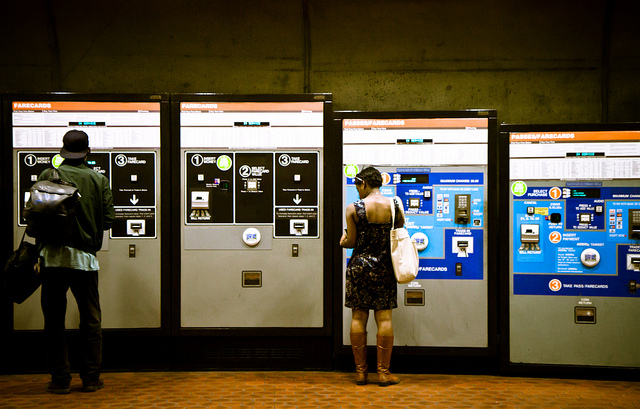 Paper fare cards will soon be a thing of the past. (Photo by ep_jhu)
Thus begins the official end of paper farecards in the Metro system.
Although less than 10 percent of riders still use the soon-to-be relic, vending machines will no longer distribute them at the King Street, Huntington, and Franconia-Springfield stations after Metro finishes retrofitting them this week. They will be the first stations to make the switch entirely to SmarTrip machines, but others will quickly follow. And by January, there won’t be a single paper farecard vending machine in the whole system, according to Metro’s timeline.
The transit agency announced the plan to retire the paper farecard more than a year ago, and it is now kicking into high gear. In August and September, they tested pilot retrofits at Union Station, Ronald Reagan Washington National Airport, and King Street. The official roll-out began at the three Virginia stations along the Blue and Yellow lines earlier this week, and they should be done by Friday. Once King Street, Huntington, and Franconia-Springfield are completed, WMATA plans to retrofit the following stations in October:
Archives, Franconia-Springfield, Arlington Cemetery, Gallery Place, Braddock Rd, Huntington, Capitol South, L’Enfant Plaza, Crystal City, McPherson Sq, Dupont Circle, Metro Center, Eisenhower Ave, Pentagon, Farragut North, Pentagon City, Farragut West, Smithsonian, Federal Center SW, Van Dorn Street, Federal Triangle, Woodley Park
After that, they will do another 25-30 stations each month until each and every one is rid of the machines and paper farecard sales cease in January. Starting in March, paper farecards will no longer work at the faregates.
Riders will have until June 30, 2016 to transfer the value from any remaining paper farecards to SmarTrips at sales offices. Metro also plans to hold trade-in days at some stations this month.
“SmarTrip is faster, safer, more reliable and less costly than paper fare media,” Jim Bongiorno, Metro’s treasury technical manager said in a release. “And eventually, when SmarTrip completely replaces paper farecards, customers will notice the benefits in the form of faster entries and exits at the faregates, and improved reliability with more faregates in service. Meanwhile, Metro expects lower expenses through reduced maintenance costs and the improved efficiency that comes from having a single way to pay.”
The agency added a $1 surcharge to each trip taken with a paper fare card in 2012 and dropped the cost of a new SmarTrip to $2 in 2013.