Rachel Kurzius
 Image courtesy of the Office of Human Rights.
A first-of-its-kind study of discrimination in hiring practices finds that nearly half of D.C. employers prefer a less-qualified applicant they perceive as cisgender to a more-qualified candidate they perceive as transgender.
Five employers will face director’s inquiries from the Office of Human Rights for their results—two in the restaurant industry, two in the administrative sector, and one university. These investigations will determine whether the actions were discriminatory and could become public documents.
The Office of Human Rights conducted the first government-run test in the nation to figure out how being perceived as transgender affects a job applicant, submitting resumes to openings in various sectors from February to July 2015.
“Employment discrimination can cause high rates of unemployment or underemployment, which can lead to homelessness and prevent individuals from accessing necessary healthcare,” the report says. “This discrimination can also force individuals into criminalized activities or criminalized economies for survival, which often leads to incarceration and criminal records that compound the challenges they face in finding employment.”
According to the study, the restaurant industry has the highest discrimination rate—67 percent—among the sectors that OHR surveyed. Rates of discrimination in both the retail and administrative sectors clocked in at 50 percent.
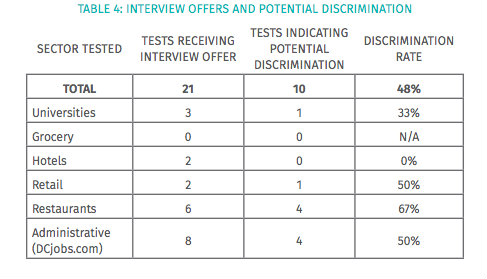 Image courtesy of the Office of Human Rights.
Transgender men with work experience at a transgender advocacy organization faced a 69 percent discrimination rate, the highest on an individual basis.
To conduct the study, OHR signaled gender identity in four different ways. Two involved referring to an applicant’s current or former legal name (one example from the report: a resume would state: “Worked under my former legal name, Clara Scott.”). The other applications used work or volunteer history in the transgender community, emphasizing a personal stake in the cause, to demonstrate gender identity.
All of the transgender resumes demonstrated one or two years more work experience, or .1 to .3 higher GPAs than their cisgender counterparts.
Because existing resume testing already demonstrates discrimination based on a number of characteristics like race, age, gaps in employment, and more, the study isolates gender identity. All of the applicants had Anglo-American-sounding names, attended college, were around the same age, had no gaps in employment, and lived in Petworth.
“The transgender community in D.C. and around the country is not all white, not all attended college, and because of what we identify in the study, many have gaps in employment,” says Elliot Imse, director of policy and communications at OHR. “We’re talking about the most privileged people in the transgender community and they still face a 48 percent discrimination rate.”
The study also doesn’t tackle in-person interviews, another potential minefield for discrimination.
The Human Rights Clarification Amendment Act of 2005, passed by D.C.’s council, includes “sexual orientation, gender identity or expression” as a protected class.
“You’re looking at a discrimination rate in a District where it’s illegal to discriminate,” says Imse. In 32 states, gender identity is not a protected class.
OHR wants the study to illustrate to government officials, advocates, and employers that the District has a problem. Moreover, it hopes the existence of the study, and the potential for follow-up reports, will act as a deterrent for businesses considering discriminating.
“There’s no guarantee that testing isn’t ongoing,” says Imse.
The director’s inquiries can take up to six months, though Imse says OHR will try to finish them sooner. The respondents must remain confidential unless OHR determines discrimination occurred, at which point it can release the names of the employers.