Rachel Kurzius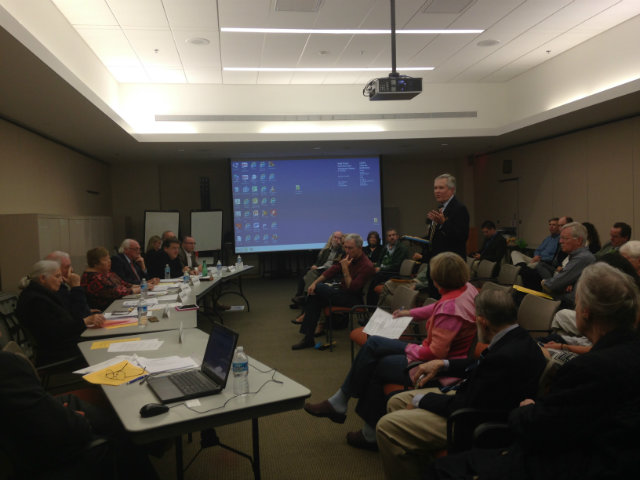
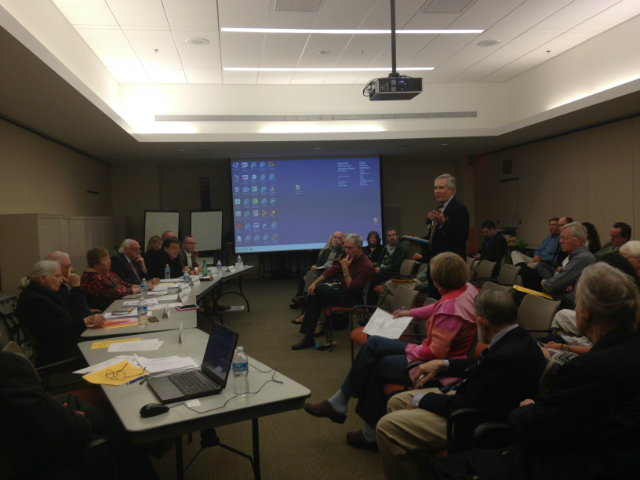 James Fallows addresses ANC3D. (Photo by Rachel Kurzius)
Haskell Small is a composer who, for the past half-dozen years, has focused on music that is very, very quiet.
His wife Betsy describes it as an “exploration of the silence within.”
There’s just one problem—leaf blowers in his neighborhood of Wesley Heights make it impossible for him to find the silence he needs to do his exploration. “This used to be a fall-time nuisance, but now it’s a year-round problem,” Small says. Plus, he notes that the leaf blowers are “off-key.”
Small and a number of other concerned residents organized as the Concerned Wesley Heights Neighbors and, last night, had their first political victory. With leaves pinned to their chest, the group attended the ANC 3D meeting last night to make their case in front of their commissioners.
James Fallows, Atlantic writer and former presidential speechwriter, is among the leaders of the crew, and has been blogging about the process. Headlines include “History’s Greatest Monster,” and “What the Devil Does in His Spare Time.” “There’s a reason to look at this anew,” Fallows said at the meeting. “The times are in our favor.”
The villain, as the Concerned Wesley Heights Neighbors see it, is specifically the two-stroke gas engine leaf blower. “It’s louder, it’s more intensively polluting, and it’s only allowed in lawn equipment,” said Fallows. He noted bans on two-stroke engines in boats and motorcycles, as well as municipalities in California, including Los Angeles, that have outright banned the use of two-stroke engine leaf blowers.
D.C.’s current noise ordinance does not allow for sound above 70 decibels from a distance of 50 feet. The Fallows, using sound equipment in their home, have measured 85 decibels, exceeding the legal limit by a factor of 10.
Deb Fallows, James’ wife who also writes for The Atlantic, called enforcement of the ordinance a “whack-a-mole” operation. “It’s a single, episodic intervention that occurs.”
The lack of enforcement leads to lifestyle changes. “I used to do a lot of work at home and I don’t do that anymore,” James said. But the noise isn’t the the only problem. “For me, noise matters most but for the public, health matters.”
A growing body of evidence supports the idea that two-stroke engines are worse for the environment, including increased air pollution from emissions, the effect of 250 mph wind on topsoil, and the health impact for workers.
James acknowledged that many people view the leaf blowing issue as a “first-world problem,” drawing laughs from the crowd, but said that criticism is “exactly wrong.” Wealthy countries can switch to alternative technologies that preserve the health of workers, he said, noting that the majority of leaf blower operators are not English-speaking and don’t have health plans.
Jerrell Brown, a landscaper with SML Services in Northeast D.C., disagrees with the focus on leaf blowers. “Using any power tool, really, could be dangerous,” he says.
“The latest technology in electric leafblowing has a backpack battery,” Small said at the meeting. “Things have been changing rapidly and they’re viable now.”
Brown says that the quality of electric leaf blowers is “terrible” and would affect productivity. Switching to electric “would have a very big impact on our business,” he says.
ANC 3D04 Commissioner Stu Ross wanted the group to focus more on the noise. “You’re not going to win this on pollution.”
Ultimately, ANC 3D passed a resolution 8-1 that calls upon Ward 3 Councilmember Mary Cheh to devise an appropriate legislative solution to the issue of leaf blowing. A call and email to Cheh’s office have not been returned.
Two-cycle engine leaf blowers are “kind of loud, kind of noisy,” says Brown, the landscaper. “But I think people should worry about other things, like who their next president is going to be.”