 Rachel Sadon
There are no newspapers on the floor or wads of gum wedged in between seats. There isn’t a single mysterious stain. Some riders commuting along 16th Street NW today may very well be in for the most pristine bus ride of their lives.
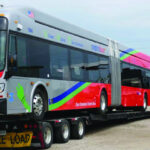
Part of a larger order that also includes 274 standard buses, Metro unveiled one of 21 new articulated buses—the longer, accordion-style vehicles—on this cloudy afternoon. But the 60-foot bus itself gleamed with new features, including a reconfigured seating arrangement and improved lighting.
“Riders will immediately notice the difference as soon as they step aboard,” says Metro’s interim general manager Jack Requa.
The new articulated buses, which each cost $970,000, are replacing ones at the end of their 12-year lifespan, while standard buses typically have a lifespan of 15 years, according to the director of Metrobus planning, Jim Hamre. Metro is spending around $20 million to replace the longer buses, which run on three of Metro’s busiest corridors: 16th Street, 14th Street, and Georgia Avenue. In total, Metro is investing $187 million to replace all 295 buses.
Once the transit agency puts all the new vehicles into service, the average age of the bus fleet will decrease from 7.8 years to 6.8 years. Metrobus’s goal is to get the average at 7.5 years, half the typical lifespan of a standard bus, Hamre says.
Amid a rise in assaults on bus drivers (most recently, a passenger punched a driver who asked for his fare payment), the new buses also feature Plexiglass shields, and all future orders will include them, according to Metro spokeswoman Sherri Ly.
The shields aren’t bulletproof, but they are “spit and drink-proof,” Hamre says. “That’s what we get the most of.”
The buses also feature a low entry point, so there are no stairs for passengers to lumber up before boarding. “The more they do this, the more seconds they can shave off,” says Kishan Putta, a former ANC commissioner who lives along 16th Street and has been among those agitating for changes along the corridor. “Then they can turn around and be put back into service faster.”
Over the years, WMATA has expanded the use of the longer vehicles, in addition to the S9 express and extra buses, but 16th Street remains a clogged mess.
Despite representing less than 5 percent of vehicles, the S-buses carry half the people traveling along the corridor each day. And each year, more and more people have been trying to get on them. Since 2008, ridership on the line has grown nearly 30 percent to more than 20,000 riders each day.
Advocates have been pushing for a dedicated bus lane as one of the solutions for years, and a District Department of Transportation study in 2013 determined it is technically feasible. Last month, DDOT released three plans to ease the problems, and two of the three include a proposal for a dedicated bus lane.
The agency held four events to discuss the plans with the public in October, and DDOT transportation planner Megan Kanagy says they are a lot closer to choosing one of the proposals to be presented as a draft preferred alternative at a December 15th meeting.
Overall, Kanagy says, DDOT saw “a lot of support” for a bus lane when they went out and surveyed riders. And Requa says that Metro “absolutely” supports a bus lane, citing the successes of Alexandria and Arlington’s dedicated bus lanes in improving performance.
It is likely that the final plan, which is slated to be presented in January, will be some combination of the three plans. Other possible improvements could include an off-board fare payment system and an expansion of plans for transit signal priority, which allows stoplights to give an early green for a bus or hold a green light just as one is pulling up.