 Rachel Sadon
 Photo by GRandallJ.
The doctor has some good news and some bad news. And by doctor, we mean the Big Cities Health Coalition, which released a wide-ranging report today on health outcomes in the country’s 26 largest cities.
In D.C., signs of progress in the Big Cities Health Inventory 2015, which looked at 34 health indicators, include the facts that cancer mortality rates in 2012 were down more than 10 percent from 2004 and heart disease mortality is down 20 percent during the same period. With a diabetes-related death rate of 24.2 per 100,000 people, the District already meets one of the “Healthy People 2020” goals set by the U.S. Department of Health and Human Services.
But the nation’s capital also tops the list of new HIV diagnoses among the cities surveyed, and it is second only to Baltimore in HIV-related deaths (though the rate has dropped by more than half since 2004). And in just about every category studied, there are major disparities between black and white Washingtonians.
Take the aforementioned diabetes rate. As with all the other urban centers highlighted in the report, D.C. as a whole already bests the “Healthy People 2020” target of 66.6 deaths per 100,000 population—with the Hispanic population’s diabetes-related mortality rate at 4.5 per 100,000 people, and the white population at 5. But the black population’s rate is more than seven times higher: 36.1 per 100,000 people.
In comparison to the white population, the black population’s HIV mortality-related rate is seven times higher, the infant mortality rate is six times higher, and the cancer morality rate is nearly double. African Americans are thirteen times likelier to die by a firearm, according to the report.
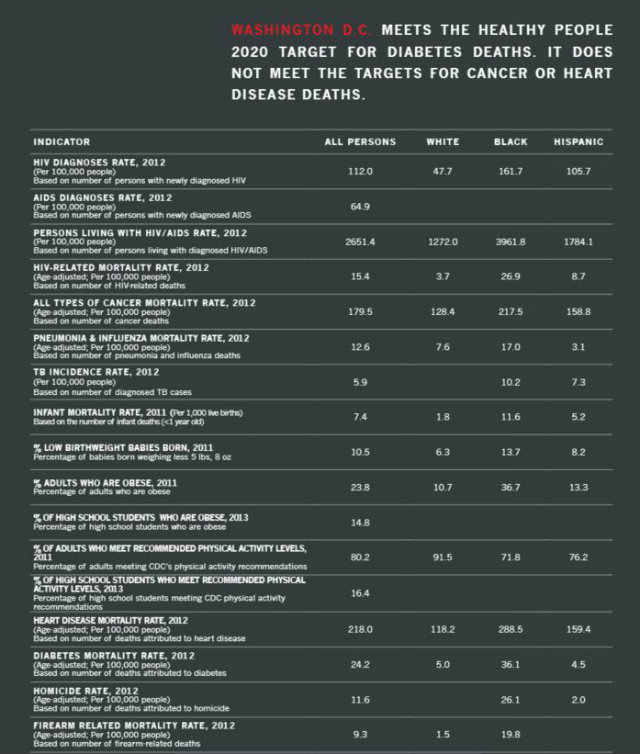 (Via the Big Cities Health Inventory)
Across the country’s largest cities, things are looking up, with major strides toward reaching the 2020 health goals since the last edition of the Big Cities Health Inventory was published in 2007. The Hispanic population, in particular, made major gains, including reaching fewer deaths caused by HIV, guns, and heart disease than the general population.
“In 2007, the Big Cities Health Inventory characterized America’s big cities as unhealthy places to live. Today, that is no longer true,” said Chrissie Juliano, director of the Big Cities Health Coalition. “While challenges remain, the cities included in this report have made remarkable progress toward improving the health of their communities. Using sound science and innovative programming, these cities are leading the way in tackling our nation’s most pervasive health problems.”
But, as in D.C., urban black populations disproportionately fared worse than white populations—bearing the burden of what the authors call “negative health outcomes.” Around the country, African Americans are far more likely to die of cancer, heart disease, diabetes, and HIV/AIDS than their white counterparts.