Rachel Kurzius
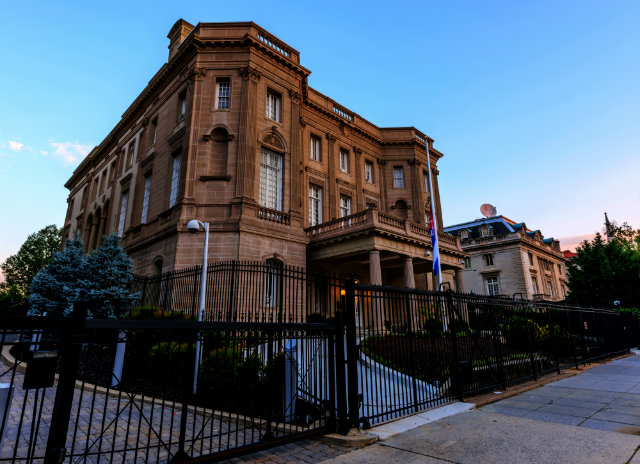 The Cuban Embassy in D.C. (Photo by Geoff Livingston)
On her second trip abroad in four months, Mayor Muriel Bowser is headed this weekend to Havana. She’ll be joined by members of her administration, a few D.C. councilmembers, and government officials from Maryland and Virginia, as well as representatives from the private sector—including some prominent donors— to build relationships and work on potential investment opportunities in Cuba.
The price tag for the District is $44,000, according to Joaquin McPeek, director of communications for the Deputy Mayor for Planning and Economic Development. That includes travel, lodging, and visa application fees, as well as the trip an advance team took a few weeks back. The delegation will be flying a commercial flight to Miami, and take a charter flight into Havana.
The trip, organized by the Greater Washington Hispanic Chamber of Commerce, “will also serve as a platform to learn best practices and showcase the Washington metropolitan area’s strengths in transportation, tourism, health, and education,” according to a statement from the Chamber.
In addition to the mayor, representatives from her administration include Deputy Mayor for Planning and Economic Development Brian Kenner and D.C. Public Schools Chancellor Kaya Henderson. From the D.C. Council, the delegation includes Ward 2 Councilmember and newly elected Chairman of the Metro Board Jack Evans and At-Large Councilmember Vincent Orange. Virginia Secretary of Commerce and Trade Maurice Jones, Montgomery County Executive Ike Leggett, and Maryland Director of the Office of Community Partnerships Bruce Adams are among the representatives from neighboring jurisdictions.
“The District has for a long time been interested in a regional trip,” says McPeek. “We know that when we combine all of our strengths, we have a lot to offer the international community.”
There are a lot of commonalities between D.C. and Havana, says Michael Czin, spokesperson for the mayor. Havana “is a capital city doing a big renovation. It’s a city that’s going to see a lot of investment but wants to maintain the integrity of its history.,” Czin says. “That’s something we have some experience with.”
Nearly 30 members of the area’s non-private and private sectors are also en route to Cuba. Just as with her trip to China, included among them are a number of contributors to FreshPAC, a pro-Bowser political action committee that shut down in November amidst public scrutiny.
The donors include Carlos Perdomo, president of Keystone Plus Construction, which gave the now defunt PAC $10,000; Scottie Irving, the president of Blue Skye Construction, which gave $5,000; and Winmar Construction President Edwin Villegas, who personally gave $10,000. PAC officials gave back most of the money it raised when FreshPAC shut down.
While the mayor’s office worked with the GWHCC to determine the delegation, Czin says that donations have nothing to do with getting an invite. “Everybody’s on the trip for one reason—because they bring a unique point-of-view. Everyone was chosen for their ability to facilitate relationships with the region and Cuba.” (He had a similar explanation when asked about donors going to China with the mayor.)
Adds McPeek, “The members of the delegation reflect the goals and objectives of the trip,” like diplomacy, health, tourism, and trade.
GWHCC spokesperson Pamela Nieto says that the Chamber “is not involved” in the now-defunct FreshPAC. According to her, GWHCC opened the opportunity for the trip to the people in its network. “Our priority is to align participants with potential opportunities in Cuba,” she says.
In addition to tourism, it makes sense for folks in the region to discuss best practices when it comes to education and medicine. Cuba has a 99.8 percent literacy rate, according to the CIA, and a robust medical system that could teach D.C. FEMS a thing or two. But who, exactly, is instructing who on transportation? After all, Metro has had an embarrassing couple of weeks with news of falling ridership and the resignation of its second-in-command. “The District has a fairly robust transportation system, at least in terms of options,” says McPeek. “The region is transit-friendly.”
Yesterday, the United States and Cuba reestablished commercial flights between the countries (previously, all flights operating were charters), following the restoration of full diplomatic relations over the summer.
Forecasters are expecting rain today in Havana, but by the time Bowser arrives on the 20th it looks like it’ll be in the high-70’s and balmy. The trip lasts through February 25.