 Rachel Sadon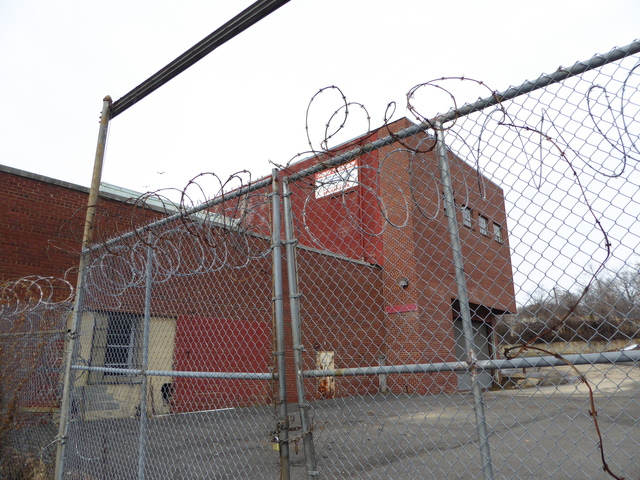
“This is not a NIMBY protest,” is one of the very first things that Rhys Gerholdt wants me to understand on a warm, but gray Saturday morning.
He’s one of the outspoken residents who’ve come out against the chosen site for a new family homeless shelter in Ward 5, part of Mayor Muriel Bowser’s plan to close D.C. General by 2018. “As residents, we just know how horrendous this spot is,” he says, gesturing to the dead end block on 25th Place Northeast. “Our concern for them is they’d be living in a hellhole.” At a community meeting last night, more than 100 residents seemed to overwhelmingly agree with that assessment, and they came up with 15 potential alternatives in Ward 5 to look into.
Indeed, calling the proposed site their “backyard” is a bit of a stretch, as a walking tour soon makes clear. Gerholt lives several blocks away and across a bridge, which separates him and his neighbors from the industrial area that may soon house as many as 50 families.
“There’s no fresh food, there’s no place to get personal items, there’s no drug store,” points out Kevin Mullone, the president of the Langdon Park Community Association. “This is not a walkable community.”
A third resident who lives in the area, Yolanda Odunsi, chimes in: “There’s nothing within 10 blocks.”
Strictly speaking, that’s not true. But they certainly aren’t the kinds of things that Mayor Muriel Bowser touted in her criteria for the administration’s search, namely access to services, public transportation, and integration with a community.
The proposed facility’s closest neighbors would include a Metro bus depot, train tracks, a nightclub, and a marijuana cultivation center—up another block is a strip club. Also nearby: several auto body shops, a trash transfer site, and several other marijuana cultivation centers. The closest Metro stop is a 45 minute walk, and there are only a handful of buses within walking distance (for some perspective, The Washington Post recently profiled the two-hour journey, each way, that one homeless woman who resides at the nearby Days Inn takes to get her daughter to school). The administration’s plan includes zoning exceptions, which would allow for a shelter in such an industrial zone.
Bowser announced the proposal at a D.C. Council breakfast earlier this month, and called community meetings for two days later to discuss them. She drew criticism for both the short notice and being opaque in how the sites were selected, as well as applause for what appears to be a viable plan to close the dilapidated shelter at D.C. General.
D.C. Councilmembers generally expressed widespread support for the plan—under the mayor’s proposal, the Council would approve all of the sites as one package—but Kenyan McDuffie immediately requested the administration choose a different site for Ward 5.
At last night’s meeting, which was convened by the heads of three local community associations, McDuffie said: “The issue is the actual location that was selected to house up to 50 families is inappropriate … I don’t know very many people who would want to live there.”
But the councilmember and most of those who spoke at the packed New Canaan Baptist Church emphasized that they are willing to welcome a new homeless shelter elsewhere in the ward. “We’re not saying we don’t want homeless families here, we’re saying this isn’t good for families,” said one woman.
“We’re here to insist that the most vulnerable in our society, particularly these children, have better housing than an industrial site,” said another, before suggesting that they consider a vacant, former tourist home at Rhode Island and Newton, part of a large development going up in Fort Totten, and several other sites.
All told, those at the meeting came up with 15 other sites. It isn’t clear how many, if any, could serve as suitable alternatives, or if the mayor is even willing to reconsider—especially given the size constraints imposed by the fact that the administration wants each shelter to accommodate between 30 and 50 families. Bowser released a list of sites today that were considered through the rolling RFP process; only two (including the final site) were in Ward 5.
“There were sites that were suggested and considered outside of the RFP process. However, once a site was determined to be potentially viable, we asked developers to respond through the RFP process,” according to Jenna Grant Cevasco, a senior policy advisor in the Office of the Deputy Mayor for Health and Human Services. She said that 2266 25th Place NE was chosen for its size, proximity to public transport, economic feasibility, and ability to be developed within a 24-30 month timeline.
As to whether or not the administration would look at other sites, Cevasco said, “This is one package and it all moves together—if we lose any site we risk not being able to close DC General. That said, we look forward to continuing the conversation and working with the community.”
The current plans for the Ward 5 facility include a “playground and recreation space, computer lab for residents, homework lounge, on-site clinic, and ongoing support services and programming for families.”
But many in Ward 5 insist that isn’t enough when they are isolated in an industrial area. “No one has a reason to be here,” Odunsi said as we walked around the site, at times straining to be heard over the noise of a passing train and a concrete mixer. “I never come over here, and I live here.”