 Rachel Sadon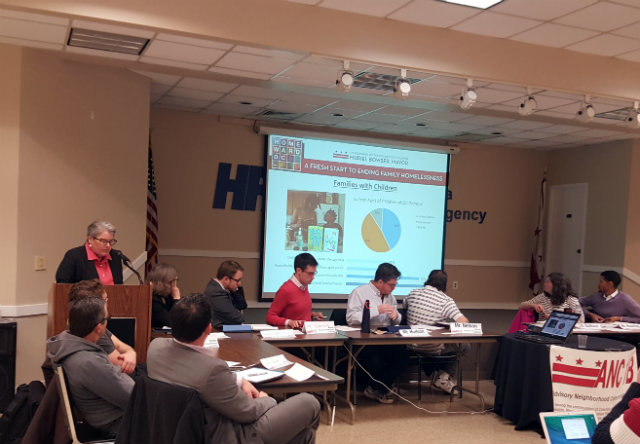
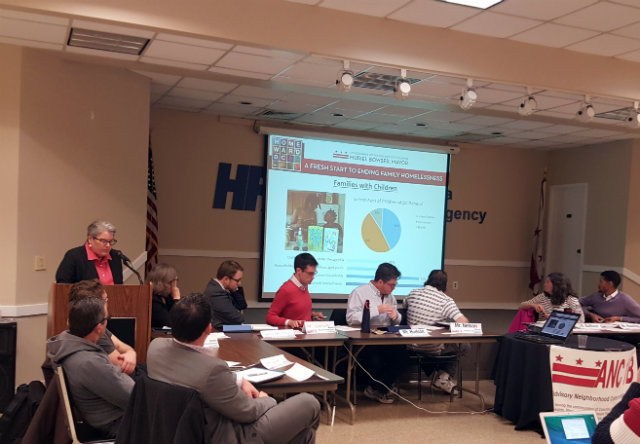 Polly Donaldson, the head of the Department of Housing and Community Development, presents the city’s plan for a shelter in Ward 1 at an ANC committee meeting. (Photo by Rachel Sadon)
It wasn’t even a full gathering of ANC 1B, the Advisory Neighborhood Commission that represents the neighborhood where Mayor Muriel Bowser has proposed putting a new homeless shelter in Ward 1, but an economic development committee meeting. Still, the administration sent some of its top representatives, including D.C. Department of Housing and Community Development Director Polly Donaldson, to engage with frustrated residents.
A mix of supporters and vocal opponents heard Donaldson out—and occasionally interrupted—last night as she went through Bowser’s plan to close the homeless shelter at D.C. General and replace it with family shelters in seven wards, including one at 10th and V Streets NW.
The city has signed a letter of intent for a 30-year ground lease on the lot, which includes a historic church, about a block away from the 9:30 Club. Owned by Sorg Architects, the land has sat vacant years, as several sets of plans for a condo building never came to pass.
While residents sat through ANC meetings and heard detailed plans for that proposed project, some neighbors charge that the administration has sidestepped community involvement in its quest for a speedy closure of the dilapidated family shelter.
“I don’t think you understand the outrage that has been generated by this process. What compelled you to go through this 100 percent without transparency?” asked Rich Schiff, who estimates he lives about 100 yards from the site. In a group of 60-70 angry residents, he said, “there isn’t one person that objects because we don’t want a homeless shelter in our neighborhood or our street. What we fully object to is the process.”
When the applause from similarly minded residents died down, Jenna Grant Cevasco, a senior policy advisor in the Office of the Deputy Mayor for Health and Human Services, responded that “If we’d asked every ward in the city, ‘can we put a short term family housing site in your neighborhood?,’ everyone would say no.”
“I think that assumption is insulting,” Schiff retorted.
Although the mayor has said she is unwilling to changes any of the site, J. Forest Hayes, the associate director of the Department of General Services, countered that “this is a transparent process in that this is the conversation.”
Among the group’s many questions, several neighbors spoke up to express their support.
On what would have been her son’s 28th birthday, Susan Ousley told the crowd that he needed help in the form of permanent supportive housing and other services. “I will be at every meeting simply to remind you that he deserved better, and we deserve better than the way we are treating each other in this process… Maybe the numbers or the location will change, but we need this.”
A man who lives about six blocks away added his perspective: “I had things that happened to me that made me think, at the end of the day, we’re all people.”
But much of the discussion revolved around the details, some of which hadn’t been publicly discussed before, of the financial aspects of the deal—particularly why the administration chose a relatively short ground lease instead of purchasing the land.
Under the terms of the proposal, D.C. would pay the company $770,000 a year to lease the lot and foot a bill of between $12 million and 14 million to construct the building.
“Just some simple math: $770,000 a year over 30 years is $23 million,” one resident said. “That price is astronomical, and it was done in the dark.”
The Sorg family initially wanted $11 million to sell the land, and they eventually came down to $10 million, Hayes told the crowd. “We decided on the ground lease because we thought the terms of the purchase sale agreement were not in line with our thoughts,” he said.
And the 30-year lease, rather than a longer one, was at the advice of the Office of the Chief Financial Officer. “At the end of the 30 year term, there will be an opportunity for the District either to acquire the site from the landowner or enter into an extension.”
But prompted by questioning from Commissioner Ellen Sullivan, Hayes conceded that those options aren’t contractually obligated, and the family could choose a third option: keep the land. At that point, just three decades from now, “it is unlikely that the improvements on the site will last. It’s very likely that they would have reached their useful life,” Hayes said.
The deal with Sorg also comes with the architect’s drawings and their permits for a building, originally slated as condos, on the site. DGS is working on modifying the interior to fit the needs of the shelter, including adding a computer lab, dining area, and support services. “[Sorg’s plan] had been through the entitlement process, and has already been approved for this use. So we were able to acquire the benefit of that soft cost as part of the land value,” Hayes said. That also means the city can likely skip the step of going to before the Board of Zoning Adjustment.
“This is a plan that you already approved; you already had your day. We’re only changing the interior,” Hayes told the group. “If it requires ANC input, we will absolutely come back to you. But if it doesn’t, it will be the same plan that you approved and you can provide feedback.”
The committee later voted to recommend that the ANC request the zoning case be reheard because of the building’s alternative use.
Regarding the costs for building a shelter in the pricey neighborhood, Ward 1 Councilmember Brianne Nadeau told the crowd the city planned for it as part of their plan to spread the shelters throughout the city. “We knew this going in and budgeted for it.”
But Sullivan, who called the plan to close D.C. General an important mission, argued the lack of community input isn’t a new problem. “There is a lot of frustration on this project because the numbers are big and confusing, but this [lack of transparency] is a frustration that our ANC and community members have felt over a number of other projects in our neighborhood,” she said. “Unfortunately this seems like business as usual.”
The officials told residents on both sides of the issue to come out to make their voices heard at a March 17 hearing before the D.C. Council. Said Donaldson: “We are listening, we are hearing you.”