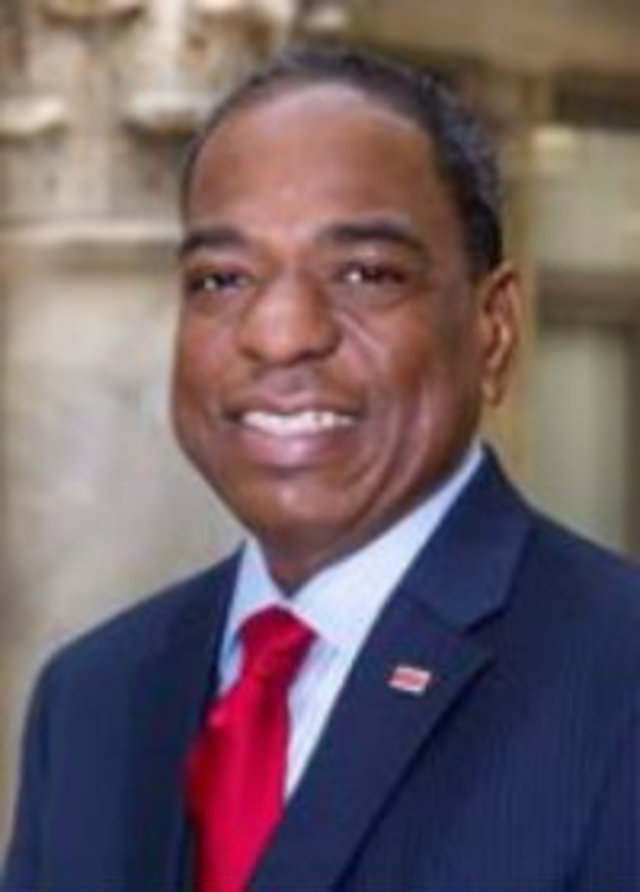
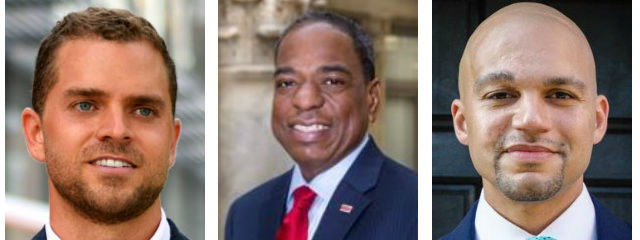
 David Garber, Vincent Orange, and Robert White.
By DCist contributor Cuneyt Dil
Vincent Orange says he has a “good story to tell” voters this year. But after nearly two decades in District politics, the At-large councilmember is facing re-election against challengers who are telling a very different tale, painting him as corrupt and claiming residents are clamoring for change.
Most years, weak incumbents roll back into office thanks to a crowded field dividing the vote. Orange, who has run in 11 District races over the years, benefited off such an arrangement in the 2012 Democratic At-large primary. He edged Sekou Biddle by less than 2,000 votes in a four-way race, then cruised in the general.
This year’s Democratic primary, on June 14, features opposition from David Garber and Robert White, and both promise a challenge. A competitive race may not be what Orange is looking for right now, coming off a poor showing the last time he ran a campaign, when he won just 2 percent of the 2014 mayoral primary vote (in the 2006 mayoral primary, he won less than 3 percent of the vote). But nevermind all that; Orange remains upbeat. He says his “good story” includes raising the minimum wage; a proposal to build “tiny houses” across the city for millennials and poorer residents (some call the idea a gimmick, but he wants to invest $50 million in it); and legislation to improve conditions for wage workers.
In a showy analogy, he compares himself to Tom Brady, “throwing touchdown after touchdown,” while his political foes plead the coach to be put in. “Well, why should we put you in?” Orange continues, “this person is throwing touchdown after touchdown.”
As Orange’s opponents look for a way into the political arena, their hopes rest on a strong strategy—and not splitting the vote. “The most critical thing that I had to do was keep the field clear,” White tells DCist on a recent afternoon, at the kind of new Logan Circle coffee shop that marks the area’s renaissance.
In the 2014 race, White lost to Elissa Silverman running as an independent, which he pegs in part to lackluster fundraising. Facing 13 other candidates couldn’t have helped, either.
But this year, a slew of former At-large wannabes are backing White, including Matthew Frumin, Khalid Pitts, Brian Hart, and others. And after a year working as community outreach director to Attorney General Karl Racine, White has the blessing of his former boss.
A fifth generation Washingtonian who grew up in 16th Street Heights, White talks about “pulling two D.C.s together.” It’s personal for him, too. Many of his relatives have been priced out of the city, he says, including his father.
“My dad literally can see D.C. from his apartment balcony in Maryland,” White says. “But he can’t afford to live here, even though he is the most die-hard Washingtonian you would ever meet.” He likes that Mayor Muriel Bowser is investing $100 million into affordable housing, but says “we have to keep money flowing to the trust fund. Otherwise it’s a small Band-Aid on a very large wound.” His other top priorities include improving neighborhood schools and the city’s job training programs.
White sketches out an equation where many of Orange’s current supporters will see himself as a “young, energetic, family man” (he and his wife just announced they are expecting their first baby) and switch over their votes. Adding to that voting bloc, his scenario goes, would be much of the rest of the city, who “wouldn’t consider voting for Vincent Orange” in the first place.
But though White is anti-Orange—he says Orange “represents pay-to-play culture” and is a “weak link” on the council—the third candidate in the race has publicly played that message much louder so far. A former two-term Navy Yard advisory neighborhood commissioner, David Garber came out swinging when he launched his campaign in August, declaring in a video “we simply deserve better” and labeling his movement as “communities over corruption.”
Since then, Garber has dialed up the rhetoric, repeatedly slamming Orange for low favorability ratings and a 2013 incident where the Board of Ethics and Government Accountability reprimanded him for interfering with city health inspectors who were trying to close a rat-infested market. (Orange defends his role in the incident, telling me that 40 employees were able to keep their jobs during the Christmas holidays and that Garber is “misleading the public.”)
Garber sees public safety, improving education options, and managing the challenges of a growing city as his top priorities. Before moving to Navy Yard, and then to Shaw, where he currently lives, Garber blogged about life in Anacostia from 2007 to 2011. His opponents ding him for being inexperienced, but Garber touts his hyperlocal credentials.
“Fortunately, I was able to work on a lot of those issues as commissioner,” Garber says of his platform, adding he wants to be a councilmember who “acts on what he hears from actual residents on the ground. … [Orange] acts mostly out of his own interest and promotes ideas and initiatives that don’t really have much connection to what residents are actually interested in.”
It’s hard to gauge exactly how much public resentment exists toward Orange, but some Wilson Building observers see Orange as vulnerable, particularly after a January poll (funded by allies of Vincent Gray, who was considering a run against Orange at the time) found him with just 29 percent favorability citywide. Even so, Garber and White could still just end up splitting the anti-Orange vote.
And Orange’s opponents have another challenge: Mayor Muriel Bowser’s political apparatus. Money and support from the Green Team have boosted Orange’s campaign, with checks flowing in from mayoral associates like former FreshPAC chair Chicho Horton, according to campaign finance records. In recent days, Orange has hosted fundraisers with Bowser pal Phinis Jones, whose controversial management of the housing complex Park Southern was a flashpoint in the 2014 mayoral race.
“I have a good working relationship with the mayor and the council,” Orange says, adding, “We still have our disagreements, but at least we have a dialogue.”
White and Garber have posted decent fundraising numbers; Garber has raised about $119,000 since entering the race, while White has totaled roughly $91,000 since December, according to the latest filings (Interestingly, Bowser fan and Busboys and Poets owner Andy Shallal donated $250 to White’s campaign.) But that still falls well shy of Orange’s total of $223,000.
Garber, for one, isn’t too worried yet. “I was really encouraged by the amount of money that we brought in,” Garber said. “In a lot of ways, the actual filing dates are pretty artificial … it’s a snapshot of where somebody is, but it doesn’t necessarily take into account the full breadth of where you are.”
White, whose fundraising operation seems to already be benefitting from the support of several former D.C. Council candidates, says some contractors and nonprofits are nervous to oppose Orange.
“As I’ve been reaching out to people around the city for support, I’ve come across a lot of people who have been pressured to support the incumbent,” White says, and adds: “But I don’t think that pressure’s gonna help [Orange] on election day.”
The non-Dems
Meanwhile, independent At-large Councilmember David Grosso, who holds one of the seats reserved for the non-majority party, is also up for reelection. Two out of the four At-large seats on the D.C. Council are reserved for the non-majority party (read: non-Democrats). Recently, this has mostly meant Democrats file to run as independents (that is what White did in 2014, for example).
For now, Grosso’s only opponent is Drew Franklin, a native Washingtonian whose leftist views led Salon to headline him the “Bernie Sanders of D.C.”
For Grosso and Franklin, things are a little quieter, as the independent field must wait until June 17 to pick up petitions to be placed on the November 8 general election ballot. A Republican challenger, David Oberting, dropped out in late February after making little headway.
Grosso got on the council by unseating incumbent Michael Brown, whose campaign faced questions of corruption (he is now in the midst of a 39 month sentence for accepting bribes). Grosso has chaired the council’s education committee for just over a year, and he estimates that his office and committee are the busiest in the Wilson Building. On top of that, he has a campaign to run, too.
“This is the first time I’m running for reelection, so this is all new to me,” Grosso says. “We really aren’t focusing on anything other than getting our campaign going slowly and surely.”
On the council, Grosso has cemented himself as a voice for progressive issues like criminal justice reform, marijuana legalization, and, most recently, his ambitious paid leave proposal. Nowadays he’s a part of a lefty bloc of councilmembers backing likeminded goals, but it wasn’t always that way.
“It’s a work in progress,” Grosso says when I ask him about the evolution of the council’s politics to embrace bills like 16-weeks of paid leave, co-introduced by fellow independent At-large Councilmember Elissa Silverman. “I don’t talk about it from the progressive point of view; when I ran for office I stood for using our talents and our thoughts to move our city forward quicker, so that is interpreted as progressive.”
But now there’s one candidate who’s staked out the bold position of running to the left of Grosso. Drew Franklin, who says growing up in D.C. has informed his understanding of race and politics, doesn’t think anyone on the council pushes hard enough for affordable housing. He’s put out a “Drew for D.C. Bill of Rights,” which lists housing and free and equitable public education as some of his top priorities. But with little name recognition—his work includes blogging on social issues and getting into online feuds with Deray Mckesson—against an incumbent who’s raised over $80,000, Franklin’s chances are currently slim.
“I don’t have any illusions about it. I do recognize that money drives politics, and we’re going to need to raise money to be competitive,” says Franklin, whose campaign has raised a paltry $2,500 so far. “It’s daunting, but I knew what I was getting into when I signed up for this.”
Franklin’s views range from aligning with the Black Lives Matter movement to a deep hatred for Teach for America. He doesn’t think Schools Chancellor Kaya Henderson has the right vision for the city’s public schools, and he was disappointed by Grosso for supporting longer school days. A white 28-year-old who grew up in Georgetown and graduated from American University, Franklin says he’ll need to work hard to win support among black residents.
“I can’t overemphasize how much this city has shaped as a person and how attached I am to it as a result,” he says. “My decision to run for office follows directly from that. One thing that’s always been stark as long as I’ve lived here is the kind of de facto segregation and the inequality.”