Waste not, want not.
Such is the goal of several food policy advocates, who brought A-list celebrity chefs to Capitol Hill this week to spotlight the issue of food waste. While people go hungry, a staggering 40 percent of the food produced in the U.S. is thrown away. According to the advocates, solutions to food waste are straightforward, affordable, and doable.
With celebrity chef Tom Colicchio as spokesperson, the Food Policy Action Education Fund and its allied chefs and advocates are backing a menu of reforms that have found common ground on Capitol Hill from members from both parties. On Wednesday, the chefs visited lawmakers to discuss the magnitude of food waste and its consequences, as well as offering support for proposed legislation to resolve the ambiguities in food expiration dates.
Authored by Sen. Richard Blumenthal (D-Conn.) and Rep. Chellie Pingree (D-Maine), the Food Date Labeling Act would standardize the language to “best if used by” for shelf-stable products and “expires on” for perishables with health and safety risks.
“As chefs, it’s in our best interest to make sure safe, edible product does not go unused,” said Colicchio, the New York restaurateur and head judge on “Top Chef”. “We are here to help Congress understand that it’s in our country’s best interest to do the same.”
Consumers typically interpret those labels to mean the date when food is spoiled and unsafe. In fact, most dates are intended to approximate when the item is the freshest and of the highest quality.
With no current federal standards, states are using phrases like “sell by”, “use by”, “best by”, “best before” — or nothing at all. The words may vary, but the effect is to prompt consumers to throw food away even if it’s still safe to consume. What’s more, some states don’t allow food bearing an expired date to be donated to charity.
Chef-lobbyists who headed to the Hill with Colicchio included D.C.’s Victor Albisu of Del Campo and Spike Mendelsohn of Good Stuff Eatery. Accompanying them were chefs Mourad Lahlou of San Francisco, Patrick Mulvaney of Sacramento and Steven Satterfield of Atlanta. The five are graduates of the James Beard Foundation’s Chefs Boot Camp for Policy and Change.
“Chefs are among the most trusted voices when it comes to food policy,” said Katherine Miller, founding executive director for Chef Action Network and senior director of food policy advocacy for the James Beard Foundation. “We are encouraged that so many of them want to step out of the kitchen and get involved in helping come up with common-sense solutions—such as reducing food waste—to fixing our broken food system.”
The food waste reduction issue was the topic of a House Agricultural Committee hearing on Wednesday, at which members voiced bipartisan support for the proposals. Lawmakers heard testimony from advocates, business representatives, and academics, including the Harvard University Food Law and Policy Clinic, which produced a video entitled “Not Really Expired” to raise public awareness of the issue.
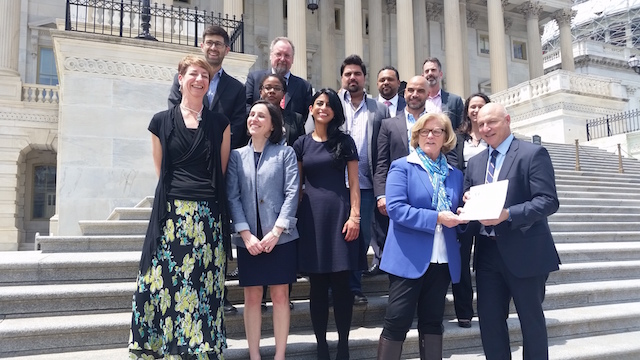
The Food Policy Action Education Fund is circulating a petition calling on Congress to enact food waste reforms. Colicchio and fellow chefs hand-delivered the petitions to Rep. Pingree on the Capitol steps.
Absent from the petition hand-off was Mendelsohn, because he had returned to the kitchen to cook for the evening reception. Using produce pulp, Mendelsohn created Pulp Fiction Veggie Burger Sliders, combining beet scraps and other produce “waste” with farro to make a patty accented with Swiss cheese, avocado, and a swirl of savory sauce.
Albisu prepared a salmon cake using scraps of fish extracted from the bones and carcass crevices, and utilizing the stems of fresh herbs to make an accompanying chimichurri sauce. Chef José Andrés sent over gazpacho made with tomato scraps, while Centrolina’s Amy Brandwein created a dish of fried potato skins with fried chicken and tomato peels.
For Andrés and Mendelsohn, this is at least the second food-waste event they’ve done in as many weeks. The two were integral to the May 18 food recovery event that made 5,000 free lunches out of aesthetically imperfect produce. “It has been a huge few weeks for food policy,” said Mendelsohn. “From the Feeding the 5,000 campaign to our talks with members of Congress today, all these parts of the food system fit together. As chefs, we have a better chance of making impactful change when we come together and look at everything to make a big shift.”