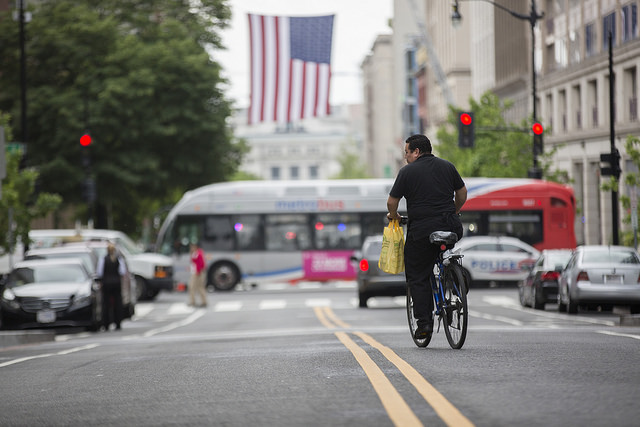
 (Photo by Jaclyn Lippelmann)
By DCist contributor Cuneyt Dil
The D.C. Council today postponed a vote on a bill heralded by cycling and pedestrian advocates to reform the city’s contributory negligence law, which makes it extremely difficult for non-motorist victims to receive compensation in the event of a crash.
After procedural wrangling, councilmembers voted 9-4 to take up a first vote on the bill at their July 12 meeting. Due to a summer recess, a final vote won’t come until the fall.
The bill addresses the negligence standard when a pedestrian or cyclist is involved in a crash with a motorist. Currently, if a non-motorist is found even 1 percent at fault, they cannot receive compensation. The Motor Vehicle Collision Recovery Act of 2015 would make victims eligible to win full compensation if they are found under 50 percent responsible for a crash.
The changes have been long sought by advocates in the District and opposed by insurance companies and AAA Mid-Atlantic. Only four other states have contributory negligence laws, including Maryland and Virginia.
At the council’s morning legislative meeting, Ward 5 Councilmember Kenyan McDuffie withdrew the bill, to the surprise and chagrin of supporters. That action came after divisions over an amendment McDuffie intended to introduce — but did not — that could limit a crash victim’s compensation. Under McDuffie’s amendment, if a victim were partly responsible for a crash, that person’s eligible compensation would be reduced. For example, if someone were found 25 percent responsible for a crash, they would be eligible for 25 percent less compensation.
Several minutes after McDuffie withdrew the legislation, Ward 3 Councilmember Mary Cheh, author of the bill, successfully got a majority of councilmembers to vote to place the bill back on the agenda.
But in one final twist, when it came back time for the bill, McDuffie, whose Judiciary Committee the legislation came out of, moved to postpone the vote. Eight other councilmembers joined him in voting to delay.
McDuffie said he supports moving away “from the antiquated contributory negligence standard that is currently in place.” But he also said he’s searching for a “happy medium.” Delaying the vote gives him more time to push for his amendment with Cheh.
“I’m disappointed. I think everything we need to know, we know now, and we should have finally taken it up after years of working on it,” Cheh said after the meeting.
In a breakfast meeting before the council’s legislative session, Cheh and McDuffie clashed over the proposed amendment. Other supporters of the bill, including Councilmember Charles Allen and David Grosso, also didn’t see eye-to-eye with McDuffie. They opposed McDuffie’s amendment, seen as equalizing motorists and non-motorists, in part because pedestrians and cyclists are inherently more susceptible to damage in a crash than a driver.
“The pedestrian and the cyclist are the vulnerable users,” Cheh told her colleagues over breakfast. “If they’re in an accident with a car, guess who loses. How many cases do you know of where a car driver was killed or seriously injured by a pedestrian [or a cyclist] in an accident?”
Greg Billing, director of the Washington Area Bicyclist Association, said he’s disappointed by the bill not getting a vote today. He added that while the legislation is stronger without McDuffie’s amendment, he would not oppose the bill if it came before a vote with it attached.
“We hope that the councilmembers that are stakeholders in this can reconcile their differences and find a compromise that works for everybody,” he said, “or keep the bill as is and move it.”