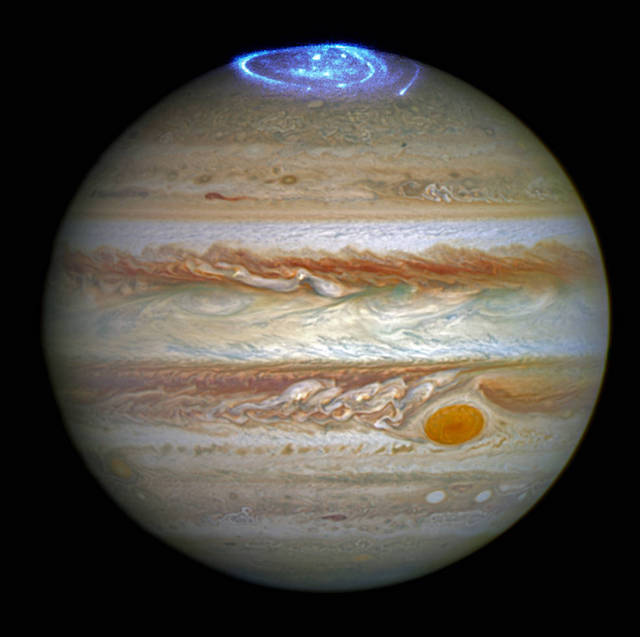
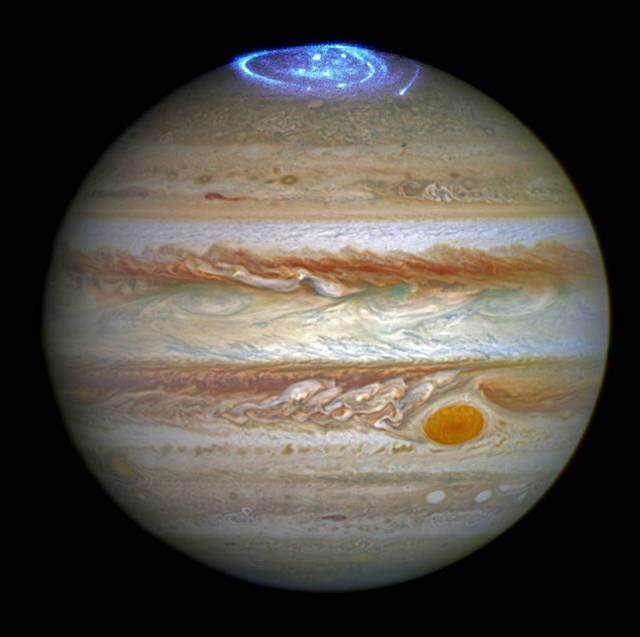
 The Northern Lights of Jupiter perform (Credits: NASA, ESA, and J. Nichols (University of Leicester))
It isn’t just the Earth’s atmosphere that puts on the dramatic performance of dancing lights known as auroras. New images released today from the Hubble Space telescope show that Jupiter, too, has its own auroras.
On Jupiter, as on Earth, the glowing lights are created by high-energy particles from the sun entering the planet’s atmosphere and colliding with atoms of gas near the planet’s magnetic poles.
But Jupiter’s auroras have their own quirks, since the gaseous planet is more than 11 times larger than Earth and nearly four times as far away. Jupiter’s auroras are hundreds of times more energetic and, unlike on Earth, they never stop, according to a release from NASA. Earth has its most intense auroras when there is a big solar storm. But Jupiter has a stronger magnetic field than Earth’s, so it constantly attracts charged particles not only from solar wind and storms but also its moon Io (which is best known as having the most volcanically active world in the Solar System).
“These auroras are very dramatic and among the most active I have ever seen,” said Jonathan Nichols, the principal investigator of the study who is based at the University of Leicester, U.K.
There are a couple cool videos that accompany the new images:
These most recent images and videos were captured after the Hubble Space Telescope—a mission based out of NASA’s Goddard Science Center in Maryland—observed the planet daily for several months. The images were captured through far-ultraviolet images.
There’s about to be a lot more cool images and findings coming from Jupiter very soon. Juno, a spacecraft launched five years ago, is expected to reach the planet on the 4th of July.
Though he’s based in the UK, Nichols has already made a joke about it: “It almost seems as if Jupiter is throwing a firework party for the imminent arrival of Juno.”
There’s even a trailer for the new mission, which will not only teach us more about Jupiter but about the origins of the Solar System: