Rachel Kurzius
 Photo by Erin Kelly.
The constitutional convention portion of D.C.’s latest quest for statehood has wrapped, and some advocates are feeling frustrated and arguing that the process was too top-down.
“The constitution is about what type of government we the people want, and if we don’t have a meaningful role in drafting the constitution, it’s really disingenuous,” says statehood activist Josh Burch, an organizer with Neighbors United for DC Statehood who walked out of Tuesday’s meeting to amend and adopt the draft.
Anise Jenkins, executive director of Stand Up For Democracy In D.C., worries that not enough people knew about the process to participate.
After the New Columbia Statehood Commission released the initial draft constitution in early May, organizers scheduled a series of conventions for residents to discuss potential changes to the draft, for which everyone was a delegate. People could also submit their comments online. On Tuesday, the commission—which is comprised of Mayor Muriel Bowser, D.C. Shadow Senators Michael Brown and Paul Strauss, U.S. Shadow Representative Franklin Garcia, and D.C. Council Chair Phil Mendelson—chose which amendments to include in the constitution that will be sent to the D.C. Council.
The constitution outlines exactly how the state of New Columbia (yep, that’s still the name, despite a fair amount of controversy over it) would function. The biggest change made on Tuesday was the size of the legislature, which the commission switched from 13 members (exactly as the D.C. Council is currently comprised) to 21 members—two from each ward, four at-large members, and a speaker of the House of Delegates. It would be the only state other than Nebraska to have a unicameral legislature.
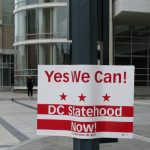
Ann Loikow, an organizer with DC Statehood Yes We Can, says the legislative compromise poses as many questions as it answers. Would wards be split in two? How would elections be spaced out? The mayor’s office has not responded to a request for a comment.
The commission has said that the constitution builds off existing government structures to ease the city’s transition to statehood.
But Loikow says that those structures were created by Congress “to be fairly small and give minimal rights to the people,” she says. “It was designed by a party to control us.”
Burch also notes the federal link. “The draft constitution put forward and adopted the other night is the Home Rule Act,” he says. “I’m not saying that government is inherently bad, but we didn’t design that or create that for ourselves. I was hoping that there would be a real discussion and debate among the community about how we want to structure our government.”
Instead, he says that all of the proposed amendments were “crammed into a three-hour meeting” in which the members of commission, rather than residents, held the power. Though they were delegates, residents were limited to three minutes of speaking time, Loikow points out.
But Strauss, one of D.C.’s shadow senators and a member of the commission, says that the process was incredibly open. “Literally anyone could come and make comments,” he says. “For the most part, when we got credible suggestions from experts or passionate suggestions from citizens, we listened.”
And Strauss disagreed with the idea that the commission was operating in a top-down fashion. “We’re not some hereditary monarchy or feudal lords,” he says. “We’re all elected officials.”
He adds that the approved constitution includes a call for a potential additional convention within five years of achieving statehood. Burch wants the language there changed from “may” convene to “will” convene. “With that one simple fix, a lot of people would be satisfied,” says Burch.
A mandatory constitutional convention could cause more problems than it could fix, says Strauss. “If we have a new state and after five years we have institutions of government that are working, to require a potentially destabilizing convention mandatorily, I don’t think that’s necessary,” says Strauss. “I’m open to the possibility that maybe the institutions we created won’t be working, but I’m not going to presume we screwed up that badly.”
Burch and Jenkins both take issue with the constitution’s amendment process, too. Only House of Delegates members can propose amendments. “If they’re genuine in saying we could change the constitution later, then have something in there that allows people to start that process,” Burch says.
If all goes according to the commission’s plan, the D.C. Council will approve the constitution as part of a referendum for November’s ballot. For now, that referendum will be a four-part question on the ballot, according to WAMU: should D.C. pursue statehood? Do residents approve the constitution? Do they approve the borders? Do they accept a republican form of government?
And Strauss believes that’s the ultimate measure of the constitution’s inclusivity. “Guess who’s gonna have the final say on this document: the people,” he says. “We’re not carving it into stone—we’re putting it on a ballot.”
Burch says having a citywide vote on statehood is “great and very important,” because representatives on the Hill constantly ask activists whether statehood has widespread support in D.C. But the way this process has played out has turned off some of the biggest advocates for the 51st state.
“For those of us that have been working hard on statehood, it took the wind out of a lot of people’s sails to have this process pushed down our throats,” he says. “I know people who will be voting against statehood because of this process. I’m not there.” Burch thinks he will be less active in mobilizing people for the referendum than he would have if he didn’t have so many concerns.
Jenkins says the vote “puts me in the most awkward position I’ve ever been in in my life. The worst thing that could happen is that people vote against it,” she says. “I would never tell anyone not to vote for the referendum, but I will be out there trying to make as any corrections as possible.”
She plans on lobbying the council to further amend the constitution. “Everyone is a potential convert,” she says.
Loikow says the most appealing option is for the council to “detach the constitution from any referendum.” This would diverge from the so-called “Tennessee Plan” that the commission has been following. (In 1796, Congress allowed then-federal territory Tennessee to become a state following a vote from residents and the ratification of a constitution.)
“There’s plenty of time to have a real constitutional convention or a much better process where the public has more than three minutes to discuss these issues,” Loikow says.