Rachel Kurzius
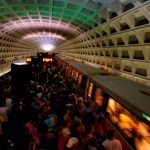
 Photo by Ryan Gregor.
Once again, looks like most commuters listened to local officials and switched up their commute to accommodate the latest Metro work surge.
Metro released its ridership numbers for the first morning of Surge 3, which segments the Blue and Yellow lines by shutting down the track between the Braddock Road and Reagan National Airport stops.
About 70% of riders most impacted by Surge #3 adjusted their commute. Here’s ridership for today’s AM rush. #wmata pic.twitter.com/qJBUIis1gD
— Metro (@wmata) July 6, 2016
Ridership was down by nearly 70 percent of riders south of and including Braddock Road as compared to this time last year. That amounts to more than 13,000 fewer riders.
But the affected stations on the other side of segmented tracks actually saw more action. National Airport, the first station for Blue/Yellow riders heading into D.C. north of the blocked tracks, had a 119 percent increase this morning.
Metro is providing a number of alternatives for riders, including free high-frequency express shuttle buses between Braddock Road and Pentagon City, free Metrobus shuttles between the stations affected by the segment shutdowns during the surges, and enhanced (and free) Metroway service.
One commuter suffering through the surge told WAMU that she “expected the worst so it is about what I expected.” Though she left an hour before she normally does, she said she would still be late for work.
This third work surge is scheduled to last until July 11, though the fourth will affect the same commuters by closing the Crystal City station and shutting down tracks between National Airport and Pentagon City from July 12 to 18.
And SafeTrack isn’t the only issue for Blue/Yellow commuters riding today.
Blue/Yellow Line: Single tracking btwn National Airport & Pentagon City due to a disabled train at Crystal City. Delays in both directions.
— Metrorail Info (@Metrorailinfo) July 6, 2016
With the third surge now underway, Metro today released a summation of its completed work on Surge 2, which bifurcated the Orange, Blue, and Silver lines.
General Manager Paul Wiedefeld said he was satisfied with the pace of the work during the second work surge, including the replacement of four major switches, 500 wooden crossties, renewal of more than 230 third-rail insulators and 12 signals, the inspection of 180 power cables, and more.
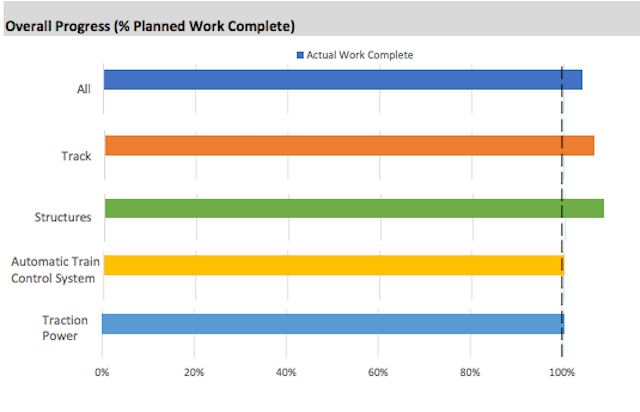 Image courtesy of Metro.
Despite the completion of Surge 2, some signal problems persist.
Orange/Silver Line: Expect delays in both directions due to a signal problem outside Stadium-Armory.
— Metrorail Info (@Metrorailinfo) July 6, 2016
“It is not unheard of to have signals requiring adjustment after new switches are installed, and that’s likely what we’re seeing here,” a Metro spokesperson told City Paper.
Wiedefeld used the report’s release to remind riders to keep steering clear of affected work zones.
“Our continued success depends upon Metro customers heeding the warnings about reduced service during SafeTrack surges and finding alternate ways to commute,” he said in a release.