 Rachel Sadon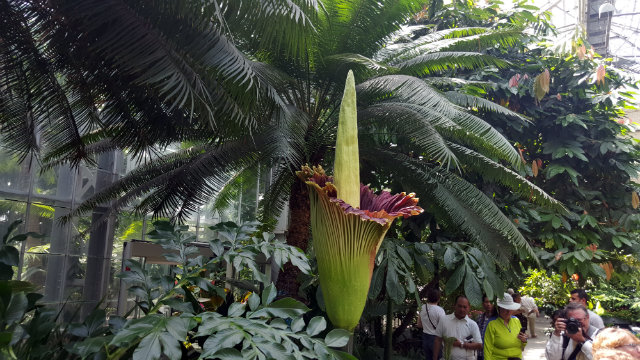
The last time Chris Van Fossan dashed down to the U.S. Botanic Garden to behold the rare and odoriferous corpse flower, she only got part of the experience.
“We saw it, but we didn’t smell it,” she said yesterday afternoon, recounting the 2013 bloom that 130,000 people made a pilgrimage to see. Not this time. When word got out that a different specimen was finally unfurling its maroon bloom after more than a week on view, Van Fossan went straight to the Botanic Garden to catch a whiff.
So what exactly did it smell like? Fluttering her eyes closed, taking a deep inhale, Van Fossan considered the question. After a few beats, she decided: “Rotting fish.”
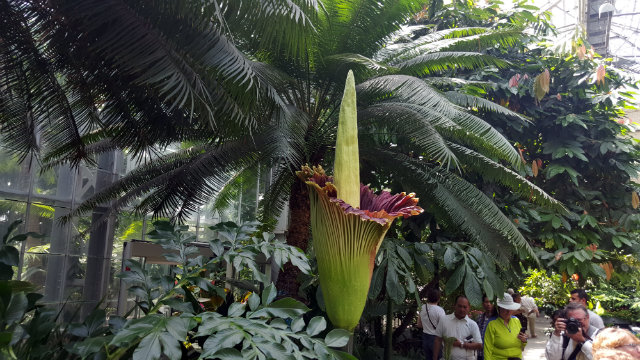 This is possibly the first time a titan arum has reached peak bloom during daytime hours. (Photo by Rachel Sadon)
For possibly the first time ever in the United States, an amorphophallus titanum or titan arum bloomed during the day, starting at 4 a.m. on Tuesday and reaching peak stench between 10 a.m. and 2 p.m. “As far as we know, it is unprecedented,” said USBG spokesperson Devin Dotson.
The plants typically start to open around sunset, emitting their namesake aroma deep into the evening, which is why Van Fossan and so many others missed much of the smell in 2013. To ensure that stench seekers got their fix this time, the Botanic Garden decided to stay open until 11 p.m. on the two nights of the bloom. But the diva of a flower had its own plans, treating crowds to a midday stink.
“Hashtag aromatic,” said Rachel Seeger, who arranged to visit the steamy conservatory during her lunch break with a friend, Steph Wheeler. They tried to pinpoint exactly what the pungent bouquet reminded them of. “We decided it definitely smells like rotten cabbage,” Wheeler said. “With an undertone of funk,” Seeger chimed in. “And an ode to trash truck, maybe garbage juices,” Wheeler finished.
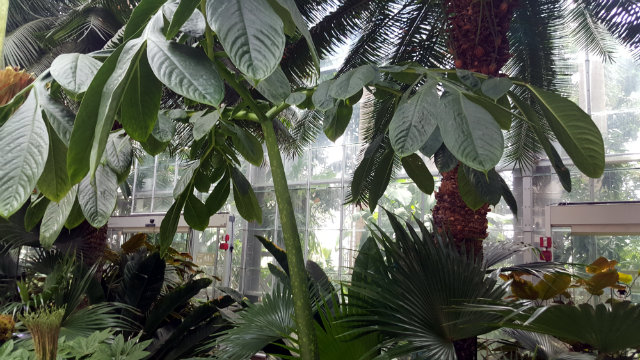 Another titan arum stands on display at the U.S. Botanic Garden in its non-blooming state. (Photo by Rachel Sadon)
The daytime arrival isn’t the only thing that is unusual about this particular plant. “These plants do things big and showy” Dotson said. But thinking that they would be lucky if it climbed to 5 feet on its first bloom, the staff was shocked that the six-year-old plant grew to 7 feet 4 inches. By comparison, a recent plant in Indiana topped out at 6 foot 1. What’s more, this specimen’s parent plant has never bloomed (it reproduced via clone) despite being 10 years old and weighing 150 pounds. So visitors are certainly seeing something extra unusual.
For Ruslan Hasan, it was even more special; he hails from Medan in Sumatra, the region of Indonesia where corpse flowers are native. He had even arranged transportation for researchers to get to the jungle to see them in the wild, but never seen one himself. “I’m a city boy!” he said.
“I find it gorgeous, like art,” Hasan said, comparing the plant’s bell-like curve to a Chanel gown he’d recently seen at The Metropolitan Museum of Art. “But it smells really bad. I hope people don’t think it’s me.”
Another visitor, Katherine Krauland, described it as “boiled cabbage meets gym socks.”
Corpse Flower Time Lapse from DCist on Vimeo.
And just as word of a freak nature show can draw crowds—the line stretched up the block yesterday afternoon, with wait times of around half an hour—that ripe smell is also catnip for pollinators like flies and dung beetles.
The odor pulses and changes over the course of the day, and can even vary depending on where visitors are standing. While it smelled “trashy” around midday, “earlier it had more of a dead animal smell,” Dotson said. The different stinks “could be to attract different animals.”
Of course, in the glass enclosed conservatory far from the jungle, that stench only served visitors. So horticulturalists cut a hole in the back of the inflorescence (the technical name for the giant bloom, which is actually a collection of several flowers) and blew pollen, overnighted from Indiana’s plant, through a tube. If the insemination took, they’ll see little berries form.
In the wild, birds would carry them to a new spot in the jungle. At the U.S. Botanic Garden, they will be tended by horticulturalist Elliott Norman.
“The staff have been phenomenal,” Van Fossan said, extolling the updates and information that the USBG has enthusiastically provided. It meant that this time around, she got to see it and smell it.
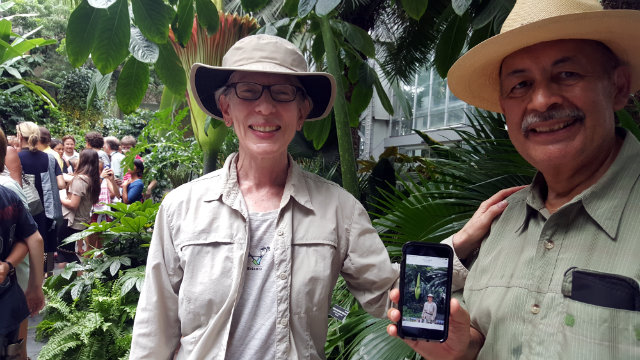 Chris Van Fossan recreates a photo taken in 2013 of her posing with a corpse flower at the U.S. Botanic Garden. This time around, she got to see it and smell it. (Photo by Rachel Sadon)