 Rachel Sadon
 (Photo by Josh Bassett)
A jury has awarded a fired Chipotle worker $550,000 in a discrimination lawsuit that helped inspire a law mandating new protections for pregnant women and those who have recently given birth.
Doris Garcia Hernandez began working at the outpost of the national chain at 18th and M streets in May of 2011, and had been receiving positive performance reviews. According to her suit, though, after informing a supervisor in October that she was pregnant, he began treating her differently—monitoring Garcia’s bathroom breaks, berating her for taking too long, prohibiting her from taking shift breaks, denying access to water, and eventually firing her in front of other employees for going to a prenatal doctor’s appointment. Throughout the trial, Chipotle argued Garcia hadn’t been treated differently than other employees.
After a four-day trial and three hours of deliberation, though, a jury sided with Garcia and awarded her $550,000—$50,000 in compensatory damages and $500,000 in punitive damages. She is likely to be awarded additional relief for lost wages and attorney’s fees.
Garcia’s son from that pregnancy is now four years old, and she’s since had another son.
“It has been five years of litigation, of being questioned and dealing with lawyers and telling a story of a very difficult period of her life—telling it and reliving it,” says Christine Tschiderer, an attorney with the Washington Lawyers’ Committee. “But she is thrilled at the result and very much not just as vindication for what she went through, but a clear message to Chipotle that they can’t do this.”
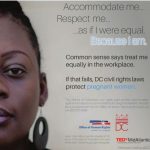
The case sparked concern among national advocates and was also one of the drivers behind D.C.’s Protecting Pregnant Workers Fairness Act of 2014.
The legislation, which was introduced by Councilmember Vincent Orange, requires employers provide “reasonable accommodations” for pregnant women and those who have recently given birth.
“The Chipotle case shed light on why the act was needed,” says Orange spokesman Manny Geraldo. “That case was a catalyst for us to study the idea and take a harder look at some of the discrimination that pregnant women face.”
The law is meant to stop employers from forcing a pregnant woman out of her job because she needs to take more breaks, requires a chair, must refrain from heavy lifting, or similar issues. It doesn’t stop with pregnancy, though, codifying that employers have to provide private space to breast feed, and, when medically necessary, they are required to give new mothers time off to recover from childbirth. Critically, it shifts the burden of proof from the worker, who previously had to prove she was entitled to an accommodation, to the employer, who now has to prove that it would be an undue burden. The act quietly went into effect last March.
In Garcia’s case, if the law had been in effect, she could have asserted a claim under the act to the Office of Human Rights and asked for more frequent breaks or longer time to use the bathroom—perhaps mediating the accommodation issue before it got to the firing.
Between the law and the judgment that Chipotle’s firing constituted pregnancy discrimination,
“hopefully others won’t have to go through it now, too,” Tschiderer says.